
[Paper Review] Auditing large language models: a three-layered approach
This paper proposes a three-layered auditing framework for large language models (LLMs) comprising governance audits (of technology providers), model audits (post-pre-training, pre-release), and application audits (of downstream uses). The approach enables coordinated, feasible, and effective risk identification across technical, ethical, and legal dimensions, offering a structured toolkit for stakeholders to manage emergent risks in LLMs.
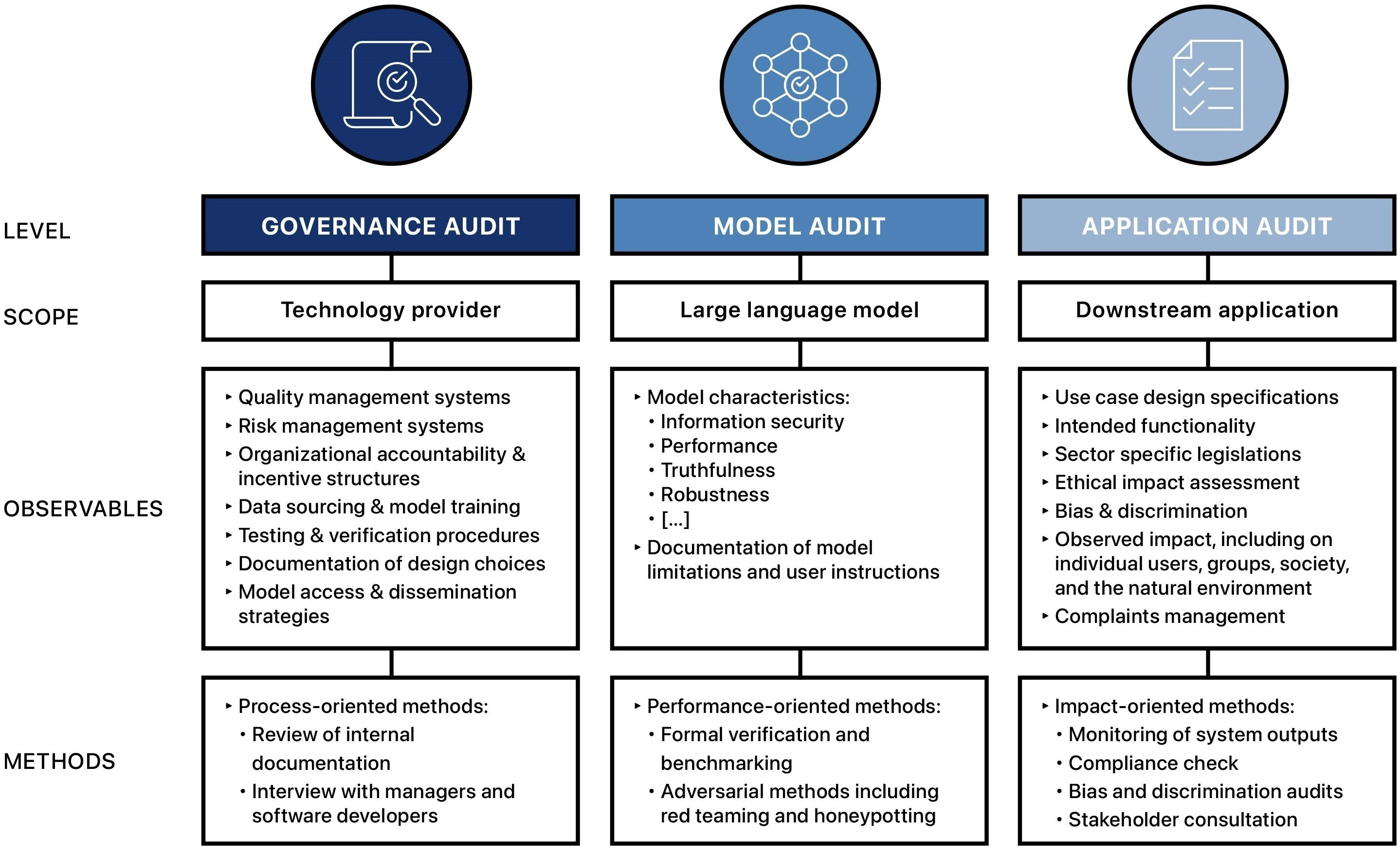
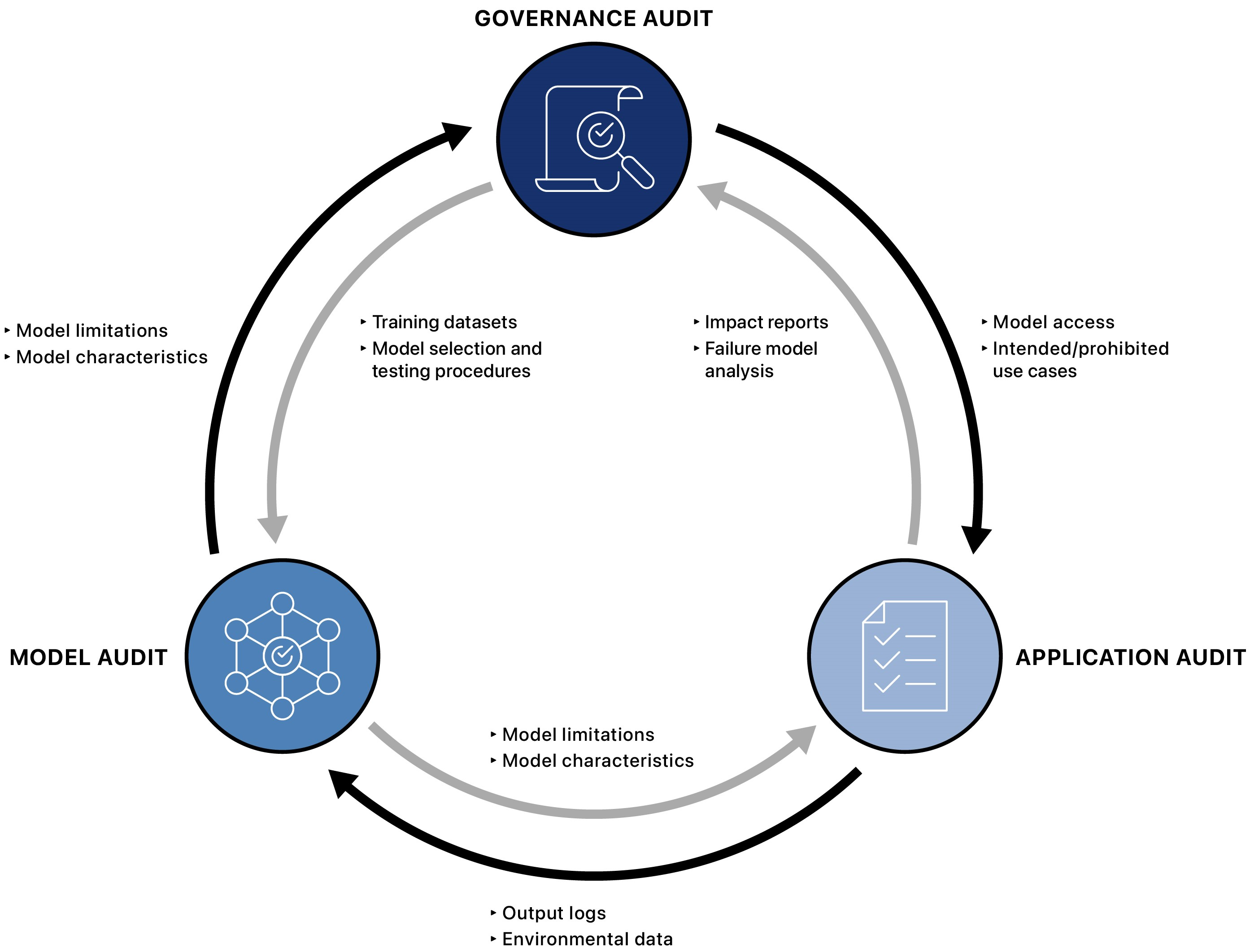
Large language models (LLMs) represent a major advance in artificial intelligence (AI) research. However, the widespread use of LLMs is also coupled with significant ethical and social challenges. Previous research has pointed towards auditing as a promising governance mechanism to help ensure that AI systems are designed and deployed in ways that are ethical, legal, and technically robust. However, existing auditing procedures fail to address the governance challenges posed by LLMs, which display emergent capabilities and are adaptable to a wide range of downstream tasks. In this article, we address that gap by outlining a novel blueprint for how to audit LLMs. Specifically, we propose a three-layered approach, whereby governance audits (of technology providers that design and disseminate LLMs), model audits (of LLMs after pre-training but prior to their release), and application audits (of applications based on LLMs) complement and inform each other. We show how audits, when conducted in a structured and coordinated manner on all three levels, can be a feasible and effective mechanism for identifying and managing some of the ethical and social risks posed by LLMs. However, it is important to remain realistic about what auditing can reasonably be expected to achieve. Therefore, we discuss the limitations not only of our three-layered approach but also of the prospect of auditing LLMs at all. Ultimately, this article seeks to expand the methodological toolkit available to technology providers and policymakers who wish to analyse and evaluate LLMs from technical, ethical, and legal perspectives.
Motivation & Objective
- Address the gap in existing auditing practices that fail to account for the emergent, general-purpose capabilities of large language models (LLMs).
- Develop a governance mechanism that complements application-level audits by addressing risks at the model development and deployment stages.
- Create a structured, coordinated, and feasible auditing approach tailored to the unique challenges posed by foundation models and LLMs.
- Provide a practical blueprint for technology providers, policymakers, and auditors to evaluate LLMs from technical, ethical, and legal perspectives.
- Acknowledge and discuss the limitations of auditing as a governance tool in the context of LLMs to set realistic expectations.
Proposed method
- Conducted a systematic literature review across five databases (Google Scholar, Scopus, SSRN, Web of Science, arXiv) using keywords related to AI auditing, fairness, transparency, and language models.
- Employed a snowballing technique to identify non-academic auditing procedures from citations of included studies, expanding coverage beyond academic sources.
- Developed a typology of auditing procedures based on dimensions such as risk/compliance, internal/external, ex-ante/ex-post, and functionality/code/impact audits.
- Performed a gap analysis between LLM-specific governance challenges and existing auditing affordances, leading to six key design claims for effective LLM auditing.
- Synthesized a minimal, effective set of auditing procedures by selecting those jointly sufficient to cover all major risks, feasible to implement, and cost-effective.
- Validated the draft blueprint through triangulation, including over 20 semi-structured interviews with researchers, auditors, AI developers, and policymakers across jurisdictions.
Experimental results
Research questions
- RQ1How can auditing be structured to effectively address the ethical and social risks posed by large language models, given their emergent capabilities and broad adaptability?
- RQ2What auditing layers are necessary to ensure accountability and risk mitigation across the entire LLM lifecycle—from model development to downstream deployment?
- RQ3How can governance, model, and application audits be coordinated to enhance transparency, robustness, and compliance without duplicating efforts?
- RQ4What are the practical and institutional constraints that limit the feasibility of auditing LLMs, and how can they be addressed in a governance framework?
- RQ5To what extent can auditing serve as a viable governance mechanism for foundation models, and what are its inherent limitations?
Key findings
- The three-layered approach—governance, model, and application audits—provides a comprehensive, coordinated framework that addresses risks at all stages of LLM development and deployment.
- The framework enables proactive risk identification by integrating auditing at the provider level before model release, ensuring that ethical and technical safeguards are built into the system from the start.
- Model audits, conducted post-pre-training but pre-release, allow for systematic evaluation of safety, fairness, and robustness before public deployment.
- Application audits ensure that downstream uses of LLMs are evaluated in context-specific ways, capturing risks that may not emerge during model-level assessment.
- The approach is designed to be feasible and scalable, with overlapping but non-reduundant auditing functions that optimize resource use and clarify responsibilities.
- Despite its strengths, the framework acknowledges that auditing alone cannot fully resolve issues like model opacity, emergent behaviors, or accountability gaps, especially when harms arise from complex interactions between models and environments.
Read this paper
Open the full text in the Nubint reader and ask about any passage as you read.
Read this paper on NubintThis review was generated by AI from the original paper. Please check the paper before citing it.