
[Paper Review] AutoSDF: Shape Priors for 3D Completion, Reconstruction and Generation
This paper proposes AutoSDF, a non-sequential autoregressive shape prior over discrete, low-dimensional latent representations of 3D shapes, enabling unified and high-quality generation for 3D completion, reconstruction, and language-guided generation. By learning a general shape prior and combining it with lightweight task-specific conditionals, AutoSDF outperforms task-specific state-of-the-art methods across diverse settings with minimal paired data.
Powerful priors allow us to perform inference with insufficient information. In this paper, we propose an autoregressive prior for 3D shapes to solve multimodal 3D tasks such as shape completion, reconstruction, and generation. We model the distribution over 3D shapes as a non-sequential autoregressive distribution over a discretized, low-dimensional, symbolic grid-like latent representation of 3D shapes. This enables us to represent distributions over 3D shapes conditioned on information from an arbitrary set of spatially anchored query locations and thus perform shape completion in such arbitrary settings (e.g., generating a complete chair given only a view of the back leg). We also show that the learned autoregressive prior can be leveraged for conditional tasks such as single-view reconstruction and language-based generation. This is achieved by learning task-specific naive conditionals which can be approximated by light-weight models trained on minimal paired data. We validate the effectiveness of the proposed method using both quantitative and qualitative evaluation and show that the proposed method outperforms the specialized state-of-the-art methods trained for individual tasks. The project page with code and video visualizations can be found at https://yccyenchicheng.github.io/AutoSDF/.
Motivation & Objective
- To develop a unified, generalizable shape prior that can be leveraged across multiple 3D inference tasks such as completion, reconstruction, and generation.
- To address the challenge of multimodal 3D generation under arbitrary partial observations, such as completing a chair from only a back leg.
- To reduce reliance on large-scale paired datasets for conditional tasks by learning lightweight task-specific conditionals.
- To enable high-fidelity, diverse 3D shape generation conditioned on diverse inputs including images, text, and partial geometry.
- To improve generalization and performance in low-data regimes by combining a powerful shape prior with efficient conditional modeling.
Proposed method
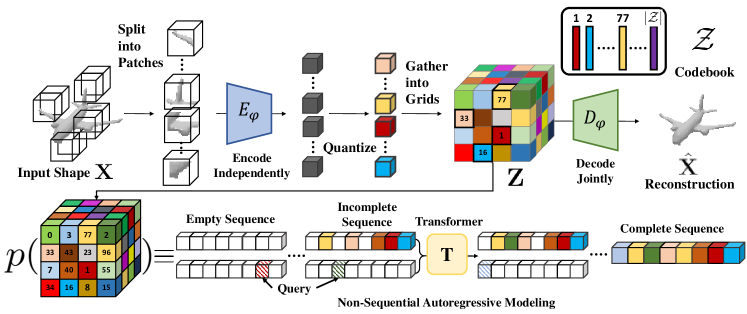
- The method uses a VQ-VAE-based encoder to learn a low-dimensional, discrete latent representation of 3D shapes from raw 3D data.
- A non-sequential autoregressive transformer is trained over the discrete latent space, using randomized sampling orders to allow conditioning on arbitrary subsets of observed voxels.
- The autoregressive prior models the joint distribution over 3D shapes as a product of conditional probabilities over latent tokens, enabling diverse and plausible shape generation.
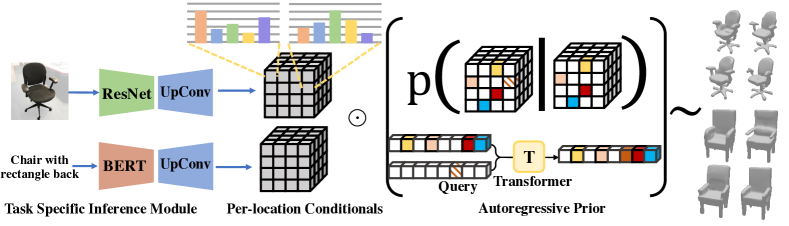
- Task-specific 'naive' conditionals are learned via lightweight models trained on minimal paired data (e.g., image-shape or text-shape pairs).
- The final generation is approximated as the product of the learned prior and the task-specific conditional, enabling efficient and effective inference.
- The framework supports arbitrary conditioning: partial observations, single-view images, or natural language descriptions.
Experimental results
Research questions
- RQ1Can a single, generalizable shape prior be effectively used across multiple 3D generation tasks such as completion, reconstruction, and generation?
- RQ2How can an autoregressive prior be made compatible with arbitrary partial observations, such as non-contiguous or scattered parts of a shape?
- RQ3Can a lightweight conditional model, trained on minimal paired data, effectively guide a powerful shape prior to produce high-quality, diverse outputs?
- RQ4Does combining a non-sequential autoregressive prior with task-specific conditionals outperform task-specific state-of-the-art models in multimodal 3D generation?
- RQ5How well does the method generalize to complex, ambiguous, or rare text descriptions in language-guided generation?
Key findings
- AutoSDF outperforms specialized state-of-the-art methods in 3D completion, single-view reconstruction, and language-guided generation, even with minimal paired data for conditionals.
- The method generates diverse, high-fidelity 3D shapes that are semantically aligned with input conditions, such as text descriptions or partial views.
- Qualitative results show that AutoSDF generates shapes more aligned with text prompts than baselines like JE and T2S, with improved diversity and realism.
- The non-sequential autoregressive prior enables effective conditioning on arbitrary spatial subsets, such as isolated legs or back views, enabling robust completion from sparse inputs.
- The framework generalizes well to held-out text descriptions, including complex and ambiguous ones, though generation quality can degrade with increasing ambiguity.
- The VQ-VAE-based latent representation preserves essential shape structure, enabling faithful reconstruction and high-quality generation from latent codes.
Read this paper
Open the full text in the Nubint reader and ask about any passage as you read.
Read this paper on NubintThis review was generated by AI from the original paper. Please check the paper before citing it.