
[Paper Review] Bactrian-X: Multilingual Replicable Instruction-Following Models with Low-Rank Adaptation
Bactrian-X introduces a multilingual instruction-following dataset of 3.4 million instruction-response pairs across 52 languages, constructed via translation and response distillation. Using low-rank adaptation (LoRA), the authors train lightweight, plug-in adapters that significantly improve zero-shot multilingual performance over base and existing instruction-tuned models, outperforming models like BLOOMZ and Alpaca across diverse benchmarks including XCOPA, XWinograd, and human evaluation.
Instruction tuning has shown great promise in improving the performance of large language models. However, research on multilingual instruction tuning has been limited due to the scarcity of high-quality instruction-response datasets across different languages. To bridge this gap, we present Bactrian-X, a comprehensive multilingual parallel dataset of 3.4 million instruction-response pairs across 52 languages. Leveraging this dataset, we train a set of adapters using low-rank adaptation (LoRA), which are lightweight components that seamlessly integrate with large language models. These adapters have a substantially lower parameter count than the base model, making them easily replaceable and usable as plug-ins for different languages or language groups. Extensive experiments in various multilingual evaluation settings demonstrate that models derived from LoRA-based training over Bactrian-X outperform both the vanilla models and existing instruction-tuned models. The code and models are publicly available at https://github.com/mbzuai-nlp/bactrian-x
Motivation & Objective
- To address the scarcity of high-quality multilingual instruction-response datasets for training instruction-following models.
- To improve the multilingual generalization of large language models beyond English, especially for low-resource languages.
- To develop a parameter-efficient fine-tuning approach using low-rank adaptation (LoRA) that enables plug-in, language-specific adaptation with minimal parameters.
- To evaluate the effectiveness of the proposed multilingual dataset and adapter technique across diverse zero-shot multilingual NLP tasks.
- To provide publicly available models and code to accelerate research in multilingual instruction tuning.
Proposed method
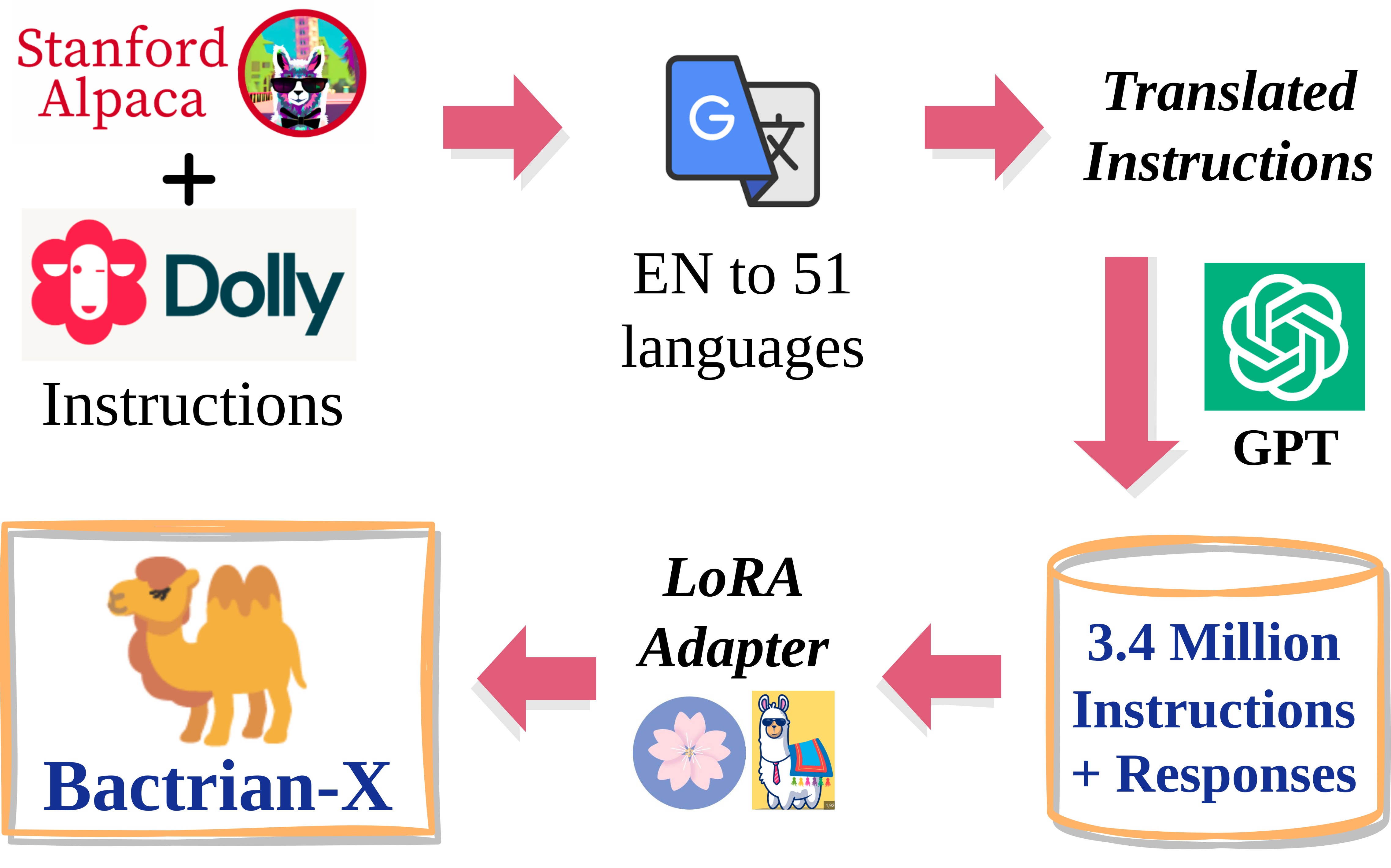
- The Bactrian-X dataset is constructed by translating English instructions from Alpaca and Dolly into 52 languages using Google Translate.
- Responses for each translated instruction are generated via GPT-4 using an output distillation technique to ensure quality and consistency.
- Low-rank adaptation (LoRA) is applied to fine-tune base models (BLOOM and LLaMA), introducing trainable adapter matrices with significantly fewer parameters than the full model.
- The LoRA adapters are trained end-to-end on the multilingual dataset, enabling plug-in deployment for different languages or language groups.
- Evaluation is conducted across multiple multilingual benchmarks, including XCOPA, XStoryCloze, XWinograd, SentimentX, and EXAMS, using both GPT-4 and human annotators.
- The method ensures replicability by releasing the full dataset, code, and trained adapter weights.
Experimental results
Research questions
- RQ1Can a large-scale, multilingual instruction-following dataset constructed via automated translation and response distillation achieve high-quality instruction tuning across diverse languages?
- RQ2Does low-rank adaptation (LoRA) enable effective, parameter-efficient instruction tuning for multilingual models, especially for low-resource languages?
- RQ3How do LoRA-fine-tuned models on Bactrian-X compare to vanilla and existing instruction-tuned models (e.g., BLOOMZ, Alpaca) in zero-shot multilingual generalization?
- RQ4To what extent do the proposed models generalize to unseen languages not present in the base model's pre-training?
- RQ5Can human evaluation and GPT-4 scoring confirm the superiority of the proposed models across diverse linguistic and task settings?
Key findings
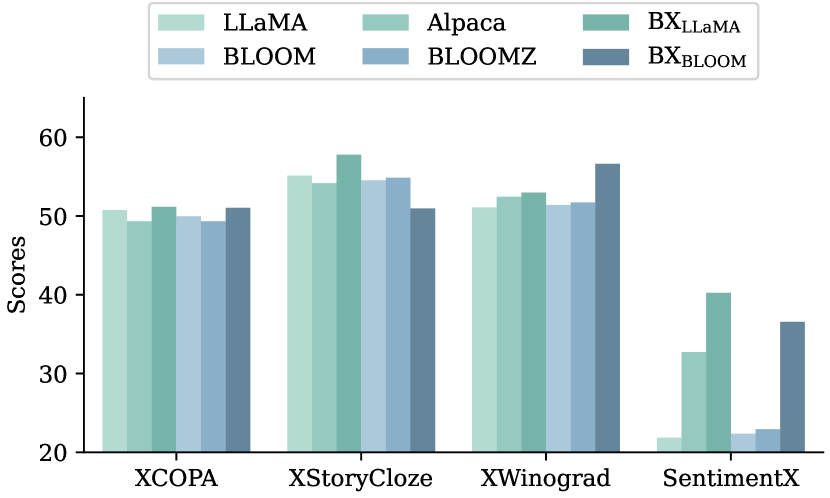
- BX${}_{\text{BLOOM}}$ and BX${}_{\text{LLaMA}}$ outperform their base models and instruction-tuned counterparts (BLOOMZ and Alpaca) across all evaluated multilingual benchmarks.
- In human evaluation, BX${}_{\text{BLOOM}}$ achieved an average ranking score of 86.7 for Arabic, 80.0 for Indonesian, and 84.6 for Chinese, significantly outperforming BLOOMZ and Alpaca.
- BX${}_{\text{LLaMA}}$ achieved the highest score (92.1) for Burmese and 81.7 for Tagalog—languages not seen during BLOOM's pre-training—demonstrating strong zero-shot generalization.
- The models achieved state-of-the-art performance on XCOPA, XWinograd, and XStoryCloze, with consistent improvements across high- and low-resource languages.
- GPT-4 evaluation confirmed that the proposed models generate more accurate, coherent, and instruction-aligned responses than baseline models.
- The Bactrian-X dataset contains 3.4 million instruction-response pairs across 52 languages, making it the largest general-purpose multilingual instruction dataset to date.
Read this paper
Open the full text in the Nubint reader and ask about any passage as you read.
Read this paper on NubintThis review was generated by AI from the original paper. Please check the paper before citing it.