
[Paper Review] Balancing Specialized and General Skills in LLMs: The Impact of Modern Tuning and Data Strategy
The paper presents a framework to fine-tune LLMs with a balanced mix of in-domain and general data, a 45-question evaluation for functionally relevant tasks, and analysis of how model size and continual training affect performance.
This paper introduces a multifaceted methodology for fine-tuning and evaluating large language models (LLMs) for specialized monetization tasks. The goal is to balance general language proficiency with domain-specific skills. The methodology has three main components: 1) Carefully blending in-domain and general-purpose data during fine-tuning to achieve an optimal balance between general and specialized capabilities; 2) Designing a comprehensive evaluation framework with 45 questions tailored to assess performance on functionally relevant dimensions like reliability, consistency, and business impact; 3) Analyzing how model size and continual training influence metrics to guide efficient resource allocation during fine-tuning. The paper details the design, data collection, analytical techniques, and results validating the proposed frameworks. It aims to provide businesses and researchers with actionable insights on effectively adapting LLMs for specialized contexts. We also intend to make public the comprehensive evaluation framework, which includes the 45 tailored questions and their respective scoring guidelines, to foster transparency and collaboration in adapting LLMs for specialized tasks.
Motivation & Objective
- Address the challenge of balancing general language skills with domain-specific capabilities in monetization-focused LLMs.
- Propose data-balancing strategies that mix in-domain and general data during supervised fine-tuning.
- Develop a comprehensive evaluation framework with 45 questions to assess reliability, consistency, and business impact.
- Analyze how model size and continual training influence performance to guide efficient resource allocation.
Proposed method
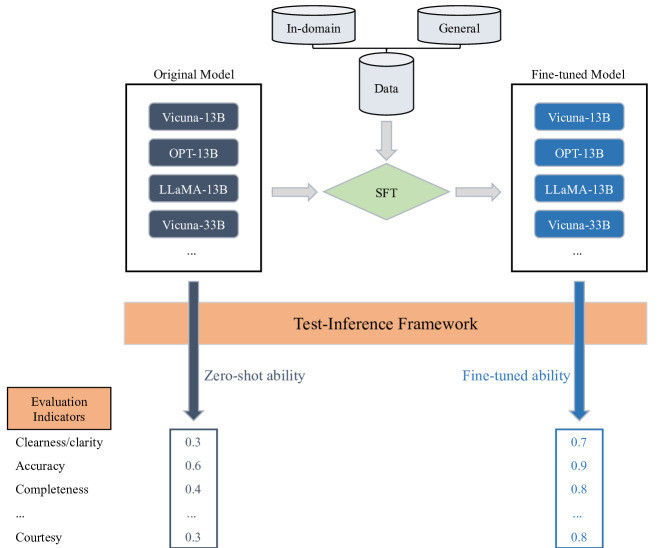
- Data combination technique blending in-domain and general data during supervised fine-tuning to preserve general proficiency while enhancing domain skills.
- Supervised fine-tuning configuration including a cosine learning-rate schedule, 0.1 weight decay, 2048 token sequence length, and model-size dependent batch sizes.
- A test-inference module using a curated set of 45 questions spanning general and in-domain tasks for comprehensive assessment.
- An eight-category, dynamically weighted scoring framework to evaluate responses across clarity, accuracy, completeness, safety, concreteness, consideration, courtesy, and overall performance.
- Continual training experiments (1–5 epochs) to study effects on performance and an open-source evaluation framework for transparency.
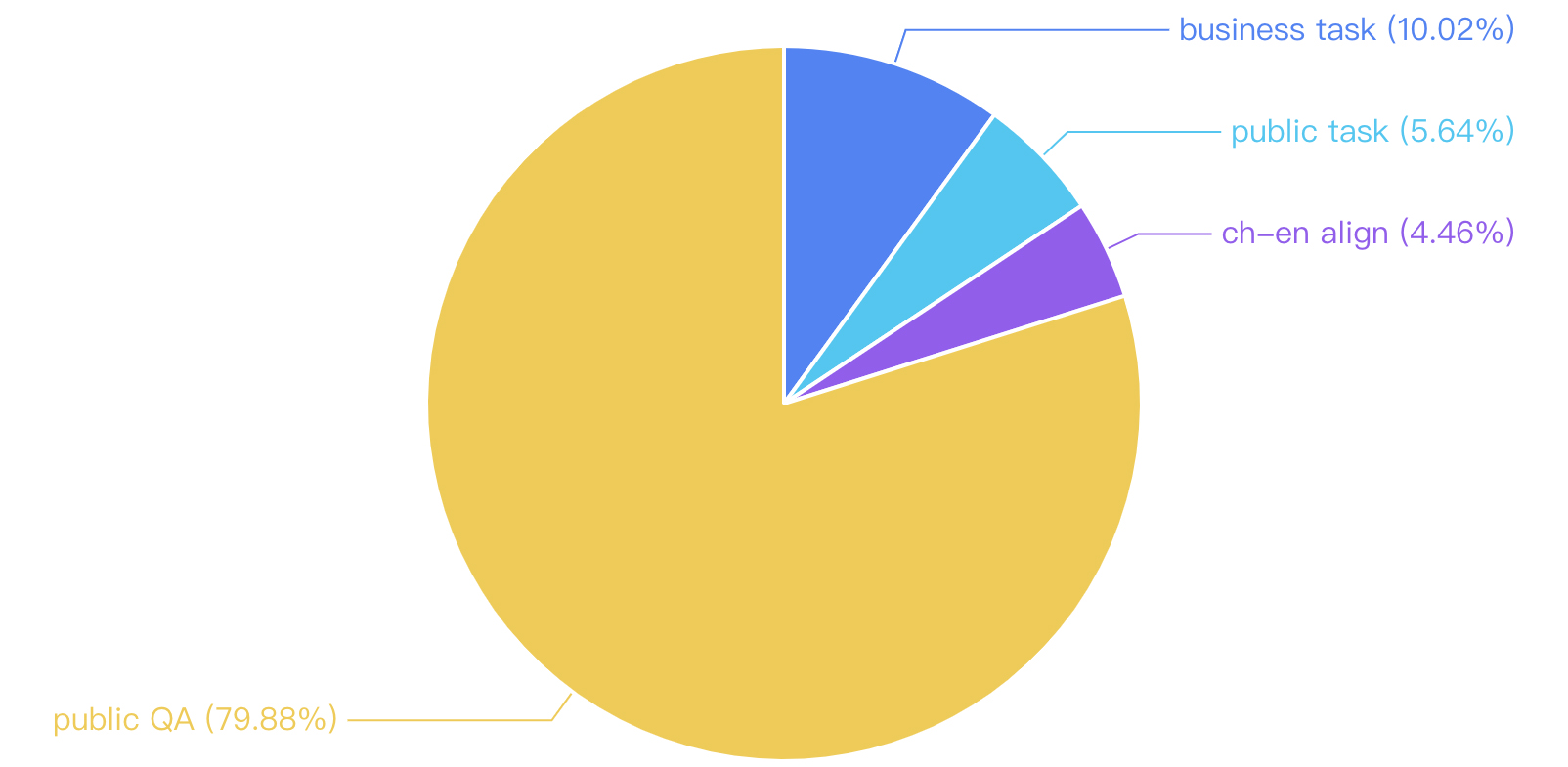
- Data privacy measures and data fusion from public sources and product/services data to create a balanced training corpus.
Experimental results
Research questions
- RQ1How can in-domain monetization data be blended with general-domain data to balance general language skills with domain-specific capabilities?
- RQ2What is the impact of model size and continual training on evaluation metrics for specialized LLMs?
- RQ3Does the 45-question evaluation framework provide a more accurate assessment of business impact than standard benchmarks?
- RQ4How do data-balancing strategies affect reliability, consistency, and actionable business outcomes in monetization contexts?
Key findings
- Blending domain data with out-of-domain data helps preserve general proficiency while improving specialized utility.
- A comprehensive 45-question evaluation framework better captures business impact than standard benchmarks.
- Continual training and model scaling influence evaluation metrics in nuanced ways, guiding resource allocation.
- Larger models generally show stronger capabilities, with trade-offs in conciseness and completeness depending on epoch and model variant.
- Vicuna-13b-v1.3 typically improves over v1.1 on certain criteria, while Llama-2-13b and Vicuna-33b-v1.3 demonstrate varying strengths across categories.
- The study provides a benchmark showing eight-category scores and overall performance across multiple SFT-trained models.
Read this paper
Open the full text in the Nubint reader and ask about any passage as you read.
Read this paper on NubintThis review was generated by AI from the original paper. Please check the paper before citing it.