
[Paper Review] Bayesian nonparametric inference for the covariate-adjusted ROC curve
This paper proposes a Bayesian nonparametric method for estimating the covariate-adjusted ROC curve using B-splines and dependent Dirichlet process mixtures combined with the Bayesian bootstrap. The approach enables robust, flexible inference on diagnostic test accuracy while adjusting for covariates like age and gender, with simulation studies showing accurate recovery of true ROC curves and valid uncertainty quantification across complex scenarios.
Accurate diagnosis of disease is of fundamental importance in clinical practice and medical research. Before a medical diagnostic test is routinely used in practice, its ability to distinguish between diseased and nondiseased states must be rigorously assessed through statistical analysis. The receiver operating characteristic (ROC) curve is the most popular used tool for evaluating the discriminatory ability of continuous-outcome diagnostic tests. It has been acknowledged that several factors (e.g., subject-specific characteristics, such as age and/or gender) can affect the test's accuracy beyond disease status. Recently, the covariate-adjusted ROC curve has been proposed and successfully applied as a global summary measure of diagnostic accuracy that takes covariate information into account. We motivate the use of the covariate-adjusted ROC curve and develop a highly robust model based on a combination of B-splines dependent Dirichlet process mixture models and the Bayesian bootstrap. Multiple simulation studies demonstrate the ability of our model to successfully recover the true covariate-adjusted ROC curve and to produce valid inferences in a variety of complex scenarios. Our methods are motivated by and applied to an endocrine study where the main goal is to assess the accuracy of the body mass index, adjusted for age and gender, for predicting clusters of cardiovascular disease risk factors. The R-package AROC, implementing our proposed methods, is provided.
Motivation & Objective
- To address the limitation of standard ROC analysis that ignores subject-specific covariates such as age and gender, which can significantly affect diagnostic test accuracy.
- To develop a flexible, robust statistical model that allows for covariate-specific estimation of the ROC curve without assuming parametric distributional forms.
- To improve inference accuracy by incorporating covariate information directly into the ROC curve estimation, avoiding bias from stratification or oversimplified assumptions.
- To provide a fully Bayesian, nonparametric framework that enables uncertainty quantification through posterior distributions and credible bands.
- To demonstrate the method’s performance in realistic simulation scenarios and a real-world endocrine study on BMI for predicting cardiovascular risk factors.
Proposed method
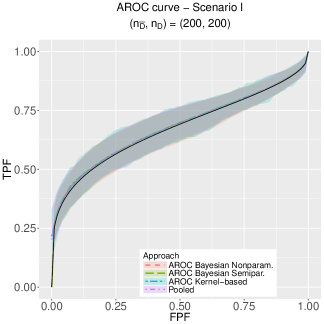
- Employs a dependent Dirichlet process mixture model with B-splines to flexibly model the conditional distribution of diagnostic test outcomes given covariates.
- Uses the Bayesian bootstrap to nonparametrically estimate the conditional cumulative distribution functions of test outcomes in diseased and nondiseased groups.
- Models the covariate-adjusted ROC curve as a function of covariates by integrating over the posterior predictive distributions of the conditional distributions.
- Applies a nonparametric prior on the mixing measure of the Dirichlet process, allowing for flexible, data-driven clustering of the outcome distributions.
- Incorporates knot placement and smoothing through B-spline basis functions, with the number of interior knots (K) treated as a hyperparameter.
- Uses the WAIC and LPML criteria for model comparison and selection across different numbers of knots and prior specifications.
Experimental results
Research questions
- RQ1Can a Bayesian nonparametric model accurately recover the true covariate-adjusted ROC curve under complex, non-normal, and heteroscedastic data structures?
- RQ2How does the inclusion of covariates like age and gender affect the estimated diagnostic accuracy of BMI in predicting cardiovascular risk factors?
- RQ3What is the performance of the proposed method in terms of coverage and bias compared to parametric or semi-parametric alternatives in diverse simulation scenarios?
- RQ4How do different prior specifications (e.g., concentration parameters, scale hyperparameters) affect posterior inference and model fit?
- RQ5Can the method provide valid uncertainty quantification through credible bands that cover the true ROC curve across a range of covariate values?
Key findings
- The proposed Bayesian nonparametric method successfully recovers the true covariate-adjusted ROC curve across all six simulation scenarios, even under complex, non-normal, and heteroscedastic data structures.
- Posterior credible bands constructed from the method achieve approximately 95% coverage across all scenarios and FPF levels (0.1 and 0.3), indicating valid uncertainty quantification.
- The model with four interior knots (K=4) consistently outperformed the model with no interior knots (K=0) in terms of both coverage and mean squared error in ROC curve estimation.
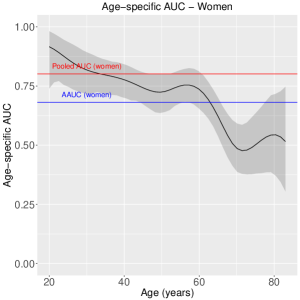
- In the real-world application to BMI and cardiovascular risk, the method revealed that diagnostic accuracy varied significantly by age and gender, with higher AUC in older males and younger females.
- Model comparison using WAIC and LPML indicated that models with more interior knots (K=4) provided better fit, with WAIC increasing and LPML decreasing as K increased, suggesting improved model fit with greater flexibility.
- The R package AROC, implementing the proposed method, is publicly available, enabling reproducible and accessible application to real diagnostic test evaluation problems.
Read this paper
Open the full text in the Nubint reader and ask about any passage as you read.
Read this paper on NubintThis review was generated by AI from the original paper. Please check the paper before citing it.