
[Paper Review] Beyond Rankings: Exploring the Impact of SERP Features on Organic Click-through Rates
This study investigates how Search Engine Results Page (SERP) features—such as knowledge panels, FAQs, and answer boxes—affect organic click-through rates (CTR) using a large-scale dataset of 67,000 keywords across 40 U.S. e-commerce domains. It finds that while SERP features generally reduce CTR on average, specific features and their combinations can significantly alter CTR, sometimes benefiting lower-ranked results, and that SERP features are a critical, quantitatively significant factor in CTR prediction beyond ranking position.
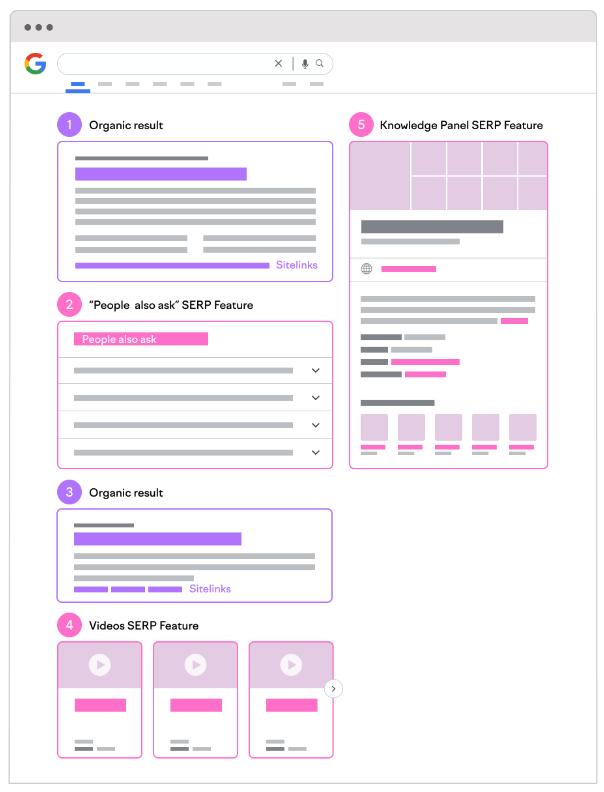
Search Engine Result Pages (SERPs) serve as the digital gateways to the vast expanse of the internet. Past decades have witnessed a surge in research primarily centered on the influence of website ranking on these pages, to determine the click-through rate (CTR). However, during this period, the landscape of SERPs has undergone a dramatic evolution: SERP features, encompassing elements such as knowledge panels, media galleries, FAQs, and more, have emerged as an increasingly prominent facet of these result pages. Our study examines the crucial role of these features, revealing them to be not merely aesthetic components, but strongly influence CTR and the associated behavior of internet users. We demonstrate how these features can significantly modulate web traffic, either amplifying or attenuating it. We dissect these intricate interaction effects leveraging a unique dataset of 67,000 keywords and their respective Google SERPs, spanning over 40 distinct US-based e-commerce domains, generating over 6 million clicks from 24 million views. This cross-website dataset, unprecedented in its scope, enables us to assess the impact of 24 different SERP features on organic CTR. Through an ablation study modeling CTR, we illustrate the incremental predictive power these features hold.
Motivation & Objective
- To examine the impact of SERP features on organic click-through rates (CTR), moving beyond the dominant focus on ranking position.
- To quantify the predictive power of SERP features relative to other result page characteristics such as keyword type, result position, and metadata.
- To identify which SERP features most significantly influence CTR and how their presence alters the importance of high ranking.
- To provide actionable insights for SEO practitioners on optimizing for SERP features to improve organic traffic.
Proposed method
- The study uses a unique, large-scale dataset of 67,000 keywords and over 6 million clicks from 24 million impressions across 40 U.S.-based e-commerce domains.
- It applies an ablation study to model CTR, systematically evaluating the incremental predictive power of 24 distinct SERP features.
- The analysis leverages a multivariate regression framework to isolate the effect of SERP features while controlling for result position, keyword characteristics, and other result-level attributes.
- The dataset covers desktop searches only from May to August 2022, limiting generalizability to mobile or international contexts.
- The study compares the relative importance of SERP features against other CTR determinants using statistical significance testing and effect size estimation.
Experimental results
Research questions
- RQ1To what extent do SERP features influence organic CTR, and how does their presence modulate the impact of ranking position?
- RQ2Which specific SERP features have the strongest positive or negative effects on CTR, and under what conditions?
- RQ3How do combinations of SERP features interact to affect CTR, and can they reduce the advantage of top-ranking results?
- RQ4How does the predictive power of SERP features compare to that of traditional SEO factors like keyword type or result position?
Key findings
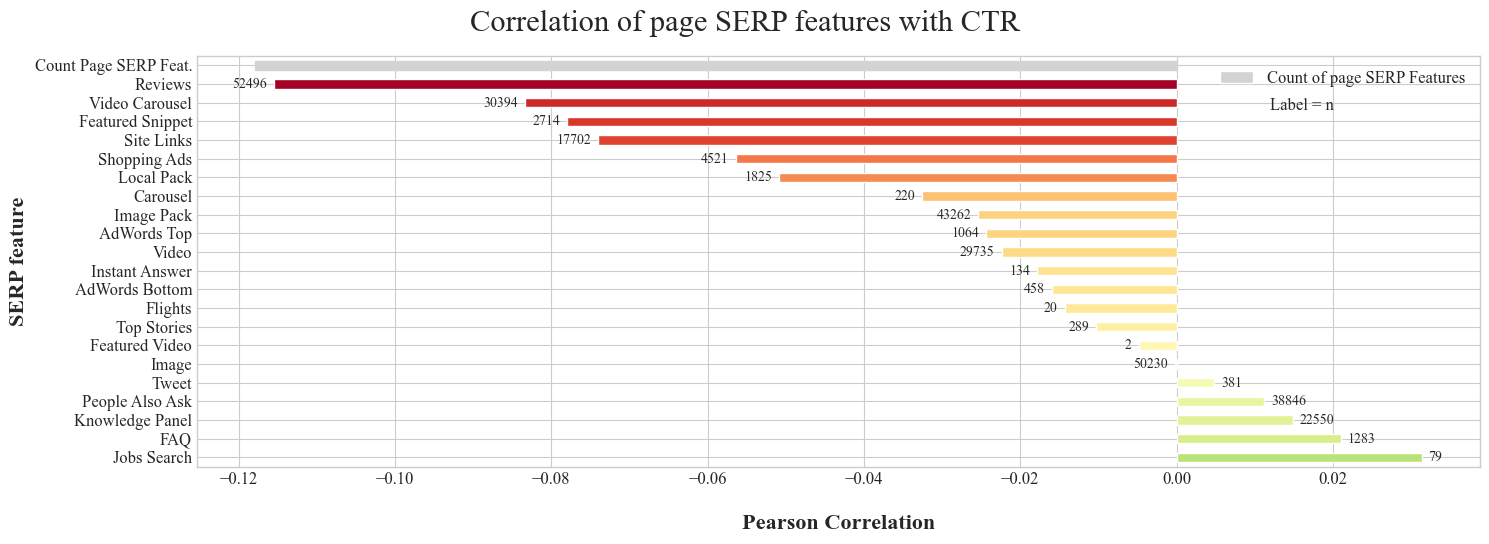
- SERP features, on average, have a negative overall impact on organic CTR, reducing the likelihood of clicks across the board.
- Despite the average negative effect, specific SERP features—such as knowledge panels and answer boxes—can significantly increase CTR when a website is featured in them, especially for lower-ranked results.
- The presence of certain SERP features can diminish the advantage of high ranking, meaning lower-ranked websites can outperform higher-ranked ones when featured in prominent SERP features.
- SERP features demonstrate substantial incremental predictive power for CTR, ranking as a key factor alongside, and sometimes exceeding, the influence of result position in certain contexts.
- The study identifies that features like 'People also ask' and 'Related searches' have a measurable but often negative impact on CTR, depending on the result's position and feature combination.
- The analysis confirms that while ranking position remains the strongest predictor of CTR, SERP features are a critical, quantitatively significant variable that must be considered in modern SEO strategies.
Read this paper
Open the full text in the Nubint reader and ask about any passage as you read.
Read this paper on NubintThis review was generated by AI from the original paper. Please check the paper before citing it.