
[Paper Review] Bidirectional quantum teleportation of even and odd coherent states through the multipartite Glauber coherent state: Theory and implementation
This paper proposes a bidirectional quantum teleportation (BQT) protocol for even and odd coherent states using multipartite Glauber coherent states—specifically Greenberger-Horne-Zeilinger (GHZ), ground, and Werner states—as entangled quantum resources. The protocol achieves high-fidelity teleportation in both directions by optimizing overlap parameters (p), number of partitions (n), and trigger phases, with fidelity maximized under maximally entangled conditions and confirmed via IBM quantum simulators.
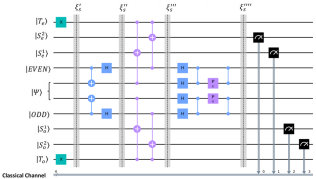
Quantum teleportation has become a fundamental building block of quantum technologies, playing a vital role in the development of quantum communication networks. Here, we present a bidirectional quantum teleportation (BQT) protocol that enables even and odd coherent states to be transmitted and reconstructed over arbitrary distances in two directions. To this end, we employ the multipartite Glauber coherent state, comprising the Greenberger-Horne-Zeilinger, ground and Werner states, as a quantum resource linking distant partners Alice and Bob. The pairwise entanglement existing in symmetric and antisymmetric multipartite coherent states is explored, and by controlling the overlap and number of probes constructing various types of quantum channels, the teleportation efficiency of teleported states in both directions may be maximized. Besides, Alice's and Bob's trigger phases are estimated to explore their roles in our protocol using two kinds of quantum statistical speed referred to as quantum Fisher information (QFI) and Hilbert-Schmidt speed (HSS). Specifically, we show that the lower bound of the statistical estimation error, quantified by QFI and HSS, corresponds to the highest fidelity from Alice to Bob and conversely from Bob to Alice, and that the choice of the pre-shared quantum channel has a critical role in achieving high BQT efficiency. Finally, we show how to implement the suggested scheme on current experimental tools, where Alice can transfer her even coherent state to Bob, and at the same time, Bob can transfer his odd coherent state to Alice.
Motivation & Objective
- To develop a bidirectional quantum teleportation (BQT) protocol enabling simultaneous transfer of even and odd coherent states between distant parties.
- To investigate how multipartite Glauber coherent states (GHZ, ground, Werner) serve as quantum resources to maximize teleportation fidelity in both directions.
- To analyze the role of trigger phase parameters (θ_e, θ_o) in teleportation efficiency using quantum Fisher information (QFI) and Hilbert-Schmidt speed (HSS).
- To validate the theoretical protocol using quantum simulators (Qasm, Aer, Belem) and compare simulated probabilities with theoretical predictions.
- To explore the impact of environmental noise and non-maximal entanglement on BQT performance, setting the stage for future work in noisy channels.
Proposed method
- Utilizes multipartite Glauber coherent states—including symmetric/antisymmetric GHZ, ground, and Werner states—as pre-shared entangled quantum channels between Alice and Bob.
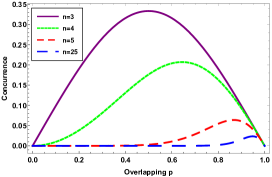
- Employs concurrence as a measure of entanglement to evaluate the degree of entanglement in the shared resource based on overlap (p) and partition number (n).
- Applies quantum Fisher information (QFI) and Hilbert-Schmidt speed (HSS) to quantify the precision of estimating trigger phase parameters (θ_e, θ_o) in both teleportation directions.
- Uses fidelity as the primary metric to evaluate teleportation efficiency, comparing theoretical predictions with results from IBM quantum simulators (Qasm, Aer, Belem).
- Optimizes teleportation performance by tuning parameters p (overlap), m (symmetric/antisymmetric state), and n (number of probes) to maximize fidelity in both directions.
- Validates the protocol by comparing theoretically predicted probabilities with those obtained from quantum circuit simulations, confirming high agreement and fidelity.
Experimental results
Research questions
- RQ1How does the choice of multipartite Glauber coherent state (GHZ, ground, Werner) as a quantum resource affect bidirectional teleportation fidelity for even and odd coherent states?
- RQ2What is the optimal configuration of overlap (p), number of partitions (n), and symmetry (m) to maximize fidelity in both directions of BQT?
- RQ3How do quantum Fisher information (QFI) and Hilbert-Schmidt speed (HSS) correlate with teleportation fidelity and phase estimation accuracy in the two directions?
- RQ4Why does the inverse relationship between fidelity and phase estimation accuracy occur in the Bob-to-Alice direction, and how is it confirmed by HSS?
- RQ5To what extent do quantum simulators (Qasm, Aer, Belem) reproduce theoretical predictions in terms of fidelity and probability distributions?
Key findings
- Fidelity reaches its maximum when the shared resource is a maximally entangled state, specifically GHZ-type (p=0, m=0) or Werner state (p=1, m=1), with optimal performance at n=3 probes.
- For symmetric states (m=0), maximum fidelity is achieved when p=1, indicating that high overlap enhances teleportation efficiency.
- In the antisymmetric case (m=1), fidelity peaks at p=1, corresponding to a Werner state, confirming the role of specific entanglement structures.
- Quantum Fisher information (QFI) and Hilbert-Schmidt speed (HSS) show a strong correlation with fidelity, with HSS confirming QFI’s role in phase estimation accuracy.
- An inverse relationship is observed: higher fidelity from Alice to Bob improves estimation of θ_e (Alice’s phase), while lower fidelity from Bob to Alice improves estimation of θ_o (Bob’s phase), a behavior confirmed by HSS.
- Simulated probabilities from IBM Qiskit simulators (Qasm, Aer, Belem) closely match theoretical predictions, validating the protocol’s feasibility and high-fidelity performance.
Read this paper
Open the full text in the Nubint reader and ask about any passage as you read.
Read this paper on NubintThis review was generated by AI from the original paper. Please check the paper before citing it.