
[Paper Review] BioPlanner: Automatic Evaluation of LLMs on Protocol Planning in Biology
This paper introduces BioPlanner, an automatic evaluation framework for LLMs in biological protocol planning using pseudocode representations. It proposes a novel dataset, BioProt, and demonstrates that GPT-4 can generate accurate, executable protocols by reconstructing pseudocode from natural language descriptions and a defined action space, successfully validating one protocol in a real lab setting.
The ability to automatically generate accurate protocols for scientific experiments would represent a major step towards the automation of science. Large Language Models (LLMs) have impressive capabilities on a wide range of tasks, such as question answering and the generation of coherent text and code. However, LLMs can struggle with multi-step problems and long-term planning, which are crucial for designing scientific experiments. Moreover, evaluation of the accuracy of scientific protocols is challenging, because experiments can be described correctly in many different ways, require expert knowledge to evaluate, and cannot usually be executed automatically. Here we present an automatic evaluation framework for the task of planning experimental protocols, and we introduce BioProt: a dataset of biology protocols with corresponding pseudocode representations. To measure performance on generating scientific protocols, we use an LLM to convert a natural language protocol into pseudocode, and then evaluate an LLM's ability to reconstruct the pseudocode from a high-level description and a list of admissible pseudocode functions. We evaluate GPT-3 and GPT-4 on this task and explore their robustness. We externally validate the utility of pseudocode representations of text by generating accurate novel protocols using retrieved pseudocode, and we run a generated protocol successfully in our biological laboratory. Our framework is extensible to the evaluation and improvement of language model planning abilities in other areas of science or other areas that lack automatic evaluation.
Motivation & Objective
- To address the lack of reliable, automatic evaluation methods for LLM-generated scientific protocols in biology.
- To improve the evaluation of long-horizon planning in LLMs by transforming protocol generation into a multiple-choice-like task using pseudocode functions.
- To create a reproducible, scalable benchmark for evaluating LLMs on protocol planning using a curated dataset of biologically accurate protocols.
- To validate the practical utility of the framework by generating and successfully executing a real laboratory protocol using LLMs.
- To enable future research on automated scientific experimentation by providing a structured, extensible evaluation framework.
Proposed method
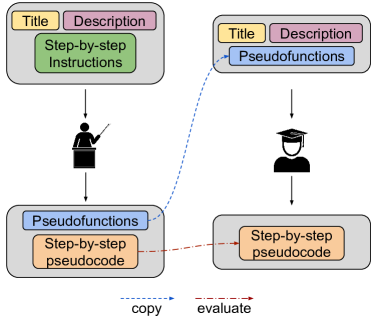
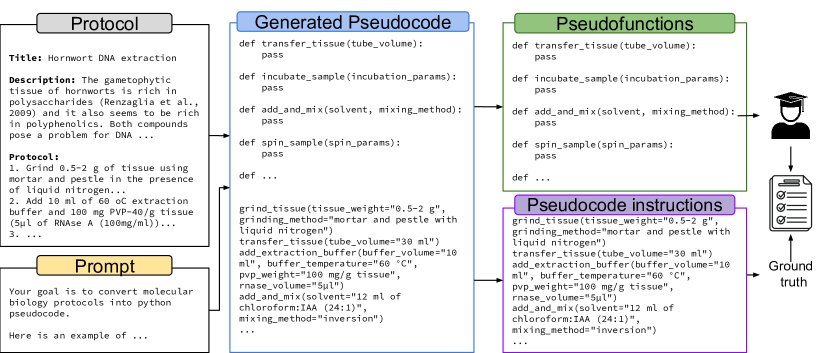
- The framework uses a 'teacher' model (GPT-4) to convert natural language protocols into step-by-step pseudocode using protocol-specific pseudofunctions.
- A 'student' model is evaluated on its ability to reconstruct the correct pseudocode from a high-level protocol description and a predefined set of admissible pseudofunctions.
- The method treats protocol generation as a multiple-choice task, improving robustness over traditional natural language metrics like BLEU or BERTScore.
- The BioProt dataset is constructed from publicly available biology protocols, with expert-verified natural language and corresponding pseudocode representations.
- An LLM agent with tool access (e.g., searching BioProt) retrieves relevant pseudofunctions and composes new protocols using only those functions.
- Real-world validation involves executing a GPT-4-generated protocol in a biological laboratory to confirm correctness and viability.
Experimental results
Research questions
- RQ1Can pseudocode representations enable more robust and accurate evaluation of LLM-generated biological protocols than natural language metrics?
- RQ2To what extent can LLMs like GPT-3.5 and GPT-4 reconstruct accurate pseudocode from high-level protocol descriptions and a defined action space?
- RQ3Can an LLM agent, using retrieved pseudofunctions from a curated dataset, generate a novel, executable biological protocol?
- RQ4Is a GPT-4-generated protocol sufficiently accurate and complete to be successfully executed in a real biological laboratory?
- RQ5How does the performance of LLMs on protocol planning vary when evaluated via pseudocode reconstruction versus direct natural language generation?
Key findings
- GPT-4 demonstrated the ability to accurately convert natural language protocols into pseudocode, enabling reliable evaluation of protocol planning capabilities.
- The proposed pseudocode-based evaluation framework outperforms traditional natural language metrics by capturing critical procedural details such as action order and substance relationships.
- A GPT-4-powered LLM agent successfully generated a novel protocol for E. coli cryopreservation using only retrieved pseudofunctions from the BioProt dataset.
- The generated protocol was successfully executed in a real laboratory, with viable E. coli cultures recovered after cryostorage, confirming its accuracy and practicality.
- The framework enables scalable, low-human-intervention evaluation of LLMs on long-horizon planning tasks in biology and beyond.
- The study demonstrates that with proper evaluation and retrieval mechanisms, LLMs can produce lab-ready experimental protocols with high reliability.
Read this paper
Open the full text in the Nubint reader and ask about any passage as you read.
Read this paper on NubintThis review was generated by AI from the original paper. Please check the paper before citing it.