
[Paper Review] Blue Large-Amplitude Pulsators and Other Short-Period Variable Stars in the OGLE-IV Galactic Disk Fields
This study presents a systematic search for short-period variable stars in OGLE-IV Galactic disk fields, detecting 25 Blue Large-Amplitude Pulsators (BLAPs), 20 of which are new discoveries, including the shortest-period BLAP known (8.42 min). The work leverages high-precision photometry of ~1.1 billion stars to identify rare pulsating stars and compact binaries, significantly expanding the known BLAP population beyond the Galactic bulge and enhancing understanding of hot, short-period stellar pulsations.
Blue Large-Amplitude Pulsators (BLAPs) form a mysterious class of variable stars with typical periods of tens of minutes and amplitudes above 0.1 mag. In this work, we present results of a variability search focused on timescales shorter than 1 h, conducted in OGLE-IV Galactic disk fields containing about 1.1 billion stellar sources down to I$\approx$20 mag. Twenty-five BLAPs have been detected, 20 of which are new discoveries. Their periods range from 8.4 min to 62.1 min. We have also found six new eclipsing binary systems with orbital periods from 38.3 min to 121.3 min and five short-period large-amplitude (> 0.17 mag in the I-band) variable stars of unknown type.
Motivation & Objective
- To detect and classify short-period variable stars with periods <1 hour in the OGLE-IV Galactic disk fields.
- To identify Blue Large-Amplitude Pulsators (BLAPs), a rare class of hot, pulsating stars with amplitudes >0.1 mag and periods of tens of minutes.
- To search for compact binary systems, including eclipsing binaries and other short-timescale variables, in an underexplored region of the variability period space.
- To expand the known population of BLAPs beyond the Galactic bulge, particularly in the disk, and to investigate their spatial distribution and physical properties.
- To provide a foundation for future spectroscopic follow-up to classify unknown short-period variables and confirm binary systems.
Proposed method
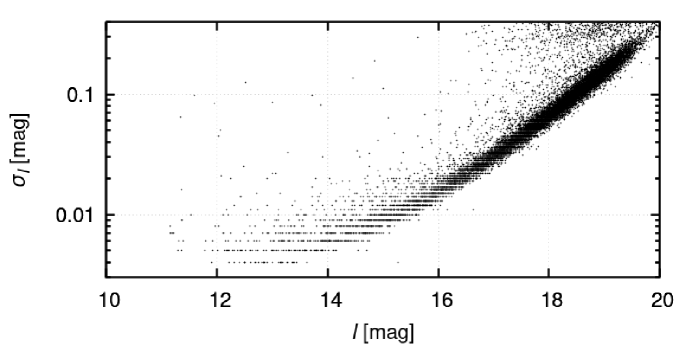
- Utilized high-precision I-band photometry from the OGLE-IV survey, covering ~2400 square degrees in the southern Milky Way disk.
- Performed a variability search on ~1.1 billion stellar sources down to I ≈ 20 mag, focusing on timescales <1 hour.
- Applied phase-folded light curve analysis and periodogram techniques to detect periodic variability with amplitudes >0.1 mag.
- Used Gaia DR3 parallaxes and photometry to estimate distances and derive physical parameters for detected objects.
- Classified variable stars based on light curve morphology, period, amplitude, and multi-band photometric properties.
- Cross-referenced candidates with existing catalogs and X-ray sources (e.g., 2RXS) to identify potential cataclysmic variables or binary systems.
Experimental results
Research questions
- RQ1What is the distribution and frequency of BLAPs in the Galactic disk, and how do they compare to those in the bulge?
- RQ2Can new short-period variable stars, particularly BLAPs and compact binaries, be detected in the OGLE-IV disk fields with periods below 1 hour?
- RQ3What are the physical properties (period, amplitude, distance, temperature) of the newly discovered BLAPs and eclipsing binaries?
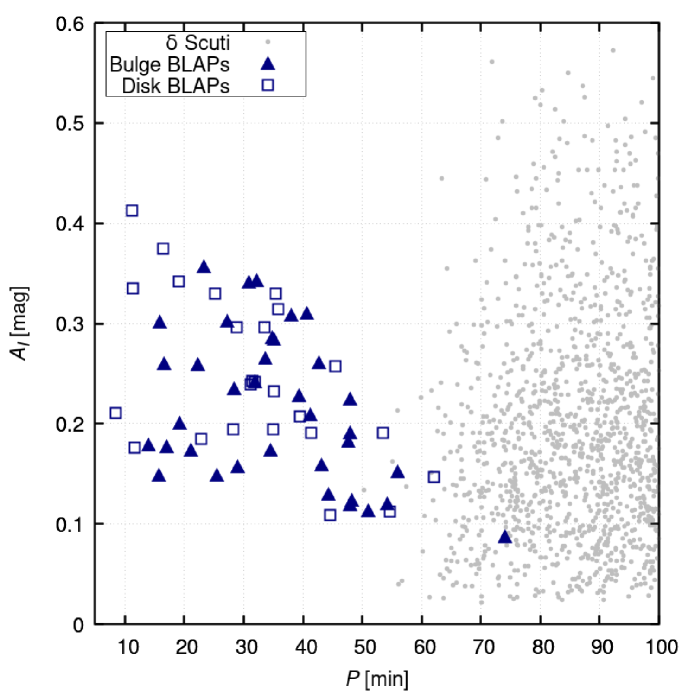
- RQ4How do the light curve shapes and amplitudes of the new BLAPs compare to known pulsators like δ Scuti or RR Lyrae stars?
- RQ5What is the nature of the five unknown short-period, large-amplitude variables, and can they be classified as cataclysmic variables or other rare types?
Key findings
- Twenty-five BLAPs were detected in the OGLE-IV Galactic disk fields, 20 of which are new discoveries, significantly expanding the known BLAP population.
- The shortest-period BLAP discovered in the OGLE area is OGLE-BLAP-044 with a period of 8.42 minutes, the shortest known BLAP to date.
- The detected BLAPs have periods ranging from 8.4 to 62.1 minutes and amplitudes exceeding 0.1 mag in the I-band.
- Six new eclipsing binary systems were identified with orbital periods between 38.3 and 121.3 minutes, indicating a population of compact, short-period binaries.
- Five additional short-period, large-amplitude variables (amplitude >0.17 mag) of unknown type were found, two of which are likely cataclysmic variables based on X-ray and photometric properties.
- The spatial distribution of BLAPs shows a concentration in the Galactic disk, with seven stars located at distances >1 kpc and five within 0.5 kpc, suggesting a disk-origin for these pulsators.
Read this paper
Open the full text in the Nubint reader and ask about any passage as you read.
Read this paper on NubintThis review was generated by AI from the original paper. Please check the paper before citing it.