
[Paper Review] BrainCLIP: Bridging Brain and Visual-Linguistic Representation Via CLIP for Generic Natural Visual Stimulus Decoding
BrainCLIP proposes a task-agnostic fMRI decoding framework that leverages CLIP’s cross-modal alignment to map brain activity to image and text embeddings, enabling zero-shot visual category decoding, fMRI-image/text matching, and high-fidelity fMRI-to-image generation. It achieves state-of-the-art performance in semantic reconstruction and retrieval by jointly optimizing visual and textual supervision, outperforming prior methods like BraVL on zero-shot classification and fMRI-to-image generation tasks.
Due to the lack of paired samples and the low signal-to-noise ratio of functional MRI (fMRI) signals, reconstructing perceived natural images or decoding their semantic contents from fMRI data are challenging tasks. In this work, we propose, for the first time, a task-agnostic fMRI-based brain decoding model, BrainCLIP, which leverages CLIP's cross-modal generalization ability to bridge the modality gap between brain activity, image, and text. Our experiments demonstrate that CLIP can act as a pivot for generic brain decoding tasks, including zero-shot visual categories decoding, fMRI-image/text matching, and fMRI-to-image generation. Specifically, BrainCLIP aims to train a mapping network that transforms fMRI patterns into a well-aligned CLIP embedding space by combining visual and textual supervision. Our experiments show that this combination can boost the decoding model's performance on certain tasks like fMRI-text matching and fMRI-to-image generation. On the zero-shot visual category decoding task, BrainCLIP achieves significantly better performance than BraVL, a recently proposed multi-modal method specifically designed for this task. BrainCLIP can also reconstruct visual stimuli with high semantic fidelity and establishes a new state-of-the-art for fMRI-based natural image reconstruction in terms of high-level semantic features.
Motivation & Objective
- To address the challenge of decoding generic natural visual stimuli from fMRI data, which is hindered by low signal-to-noise ratio and lack of paired data.
- To develop a unified, task-agnostic brain decoding framework that generalizes across multiple fMRI-based tasks without task-specific retraining.
- To improve semantic-level decoding by leveraging CLIP’s pre-trained, well-aligned visual-textual embedding space as a pivot for brain activity mapping.
- To demonstrate that combining visual and textual supervision during training enhances decoding performance for fMRI-to-image generation and fMRI-text matching.
Proposed method
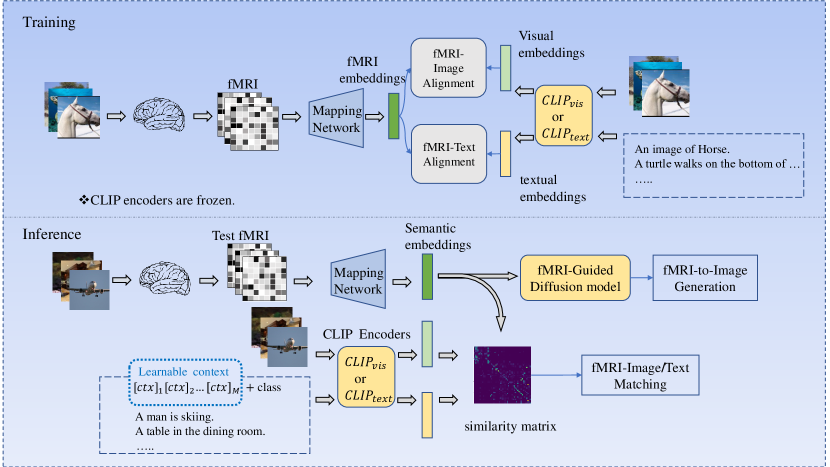
- A mapping network is trained to project fMRI patterns into CLIP’s shared embedding space using contrastive learning with both image and text data.
- The framework uses CLIP’s vision and text encoders pre-trained on 400M image-text pairs to provide a brain-like, semantically rich representation space.
- Two architectures are explored: a linear mapping head and a VAE-based mapping network to model the fMRI-to-CLIP embedding transformation.
- During inference, the model supports zero-shot visual category classification via prompt engineering, fMRI-image/text matching, and diffusion-based image generation.
- The training objective combines fMRI-image contrastive loss and fMRI-text contrastive loss to jointly align brain activity with both modalities.
- The model is evaluated on the NSD and GOD fMRI datasets, with quantitative metrics including CLIP-based and Inception V3-based similarity scores.
Experimental results
Research questions
- RQ1Can CLIP’s cross-modal representation space serve as a universal pivot to bridge fMRI brain activity with visual and linguistic data?
- RQ2Does joint supervision from both images and text improve fMRI decoding performance compared to single-modality supervision?
- RQ3Can a unified, task-agnostic model achieve state-of-the-art results across multiple fMRI decoding tasks, including zero-shot classification, retrieval, and image generation?
- RQ4How do different mapping network architectures (linear vs. VAE) affect performance in fMRI-to-image generation and retrieval tasks?
Key findings
- BrainCLIP-VAE achieved 90.8% accuracy on fMRI-text retrieval with both visual and textual supervision, outperforming settings with only one modality.
- On fMRI-to-image generation, BrainCLIP-VAE achieved a CLIP-based 2-way identification score of 89.4% using noised images as input, indicating high semantic fidelity.
- The model achieved 86.7% fMRI-text retrieval accuracy with both visual and textual supervision, demonstrating the benefit of multi-modal alignment.
- BrainCLIP outperformed BraVL on zero-shot visual category decoding, achieving 86.7% accuracy on the fMRI-text retrieval task.
- The combination of fMRI-image and fMRI-text alignment improved performance across all tasks, confirming the value of multi-modal supervision.
- BrainCLIP-VAE showed superior performance on fMRI-to-image generation and fMRI-text retrieval, while BrainCLIP-Linear excelled in fMRI-image retrieval.

Read this paper
Open the full text in the Nubint reader and ask about any passage as you read.
Read this paper on NubintThis review was generated by AI from the original paper. Please check the paper before citing it.