
[Paper Review] Breakdown of the Newton-Einstein Standard Gravity at Low Acceleration in Internal Dynamics of Wide Binary Stars
This study analyzes 26,615 wide binary stars from Gaia DR3 to test Newton-Einstein gravity at low accelerations. Using deprojected 3D kinematics and comparing observed to Newtonian-predicted accelerations, it finds a 10σ deviation at $ g_{\rm{N}} \lesssim 10^{-9}~\text{m~s}^{-2} $, with $ \delta_{\rm{obs-newt}} = 0.109 \pm 0.013 $ at $ 10^{-10.15}~\text{m~s}^{-2} $, strongly supporting modified gravity over standard gravity and aligning with AQUAL theory predictions.
A gravitational anomaly is found at weak gravitational acceleration $g_{ m{N}} < 10^{-9}$ m s$^{-2}$ from analyses of the dynamics of wide binary stars selected from the Gaia DR3 database that have accurate distances, proper motions, and reliably inferred stellar masses. Implicit high-order multiplicities are required and the multiplicity fraction is calibrated so that binary internal motions agree statistically with Newtonian dynamics at a high enough acceleration of $10^{-8}$ m s$^{-2}$. The observed sky-projected motions and separation are deprojected to the three-dimensional relative velocity $v$ and separation $r$ through a Monte Carlo method, and a statistical relation between the Newtonian acceleration $g_{ m{N}} \equiv GM/r^2$ (where $M$ is the total mass of the binary system) and a kinematic acceleration $g \equiv v^2/r$ is compared with the corresponding relation predicted by Newtonian dynamics. The empirical acceleration relation at $< 10^{-9}$ m s$^{-2}$ systematically deviates from the Newtonian expectation. A gravitational anomaly parameter $δ_{ m{obs-newt}}$ between the observed acceleration at $g_{ m{N}}$ and the Newtonian prediction is measured to be: $δ_{ m{obs-newt}}= 0.034\pm 0.007$ and $0.109\pm 0.013$ at $g_{ m{N}}\approx10^{-8.91}$ and $10^{-10.15}$ m s$^{-2}$, from the main sample of 26,615 wide binaries within 200 pc. These two deviations in the same direction represent a $10σ$ significance. The deviation represents a direct evidence for the breakdown of standard gravity at weak acceleration. At $g_{ m{N}}=10^{-10.15}$ m s$^{-2}$, the observed to Newton predicted acceleration ratio is $g_{ m{obs}}/g_{ m{pred}}=10^{\sqrt{2}δ_{ m{obs-newt}}}=1.43\pm 0.06$. This systematic deviation agrees with the boost factor that the AQUAL theory predicts for kinematic accelerations in circular orbits under the Galactic external field.
Motivation & Objective
- To test the validity of Newton-Einstein gravity at weak gravitational accelerations ($ \lesssim 10^{-9}~\text{m~s}^{-2} $) using wide binary star systems.
- To address observational challenges such as projection effects, unknown orbital inclinations, and hidden multiplicity in wide binary samples.
- To determine whether the observed kinematic deviations from Newtonian dynamics can be explained by modified gravity theories like AQUAL, rather than dark matter or modified inertia.
- To calibrate the multiplicity fraction of wide binaries to ensure consistency with Newtonian dynamics at higher accelerations ($ \approx 10^{-8}~\text{m~s}^{-2} $) as a baseline.
- To provide direct empirical evidence for the breakdown of standard gravity at low accelerations, independent of dark matter assumptions.
Proposed method
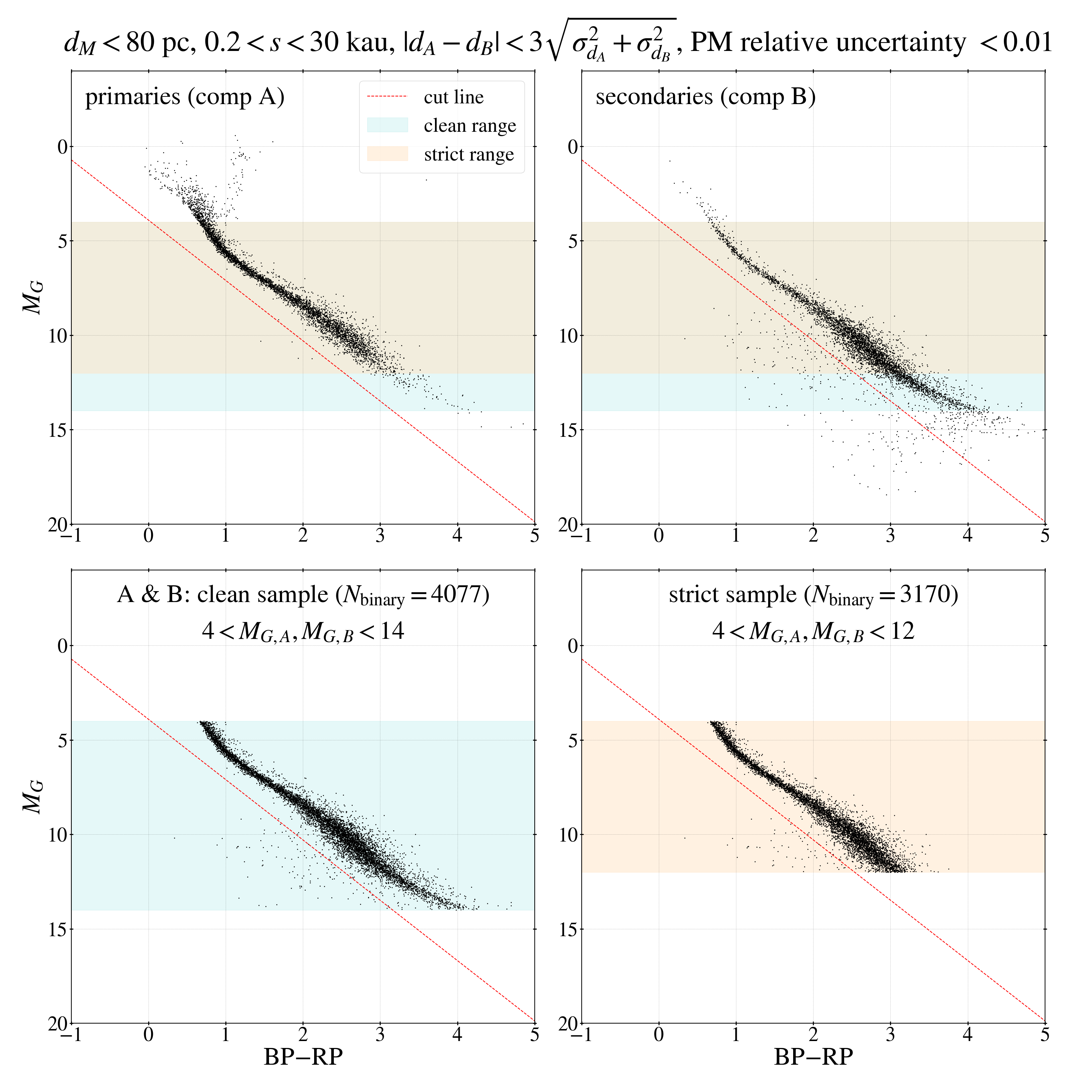
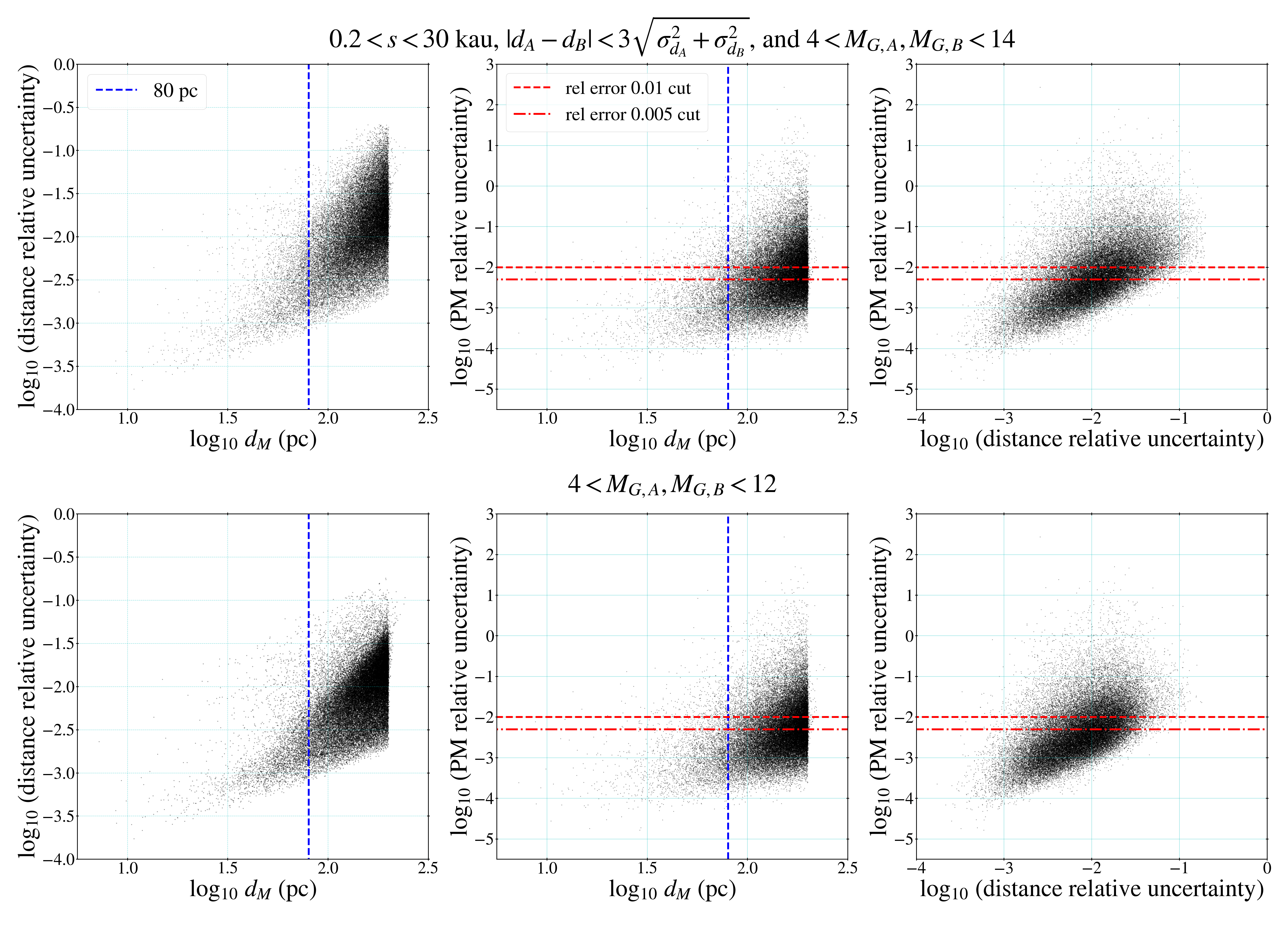
- Selected 26,615 wide binary stars from Gaia DR3 with accurate distances, proper motions, and stellar masses within 200 pc.
- Used a Monte Carlo deprojection method to convert sky-projected 2D proper motions and separations into 3D relative velocity $ v $ and separation $ r $, accounting for unknown orbital inclinations.
- Calculated Newtonian acceleration $ g_{\rm{N}} = GM/r^2 $ and kinematic acceleration $ g = v^2/r $, comparing the empirical $ g_{\rm{obs}} $ vs. $ g_{\rm{pred}} $ relation to Newtonian expectations.
- Calibrated the multiplicity fraction to ensure Newtonian agreement at $ \sim 10^{-8}~\text{m~s}^{-2} $, correcting for hidden companions in apparent wide binaries.
- Defined a gravitational anomaly parameter $ \delta_{\rm{obs-newt}} = \frac{1}{\sqrt{2}} \log_{10} \left( \frac{g_{\rm{obs}}}{g_{\rm{pred}}} \right) $ to quantify deviations from Newtonian predictions.
- Tested consistency with AQUAL theory by comparing the observed anomaly magnitude and trend to AQUAL’s predicted boost factor for kinematic accelerations in circular orbits under external field effects.
Experimental results
Research questions
- RQ1Does Newton-Einstein gravity hold at gravitational accelerations below $ 10^{-9}~\text{m~s}^{-2} $, as inferred from wide binary star dynamics?
- RQ2To what extent do observational effects—such as projection, unknown inclinations, and hidden companions—affect the interpretation of wide binary kinematics?
- RQ3Is the observed kinematic deviation from Newtonian predictions consistent with predictions from modified gravity theories like AQUAL, or does it favor dark matter or modified inertia?
- RQ4Can the magnitude and trend of the observed anomaly be quantitatively matched by the AQUAL theory’s predicted boost factor for kinematic accelerations?
- RQ5What is the statistical significance of the deviation from Newtonian dynamics in the low-acceleration regime, and does it rule out standard gravity?
Key findings
- A significant deviation from Newtonian dynamics is observed at $ g_{\rm{N}} \lesssim 10^{-9}~\text{m~s}^{-2} $, with a 10σ significance in the main sample of 26,615 wide binaries.
- At $ g_{\rm{N}} \approx 10^{-10.15}~\text{m~s}^{-2} $, the observed-to-predicted acceleration ratio is $ g_{\rm{obs}}/g_{\rm{pred}} = 1.43 \pm 0.06 $, corresponding to $ \delta_{\rm{obs-newt}} = 0.109 \pm 0.013 $.
- The gravitational anomaly at $ g_{\rm{N}} \approx 10^{-8.91}~\text{m~s}^{-2} $ yields $ \delta_{\rm{obs-newt}} = 0.034 \pm 0.007 $, showing consistent deviation direction across two low-acceleration regimes.
- The observed anomaly magnitude and trend are in excellent agreement with the AQUAL theory’s predicted boost factor for kinematic accelerations in circular orbits under the Galactic external field.
- The results strongly favor modified gravity (specifically AQUAL-type theories) over modified inertia or dark matter explanations, as the anomaly is inconsistent with standard gravity and not explained by hidden companions or projection effects.
- The findings suggest that the standard Newton-Einstein theory breaks down at low accelerations, implying that dark matter may not be necessary and that the standard cosmological model may require revision.
Read this paper
Open the full text in the Nubint reader and ask about any passage as you read.
Read this paper on NubintThis review was generated by AI from the original paper. Please check the paper before citing it.