
QUICK REVIEW
[Paper Review] Building the First Galaxies -- Chapter 2. Starbursts Dominate The Star Formation Histories of 6 < z <12 Galaxies
Alan Dressler, Marcia Rieke|arXiv (Cornell University)|Jun 4, 2023
TL;DR
The study analyzes 894 galaxies at 6<z<12 from JWST/JADES GOODS-S with SEDz* to derive star formation histories, finding that starbursts dominate the histories (~70%) while longer SFHs contribute about one-third of stellar mass by z~6.
ABSTRACT
We use SEDz* -- a code designed to chart star formation histories (SFHs) of 6
Motivation & Objective
- Characterize the star formation histories of first galaxies in the 6<z<12 interval using JWST/NIRCam SEDs.
- Test and validate SEDz* as a tool to recover epoch-by-epoch stellar mass buildup from A-star dominated populations.
- Classify SFHs into distinct types and quantify their contributions to stellar mass over cosmic time.
Proposed method
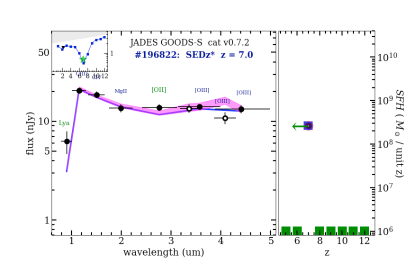
- Apply SEDz*, a NNLS-based tool, to fit 9-band NIRCam photometry with templates built from Bruzual & Charlot models including emission/continuum.
- Divide redshifts 6<z<12 into seven integer steps (z=12 to z=6) representing 42–186 Myr epochs and test two template sets (10 Myr bursts and constant star formation CSF).
- Reconstruct SFHs by adding template epochs from z=12 downward, selecting epoch of observation by minimum chi-squared, and summing mass contributions per epoch to form the SFH.
- Mitigate z<4/low-z interlopers using a multi-step validation: minima shallow/steepness of chi-squared, HST detections in visible bands, and EAZY photo-z comparisons to build a gold sample.
- Assess robustness of SFH types against dust extinction and confirm no strong extinction in the sample (AV ~0.1–0.4 ruled out).
Experimental results
Research questions
- RQ1What are the dominant star formation histories of galaxies in the 6<z<12 epoch?
- RQ2Can SED-based templates using A-star dominated populations reliably recover epoch-by-epoch stellar mass buildup in the first galaxies?
- RQ3What is the distribution of SFH types (burst, stochastic, contiguous, continuous) in this redshift range?
- RQ4How do SFH types correlate with redshift, mass, and environment within the JADES GOODS-S field?
- RQ5What fraction of stellar mass by z~6 is assembled through short bursts versus longer star-formation histories?
Key findings
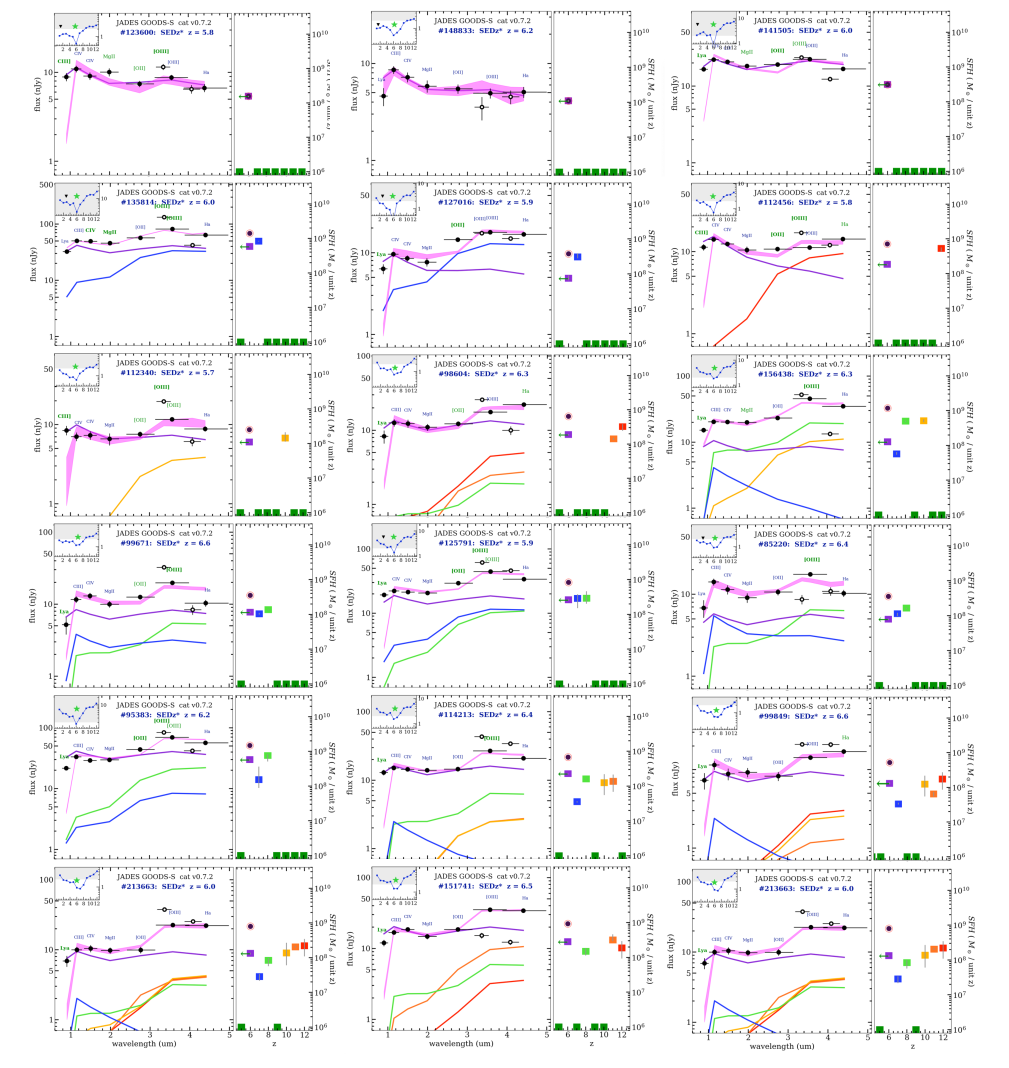
- SFH types are four: SFH1 (burst), SFH2 (stochastic), SFH3 (contiguous 3-epoch), SFH4 (continuous 4–6 epochs).
- Starbursts dominate the SFHs, comprising ~70% of the sample, while longer SFHs contribute about one-third of the accumulated stellar mass by z~6.
- The 894 SFHs imply integrated masses of 1.34e11, 1.09e11, 1.00e11, and 3.16e10 Msun for SFH1–SFH4 respectively, totaling ~4e11 Msun by z=6 in the field.
- No strong dependencies of SFH type on large-scale environment were found, though a compact group with early star formation at z=11–12 suggests long SFHs may dominate in rare dense environments.
- The sample is broadly dust-poor, with AV constraints ruling out significant extinction; yet a dust-enshrouded early burst is proposed as a possible precursor to measured SFHs.
Read this paper
Open the full text in the Nubint reader and ask about any passage as you read.
Read this paper on NubintThis review was generated by AI from the original paper. Please check the paper before citing it.