
[Paper Review] JADES: Carbon enrichment 350 Myr after the Big Bang in a gas-rich galaxy
This paper reports a deep JWST/NIRSpec analysis of a z=12.5 galaxy (target) revealing a robust C iii] emission line, implying solar or super-solar C/O and a substantial gas reservoir, challenging standard chemical enrichment scenarios at Cosmic Dawn.
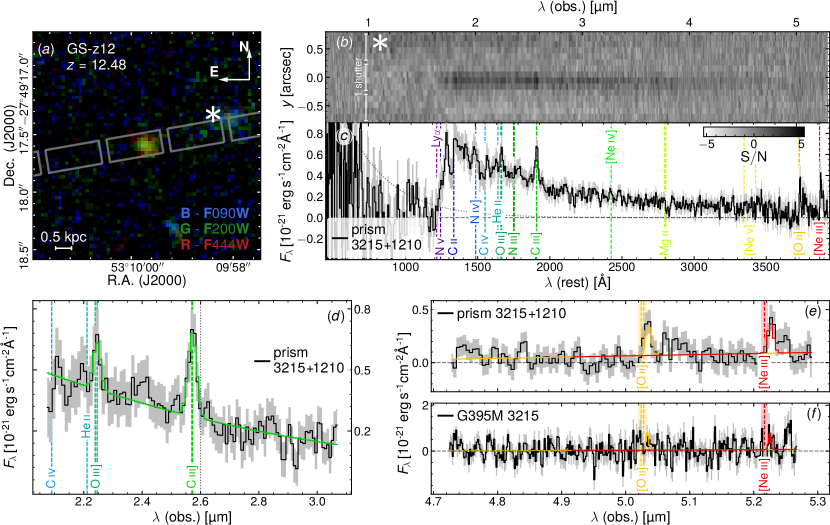
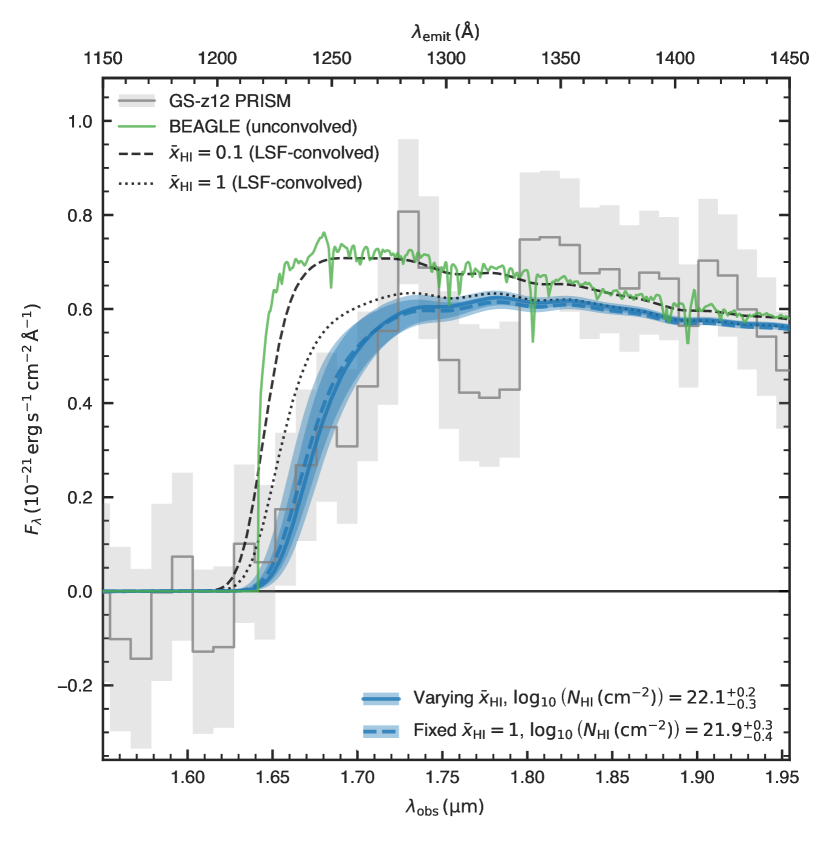
Finding the emergence of the first generation of metals in the early Universe, and identifying their origin, are some of the most important goals of modern astrophysics. We present deep JWST/NIRSpec spectroscopy of GS-z12, a galaxy at z=12.5, in which we report the detection of C III]$λλ$1907,1909 nebular emission. This is the most distant detection of a metal transition and the most distant redshift determination via emission lines. In addition, we report tentative detections of [O II]$λλ$3726,3729 and [Ne III]$λ$3869, and possibly O III]$λλ$1661,1666. By using the accurate redshift from C III], we can model the Ly$α$ drop to reliably measure an absorbing column density of hydrogen of $N_{HI} \approx 10^{22}$ cm$^{-2}$ - too high for an IGM origin and implying abundant ISM in GS-z12 or CGM around it. We infer a lower limit for the neutral gas mass of about $10^7$ MSun which, compared with a stellar mass of $\approx4 imes 10^7$ MSun inferred from the continuum fitting, implies a gas fraction higher than about 0.1-0.5. We derive a solar or even super-solar carbon-to-oxygen ratio, tentatively [C/O]>0.15. This is higher than the C/O measured in galaxies discovered by JWST at z=6-9, and higher than the C/O arising from Type-II supernovae enrichment, while AGB stars cannot contribute to carbon enrichment at these early epochs and low metallicities. Such a high C/O in a galaxy observed 350 Myr after the Big Bang may be explained by the yields of extremely metal poor stars, and may even be the heritage of the first generation of supernovae from Population III progenitors.
Motivation & Objective
- Identify and characterize metal lines in a z=12.5 galaxy using deep JWST/NIRSpec spectroscopy.
- Constrain redshift, gas content, and metallicity through nebular emission lines and continuum modelling.
- Infer carbon-to-oxygen abundance and possible enrichment channels in the early Universe.
Proposed method
- Obtain deep NIRSpec spectroscopy with prism and G140M/G395M gratings totaling ~100 hours of integration.
- Perform emission-line fitting with a local pixel-integrated Gaussian model, using a 5-sigma detection threshold for secure lines.
- Use BEAGLE to model the stellar continuum, nebular emission, dust attenuation, and SFH with a delayed exponential form and an IMF upper-mass cut of 300 M_sun.
- Constrain Ly-alpha damping-wing absorption by combining intrinsic BEAGLE spectrum with DLA and IGM absorption models to derive N_HI.
- Derive gas masses and metallicities from au_V-based attenuation and DLA-like metallicity estimates, acknowledging systematics in extinction versus attenuation treatments.
Experimental results
Research questions
- RQ1What is the chemical composition and C/O ratio in a galaxy observed 350 Myr after the Big Bang?
- RQ2Is there evidence for a large reservoir of cold, metal-poor gas in the ISM/CGM of the galaxy?
- RQ3Can C iii] and other nebular lines constrain the gas mass, metallicity, and star-formation properties at z>12?
- RQ4Do the observed abundances point to Population III/enhanced early stellar yields as the source of enrichment?
Key findings
- Detection of C iii] 1907,1909 at 5-sigma, the most distant metal line detection to date.
- Redshift constrained to z = 12.482 ± 0.012 ( z = 12.479 ± 0.014 from C iii ] alone).
- Gas-phase oxygen abundance inferred as log O/H = 7.9 ± 0.2, with a solar or super-solar C/O ratio of log C/O > 0.15 (C/O ≳ 1.4 times solar in BEAGLE fit).
- Neutral hydrogen column density in ISM/CGM inferred as log10 N_HI(cm^-2) = 22.1^{+0.2}_{-0.3} (fiducial), indicating dense neutral gas beyond IGM contributions.
- Estimated atomic gas mass log(M_gas/M_sun) = 7.0 ± 0.25, implying a substantial gas reservoir comprising 10–50% of the stellar mass, depending on gas phase assumptions.
- Evidence suggests high C/O and metal-poor gas consistent with yields from extremely metal-poor stars, possibly linked to Population III progenitors.
Read this paper
Open the full text in the Nubint reader and ask about any passage as you read.
Read this paper on NubintThis review was generated by AI from the original paper. Please check the paper before citing it.