
[Paper Review] BuildingsBench: A Large-Scale Dataset of 900K Buildings and Benchmark for Short-Term Load Forecasting
BuildingsBench introduces Buildings-900K, a nearly one-million simulated building dataset, and an evaluation platform for zero-shot STLF and transfer learning on real buildings.
Short-term forecasting of residential and commercial building energy consumption is widely used in power systems and continues to grow in importance. Data-driven short-term load forecasting (STLF), although promising, has suffered from a lack of open, large-scale datasets with high building diversity. This has hindered exploring the pretrain-then-fine-tune paradigm for STLF. To help address this, we present BuildingsBench, which consists of: 1) Buildings-900K, a large-scale dataset of 900K simulated buildings representing the U.S. building stock; and 2) an evaluation platform with over 1,900 real residential and commercial buildings from 7 open datasets. BuildingsBench benchmarks two under-explored tasks: zero-shot STLF, where a pretrained model is evaluated on unseen buildings without fine-tuning, and transfer learning, where a pretrained model is fine-tuned on a target building. The main finding of our benchmark analysis is that synthetically pretrained models generalize surprisingly well to real commercial buildings. An exploration of the effect of increasing dataset size and diversity on zero-shot commercial building performance reveals a power-law with diminishing returns. We also show that fine-tuning pretrained models on real commercial and residential buildings improves performance for a majority of target buildings. We hope that BuildingsBench encourages and facilitates future research on generalizable STLF. All datasets and code can be accessed from https://github.com/NREL/BuildingsBench.
Motivation & Objective
- Demonstrate the value of large-scale synthetic data for pretraining STLF models across residential and commercial buildings.
- Provide an open evaluation platform combining simulated and real datasets for zero-shot STLF and transfer learning.
- Analyze generalization from synthetic pretraining to real buildings and the benefits of fine-tuning on target data.
- Investigate how dataset size, model size, and architecture affect zero-shot and transfer-learning performance.
Proposed method
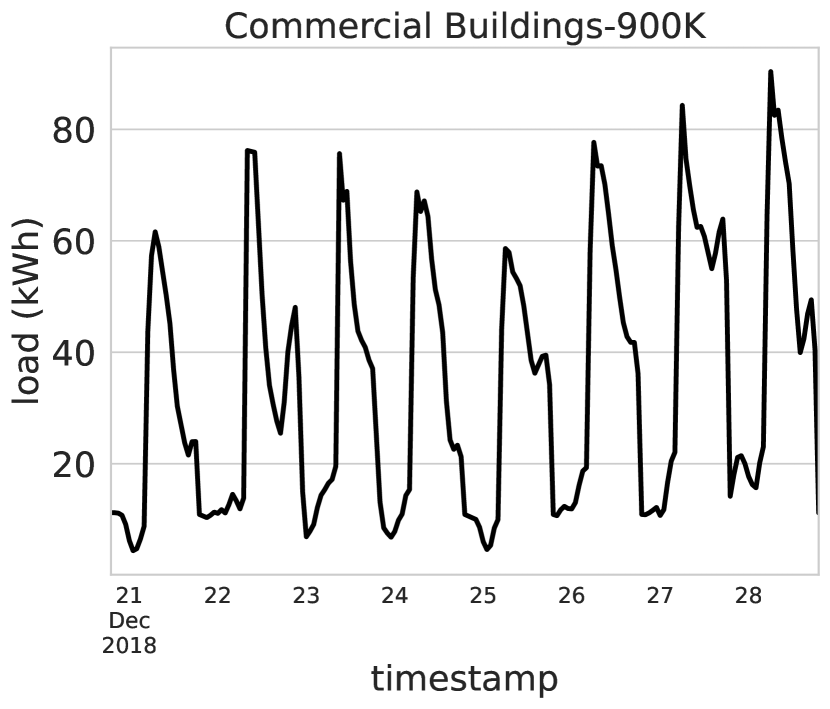
- Introduce Buildings-900K, a simulated dataset derived from the NREL End-Use Load Profiles (EULP) with 900K building models across residential and commercial types.
- Adopt a probabilistic short-term load forecasting formulation predicting distributions over 24-hour ahead loads given 168 hours of history and covariates.
- Pretrain transformer-based time-series models (Gaussian and tokenized) on Buildings-900K with 1B load-hours, then evaluate zero-shot and transfer learning on real datasets.
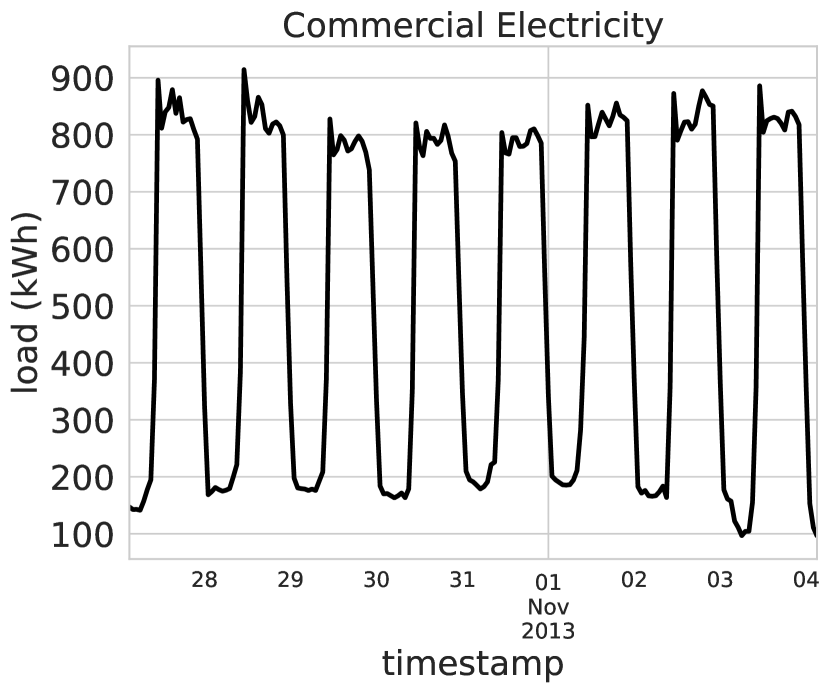
- Provide a real-building evaluation suite with over 1,900 buildings from seven open datasets (BuildingsBench).
- Benchmark baselines including persistence, LightGBM, linear/DLinear/RNN variants, and transformer-based forecasters with and without fine-tuning.
- Assess performance with NRMSE and ranked probability score (RPS) for both point forecasts and uncertainty.
Experimental results
Research questions
- RQ1Can models pretrained on Buildings-900K generalize to real buildings, especially commercial ones?
- RQ2Does fine-tuning a pretrained model on limited real data improve performance on target buildings?
- RQ3How does pretraining dataset size and model size influence zero-shot performance and generalization to real data?
- RQ4Is pretraining with tokenized loads advantageous compared to continuous loads for large-scale STLF pretraining?
- RQ5What is the impact of incorporating geospatial and building-type covariates on forecast accuracy?
Key findings
- Pretraining on Buildings-900K yields strong zero-shot STLF performance on real commercial buildings, with some sim-to-real gaps for residential buildings.
- Fine-tuning pretrained transformers on 6 months of real data improves STLF for both commercial and residential buildings, with notable gains for commercial cases.
- Zero-shot performance for commercial buildings follows a power-law with diminishing returns as dataset size increases; residential performance is more limited due to higher sim-to-real mismatch.
- Transformer-M models show the largest gains from fine-tuning, approaching or matching large pretrained baselines, while very large models may saturate in zero-shot settings.
- Tokenized load representations (Tokens) offer training stability but generally underperform Gaussian transformers in accuracy, though quantization compresses data effectively.
- Geospatial covariates provide modest accuracy improvements, suggesting location-awareness helps slightly with generalization.
Read this paper
Open the full text in the Nubint reader and ask about any passage as you read.
Read this paper on NubintThis review was generated by AI from the original paper. Please check the paper before citing it.