
[Paper Review] Bullying10K: A Large-Scale Neuromorphic Dataset towards Privacy-Preserving Bullying Recognition
Bullying10K introduces a large-scale DVS-based dataset for privacy-preserving bullying/violent behavior recognition, offering action recognition, temporal action localization, and pose estimation benchmarks with 10,000 event segments and 12 billion events.
The prevalence of violence in daily life poses significant threats to individuals' physical and mental well-being. Using surveillance cameras in public spaces has proven effective in proactively deterring and preventing such incidents. However, concerns regarding privacy invasion have emerged due to their widespread deployment. To address the problem, we leverage Dynamic Vision Sensors (DVS) cameras to detect violent incidents and preserve privacy since it captures pixel brightness variations instead of static imagery. We introduce the Bullying10K dataset, encompassing various actions, complex movements, and occlusions from real-life scenarios. It provides three benchmarks for evaluating different tasks: action recognition, temporal action localization, and pose estimation. With 10,000 event segments, totaling 12 billion events and 255 GB of data, Bullying10K contributes significantly by balancing violence detection and personal privacy persevering. And it also poses a challenge to the neuromorphic dataset. It will serve as a valuable resource for training and developing privacy-protecting video systems. The Bullying10K opens new possibilities for innovative approaches in these domains.
Motivation & Objective
- Motivate privacy-preserving violence detection in public surveillance contexts.
- Provide a large-scale neuromorphic dataset captured with Dynamic Vision Sensors (DVS).
- Enable evaluation of action recognition, temporal action localization, and pose estimation on event-based data.
- Offer benchmarks to advance privacy-protecting video systems in real-world scenarios.
Proposed method
- Use two Davis346 DVS cameras to collect multi-view event streams of violent and friendly actions.
- Annotate the dataset with action categories, camera positions, lighting, and pose keypoints derived from RGB-aligned pose estimation tools.
- Transform raw event streams into frames and 10 ms temporal units for model input.
- Evaluate multiple action recognition, temporal localization, and pose estimation models on DVS data.
- Compare privacy-preserving approaches on RGB vs. DVS data to assess privacy-performance trade-offs.
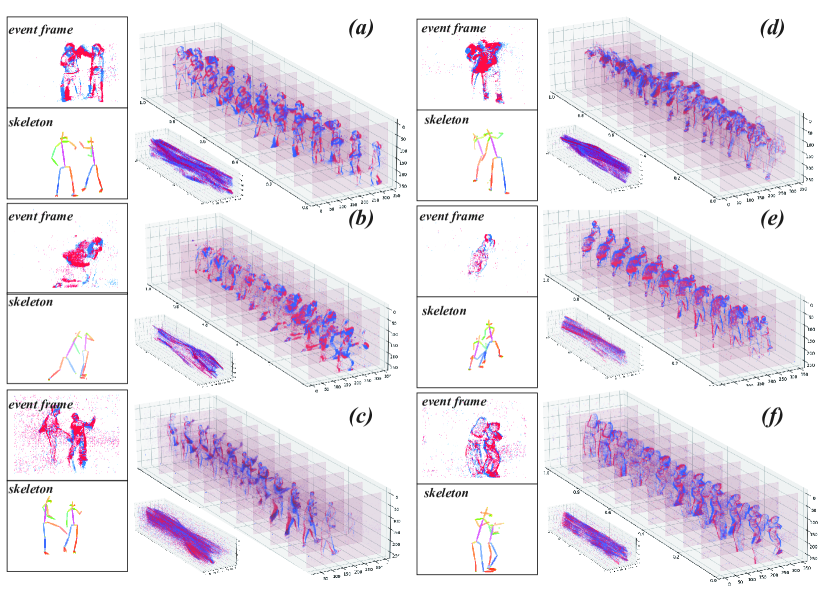
Experimental results
Research questions
- RQ1Can a large-scale event-based dataset capture complex, fast, and occluded violent actions while preserving privacy?
- RQ2How do state-of-the-art action recognition, localization, and pose estimation methods perform on neuromorphic DVS data for violence detection?
- RQ3What are the privacy implications and performance trade-offs when applying privacy-preserving techniques to RGB vs. DVS modalities in violent scene recognition?
Key findings
- Bullying10K contains 10,000 event segments, totaling 12 billion events and 255 GB of data.
- The dataset targets 10 actions (6 violent, 4 friendly) and provides three benchmarks: action recognition, temporal action localization, and pose estimation.
- DVS-based action recognition shows robustness to illumination changes and motion blur, often outperforming RGB-derived baselines under privacy-preserving settings.
- Temporal action localization and pose estimation on Bullying10K present substantial challenges, reflecting the dataset’s complexity and the need for specialized event-based models.
- Analysis includes keypoint motion, event polarity distributions, and IoU distributions to characterize event dynamics and occlusions.

Read this paper
Open the full text in the Nubint reader and ask about any passage as you read.
Read this paper on NubintThis review was generated by AI from the original paper. Please check the paper before citing it.