
[Paper Review] Can LLMs Produce Faithful Explanations For Fact-checking? Towards Faithful Explainable Fact-Checking via Multi-Agent Debate
The paper shows zero-shot LLMs often produce unfaithful fact-check explanations and introduces the Multi-Agent Debate Refinement (MADR) framework, which uses multiple LLM agents to iteratively debate and refine explanations to improve faithfulness to evidence.
Fact-checking research has extensively explored verification but less so the generation of natural-language explanations, crucial for user trust. While Large Language Models (LLMs) excel in text generation, their capability for producing faithful explanations in fact-checking remains underexamined. Our study investigates LLMs' ability to generate such explanations, finding that zero-shot prompts often result in unfaithfulness. To address these challenges, we propose the Multi-Agent Debate Refinement (MADR) framework, leveraging multiple LLMs as agents with diverse roles in an iterative refining process aimed at enhancing faithfulness in generated explanations. MADR ensures that the final explanation undergoes rigorous validation, significantly reducing the likelihood of unfaithful elements and aligning closely with the provided evidence. Experimental results demonstrate that MADR significantly improves the faithfulness of LLM-generated explanations to the evidence, advancing the credibility and trustworthiness of these explanations.
Motivation & Objective
- Assess whether LLMs can generate faithful explanations for fact-checking in zero-shot settings.
- Characterize common faithfulness errors in LLM explanations using a new error typology.
- Propose and evaluate the Multi-Agent Debate Refinement (MADR) framework to improve faithfulness.
- Compare MADR to baseline prompting strategies using automated and human evaluations.
Proposed method
- Develop a novel error typology for faithfulness in fact-check explanations (intrinsic/extrinsic entity/event/noun-phrase errors, reasoning coherence, overgeneralization, irrelevant evidence).
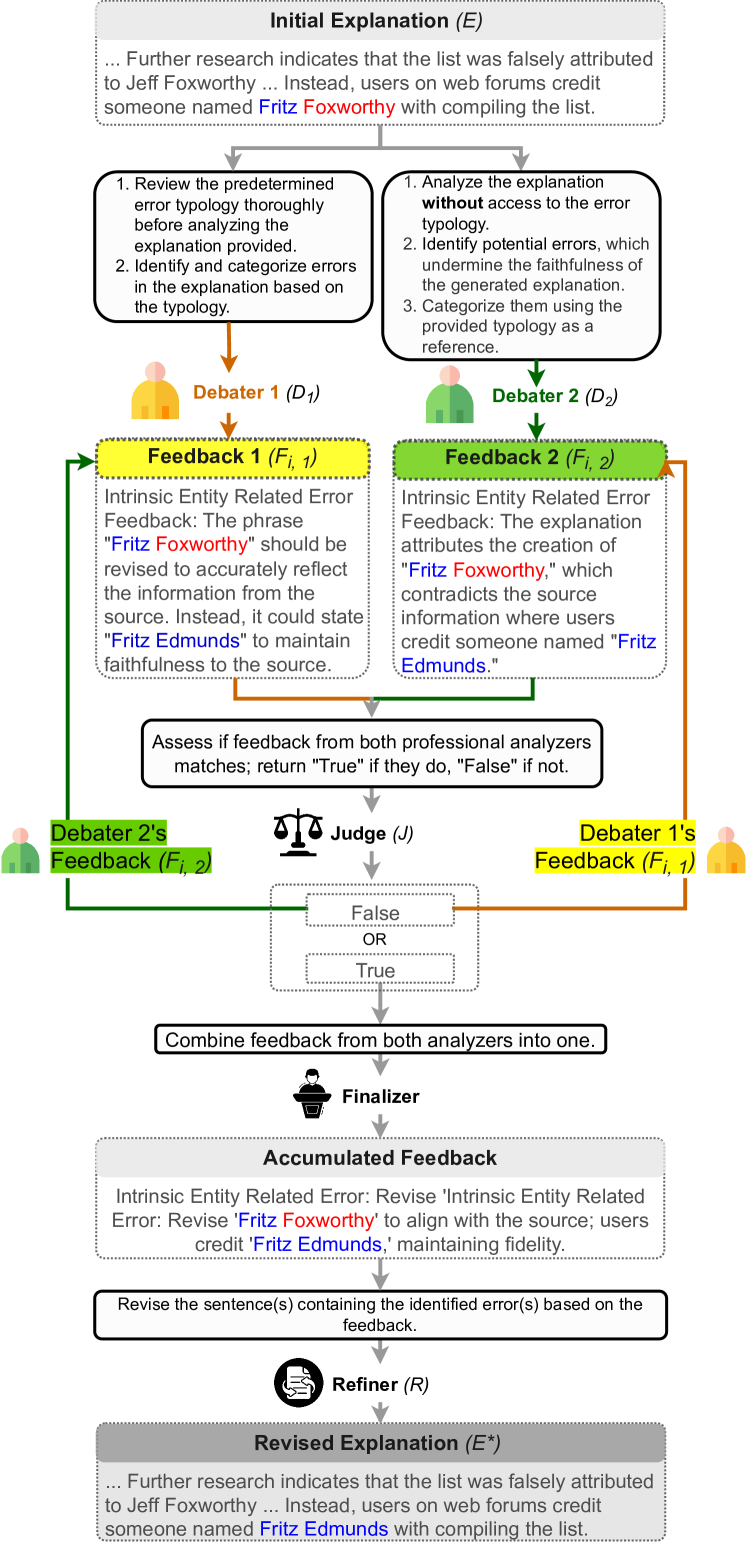
- Propose MADR: multiple LLM agents (two Debaters, one Judge, one Refiner) iteratively generate feedback to refine explanations.
- Debaters identify errors based on typology and non-typology cues; Judge adjudicates feedback consensus; Refiner produces the final explanation.
- Apply a finite multi-agent debate loop to generate faithful explanations, with termination by consensus or iteration limit.
- Evaluate using PolitiHop multi-hop fact-checking data and G-Eval with GPT-4 Turbo across multiple granularity protocols (sentence- and document-level).
- Compare against zero-shot, chain-of-thought, and Self-Refine baselines using automatic faithfulness scores and human judgments.
Experimental results
Research questions
- RQ1Can LLMs generate faithful explanations for fact-checking under zero-shot prompting?
- RQ2What typology of unfaithfulness errors commonly appears in LLM-generated explanations?
- RQ3Can a multi-agent debate refinement process improve the faithfulness of generated explanations?
- RQ4How should faithfulness be evaluated for LLM explanations in fact-checking (automatic vs human)?
Key findings
- Zero-shot explanations are frequently unfaithful, with up to 80% hallucinated details in some prompts.
- MADR significantly improves faithfulness over baselines in automatic evaluations across protocol variants.
- Human evaluations show MADR yields more faithful explanations on sampled cases, with debaters catching errors missed by single agents.
- Automatic evaluation protocols with typology-informed prompts correlate better with human judgments than typology-free protocols.
- A correlation analysis indicates sentence-level evaluation with typology aligns more closely with human faithfulness judgments (higher Kendall’s Tau).
- Self-refinement alone is less effective than MADR for correcting errors and achieving faithful rationales.

Read this paper
Open the full text in the Nubint reader and ask about any passage as you read.
Read this paper on NubintThis review was generated by AI from the original paper. Please check the paper before citing it.