
[Paper Review] Causal Inference in Recommender Systems: A Survey of Strategies for Bias Mitigation, Explanation, and Generalization
This survey reviews how causal inference is incorporated into recommender systems to debias predictions, improve explainability, and enhance generalization, via Rubin’s potential outcomes and Pearl’s structural causal models.
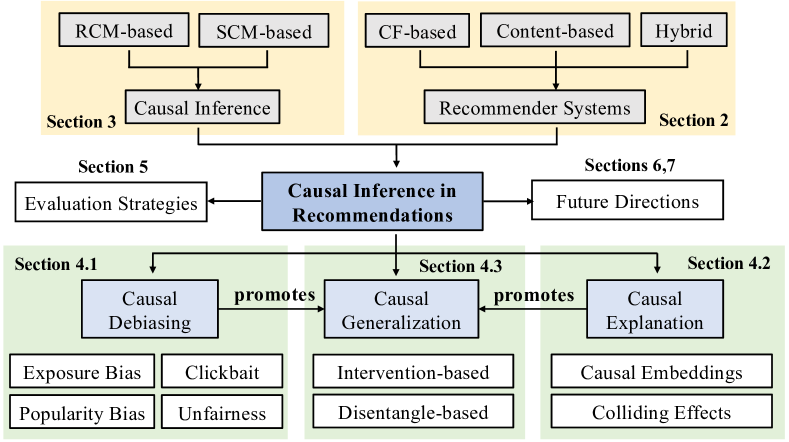
In the era of information overload, recommender systems (RSs) have become an indispensable part of online service platforms. Traditional RSs estimate user interests and predict their future behaviors by utilizing correlations in the observational historical activities, their profiles, and the content of interacted items. However, since the inherent causal reasons that lead to the observed users' behaviors are not considered, multiple types of biases could exist in the generated recommendations. In addition, the causal motives that drive user activities are usually entangled in these RSs, where the explainability and generalization abilities of recommendations cannot be guaranteed. To address these drawbacks, recent years have witnessed an upsurge of interest in enhancing traditional RSs with causal inference techniques. In this survey, we provide a systematic overview of causal RSs and help readers gain a comprehensive understanding of this promising area. We start with the basic concepts of traditional RSs and their limitations due to the lack of causal reasoning ability. We then discuss how different causal inference techniques can be introduced to address these challenges, with an emphasis on debiasing, explainability promotion, and generalization improvement. Furthermore, we thoroughly analyze various evaluation strategies for causal RSs, focusing especially on how to reliably estimate their performance with biased data if the causal effects of interests are unavailable. Finally, we provide insights into potential directions for future causal RS research.
Motivation & Objective
- Explain the limitations of traditional correlation-based recommender systems due to causal reasoning gaps.
- Summarize two major causal inference frameworks (Rubin’s potential outcome and Pearl’s structural causal model) and their connections to RSs.
- Discuss how causal techniques address debiasing, explainability, and generalization in RSs.
- Analyze evaluation strategies for causal RSs with biased data and unavailable causal effects.
- Provide directions for future causal RS research.
Proposed method
- Present the basics of traditional RSs and their correlation-based limitations.
- Introduce Rubin’s potential outcome framework and Pearl’s structural causal model in the RS context.
- Describe how causal inference techniques can debias RSs (e.g., addressing exposure bias), promote explainability, and improve generalization.
- Discuss causal graph structures and intervention concepts (do-operator) in RSs.
- Explain backdoor adjustment and covariate-based strategies (IPW) for identifying causal effects in RS data.
Experimental results
Research questions
- RQ1How do exposure biases arise in traditional RSs and how can causal methods mitigate them?
- RQ2What are the benefits and trade-offs of Rubin’s and Pearl’s causal frameworks for recommender systems?
- RQ3How can causal inference techniques improve explainability and generalization in RSs?
- RQ4What evaluation strategies reliably assess causal RS performance when causal effects are unavailable?
- RQ5What future directions are promising for advancing causal recommender systems?
Key findings
- Causal RSs provide a principled way to address biases that arise from non-random exposure and confounding in observed ratings.
- Rubin’s and Pearl’s frameworks offer complementary perspectives: RCM focuses on potential outcomes; SCM emphasizes causal graphs and interventions.
- Hybrid approaches (e.g., incorporating side information) aid in forming causal relationships and mitigating spurious correlations.
- SCM enables reasoning about interventions and counterfactuals, aiding explainability and targeted generalization across settings.
- The survey outlines evaluation strategies for causal RSs, especially when causal effects are not directly observable.
- It identifies open questions and future directions for causal RS research.

Read this paper
Open the full text in the Nubint reader and ask about any passage as you read.
Read this paper on NubintThis review was generated by AI from the original paper. Please check the paper before citing it.