
[Paper Review] Chain-of-Dictionary Prompting Elicits Translation in Large Language Models
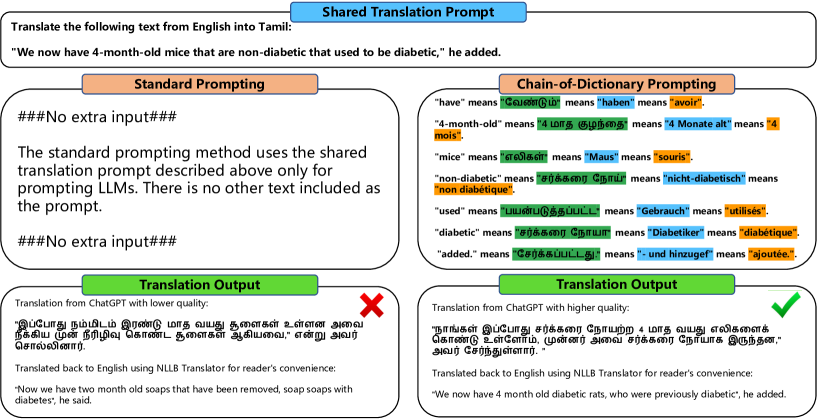
This paper proposes Chain-of-Dictionary Prompting (CoD), a zero-shot prompting framework that enhances large language models (LLMs) for multilingual neural machine translation by chaining multilingual dictionaries as external knowledge. CoD boosts translation performance by up to 13x chrF++ points—e.g., from 3.08 to 42.63 on English-to-Serbian (Cyrillic)—and outperforms few-shot in-context learning, especially for low-resource languages.
Large language models (LLMs) have shown surprisingly good performance in multilingual neural machine translation (MNMT) even when trained without parallel data. Yet, despite the fact that the amount of training data is gigantic, they still struggle with translating rare words, particularly for low-resource languages. Even worse, it is usually unrealistic to retrieve relevant demonstrations for in-context learning with low-resource languages on LLMs, which restricts the practical use of LLMs for translation -- how should we mitigate this problem? To this end, we present a novel method, CoD, which augments LLMs with prior knowledge with the chains of multilingual dictionaries for a subset of input words to elicit translation abilities for LLMs. Extensive experiments indicate that augmenting ChatGPT with CoD elicits large gains by up to 13x chrF++ points for MNMT (3.08 to 42.63 for English to Serbian written in Cyrillic script) on FLORES-200 full devtest set. We further demonstrate the importance of chaining the multilingual dictionaries, as well as the superiority of CoD to few-shot demonstration for low-resource languages.
Motivation & Objective
- Address the poor performance of large language models (LLMs) in translating rare words, particularly in low-resource languages.
- Overcome the limitation of few-shot in-context learning, which often fails to retrieve relevant demonstrations for low-resource language translation.
- Improve zero-shot multilingual neural machine translation (MNMT) by integrating multilingual lexical knowledge without model fine-tuning.
- Demonstrate that chaining multilingual dictionaries enhances reasoning and translation accuracy compared to isolated or unchained lexical hints.
Proposed method
- Augment standard translation prompts with chains of multilingual dictionary entries, where each word is linked to its translations in multiple languages (e.g., 'limit' → 'Grenze' → 'çäk').
- Structure the prompt to include a reasoning-like chain of dictionary mappings as intermediate steps, inspired by Chain-of-Thought (CoT) prompting.
- Use high-resource languages (e.g., English, German) as intermediate links in the chain to improve cross-lingual transfer and robustness.
- Apply the CoD prompt to zero-shot inference on the FLORES-200 benchmark, using models like ChatGPT without any fine-tuning.
- Design the chain to preserve semantic equivalence across languages, ensuring that translation paths are coherent and semantically consistent.
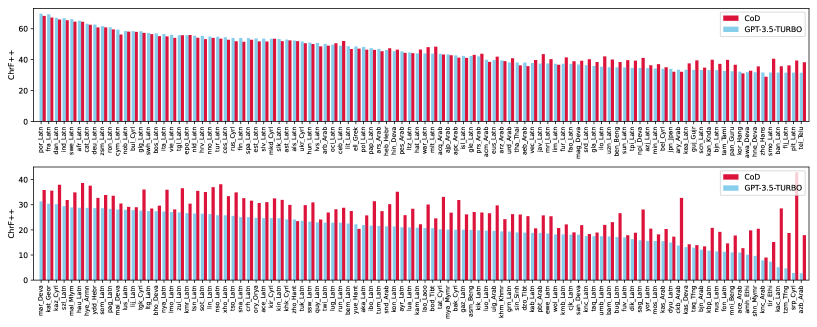
- Evaluate performance using chrF++ on the full devtest set of FLORES-200, comparing CoD to standard prompting and few-shot in-context learning.
Experimental results
Research questions
- RQ1Can chaining multilingual dictionaries as external knowledge significantly improve zero-shot translation performance in low-resource language pairs?
- RQ2How does CoD compare to few-shot in-context learning in terms of translation quality for low-resource languages?
- RQ3Is the performance gain from CoD dependent on the structure of the dictionary chain, or does it rely on isolated lexical mappings?
- RQ4Does the choice of intermediate languages in the chain affect translation performance, particularly for languages with non-Latin scripts?
- RQ5Can CoD be generalized across diverse language pairs, including those with different writing systems?
Key findings
- CoD achieves a maximum improvement of 13x chrF++ points on the English-to-Serbian (Cyrillic) translation task, rising from 3.08 to 42.63 on the FLORES-200 full devtest set.
- Chaining multilingual dictionaries is essential—separating word mappings or using unchained dictionaries results in significantly lower performance.
- CoD outperforms few-shot in-context learning, especially for low-resource languages, where relevant demonstrations are often unavailable or irrelevant.
- Using high-resource languages like English or German as intermediate links in the chain improves performance, while using similar target languages can degrade results.
- The method is robust across 200 language pairs in FLORES-200, with minimal negative impact on high-resource languages, indicating broad applicability.
- CoD enables translation in languages where standard prompting fails entirely, such as in low-resource Cyrillic-script languages, demonstrating its ability to elicit latent translation capabilities.
Read this paper
Open the full text in the Nubint reader and ask about any passage as you read.
Read this paper on NubintThis review was generated by AI from the original paper. Please check the paper before citing it.