
[Paper Review] Challenges and Opportunities of Using Transformer-Based Multi-Task Learning in NLP Through ML Lifecycle: A Survey
This survey investigates transformer-based multi-task learning (MTL) in NLP across the full machine learning lifecycle, identifying challenges and opportunities in data engineering, model development, deployment, and monitoring. It proposes Continual Multi-Task Learning (CMTL) as a novel integration of MTL and continual learning to enable periodic retraining and dynamic adaptation to distribution shifts and new tasks.
The increasing adoption of natural language processing (NLP) models across industries has led to practitioners' need for machine learning systems to handle these models efficiently, from training to serving them in production. However, training, deploying, and updating multiple models can be complex, costly, and time-consuming, mainly when using transformer-based pre-trained language models. Multi-Task Learning (MTL) has emerged as a promising approach to improve efficiency and performance through joint training, rather than training separate models. Motivated by this, we first provide an overview of transformer-based MTL approaches in NLP. Then, we discuss the challenges and opportunities of using MTL approaches throughout typical ML lifecycle phases, specifically focusing on the challenges related to data engineering, model development, deployment, and monitoring phases. This survey focuses on transformer-based MTL architectures and, to the best of our knowledge, is novel in that it systematically analyses how transformer-based MTL in NLP fits into ML lifecycle phases. Furthermore, we motivate research on the connection between MTL and continual learning (CL), as this area remains unexplored. We believe it would be practical to have a model that can handle both MTL and CL, as this would make it easier to periodically re-train the model, update it due to distribution shifts, and add new capabilities to meet real-world requirements.
Motivation & Objective
- To systematically analyze how transformer-based MTL integrates into the full machine learning lifecycle phases, including data engineering, model development, deployment, and monitoring.
- To identify key challenges and opportunities in applying MTL to real-world NLP production systems, particularly regarding computational cost, model maintenance, and scalability.
- To highlight the underexplored connection between MTL and continual learning (CL), advocating for a unified framework to support dynamic model updates.
- To propose Continual Multi-Task Learning (CMTL) as a practical solution for handling sequential task addition, distribution shifts, and periodic retraining in production.
- To motivate the creation of a benchmark that realistically simulates real-world ML system challenges for evaluating CMTL models.
Proposed method
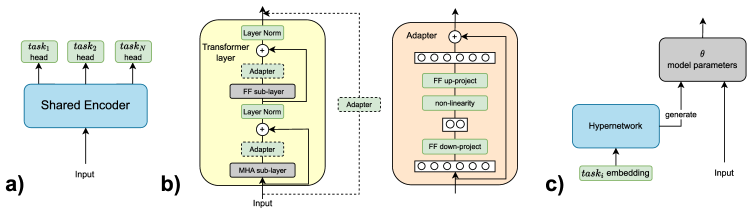
- Surveying existing transformer-based MTL architectures in NLP, with focus on parameter-sharing mechanisms such as task-specific heads, adapters, and hypernetworks.
- Mapping MTL components to ML lifecycle phases to identify phase-specific challenges, such as data imbalance in data engineering and model staleness in monitoring.
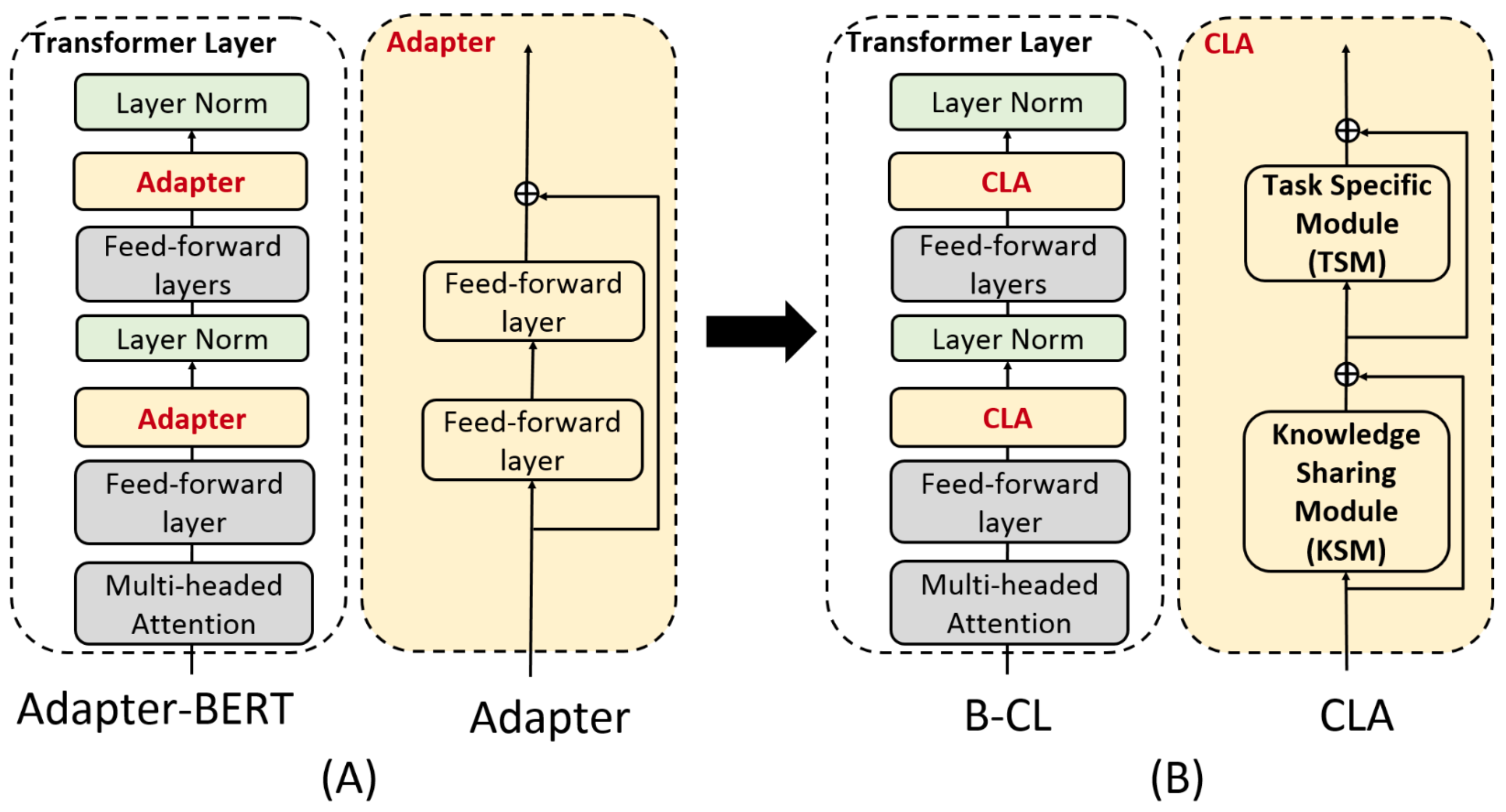
- Analyzing architectural similarities between MTL and continual learning (CL), particularly in adapter-based and parameter-isolation designs, to enable CMTL integration.
- Proposing a CMTL framework that combines MTL's simultaneous learning with CL's incremental learning, using shared components like adapters and hypernetworks.
- Designing a benchmark strategy that simulates real-world conditions, including varying task arrival frequencies, retraining schedules, and distribution shifts.
- Using visual and architectural comparisons (e.g., Figure 3) to illustrate how MTL and CL components can be interchanged or combined, such as replacing MTL adapters with CL-aware modules.
Experimental results
Research questions
- RQ1How can transformer-based MTL be effectively integrated into the full ML lifecycle, and what are the key challenges in data engineering, model development, deployment, and monitoring?
- RQ2What architectural similarities exist between MTL and continual learning (CL) that could enable a unified CMTL framework?
- RQ3How can MTL be extended to support sequential task learning and adaptation to distribution shifts in production environments?
- RQ4What benchmarking strategies are needed to fairly evaluate CMTL models under realistic production conditions?
- RQ5Can existing MTL components like adapters and hypernetworks be repurposed to support continual learning, enabling efficient and modular CMTL models?
Key findings
- Transformer-based MTL improves model efficiency and reduces computational and economic costs by sharing parameters across multiple NLP tasks.
- MTL simplifies model deployment and maintenance in production by enabling modular, reusable architectures with shared backbone components.
- Architectural components like adapters and hypernetworks are shared between MTL and CL, suggesting a strong foundation for building CMTL models.
- The integration of MTL and CL into a CMTL framework could enable models to handle new tasks and distribution shifts without catastrophic forgetting.
- A benchmark simulating periodic retraining, task arrival frequency, and distribution shifts is essential for evaluating CMTL models effectively.
- The proposed CMTL approach leverages existing MTL components and could be implemented by modifying only the adapter or parameter isolation modules, enabling backward compatibility with existing MTL systems.
Read this paper
Open the full text in the Nubint reader and ask about any passage as you read.
Read this paper on NubintThis review was generated by AI from the original paper. Please check the paper before citing it.