
[Paper Review] Channel Estimation for Extremely Large-Scale Massive MIMO: Far-Field, Near-Field, or Hybrid-Field?
This paper proposes a hybrid-field channel estimation scheme for extremely large-scale massive MIMO (XL-MIMO) that jointly models far-field and near-field path components, leveraging angle-domain sparsity for far-field paths and polar-domain sparsity for near-field paths. The scheme achieves superior NMSE performance over existing far-field and near-field methods by accurately capturing the hybrid-field channel feature with low pilot overhead.
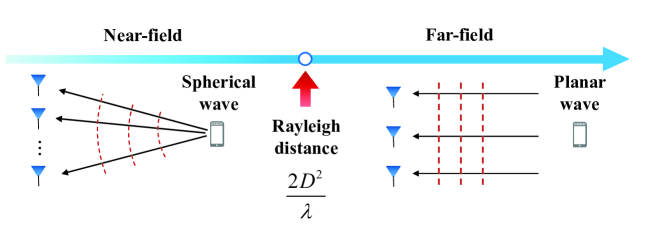
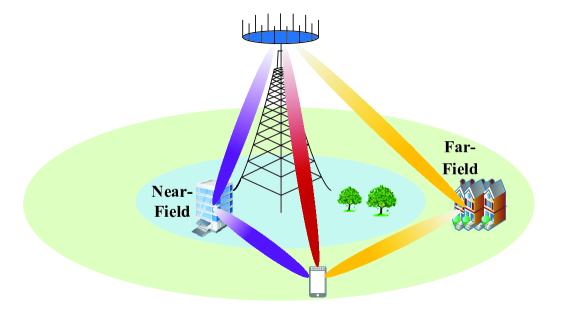
Extremely large-scale massive MIMO (XL-MIMO) is a promising technique for future 6G communications.However, existing far-field or near-field channel model mismatches the hybrid-field channel feature in the practical XL-MIMO system.Thus,existing far-field and near-field channel estimation schemes cannot be directly used to accurately estimate the hybrid-field XL-MIMO channel. To solve this problem, we propose an efficient hybrid-field channel estimation scheme by accurately modeling the XL-MIMO channel.Specifically,we firstly reveal the hybrid-field channel feature of the XL-MIMO channel, where different scatters may be in far-field or near-field region.Then, we propose a hybrid-field channel model to capture this feature, which contains both the far-field and near-field path components. Finally, we propose a hybrid-field channel estimation scheme, where the far-field and near-field path components are respectively estimated. Simulation results show that the proposed scheme performs better than existing schemes.
Motivation & Objective
- To address the mismatch in existing channel models that assume all scatterers are either in the far-field or near-field region, which fails to reflect real-world hybrid-field conditions in XL-MIMO systems.
- To model the XL-MIMO channel accurately by incorporating both far-field and near-field path components, reflecting the coexistence of distant and close scatterers.
- To develop a low-pilot-overhead channel estimation scheme that separately estimates far-field and near-field components using their distinct sparsity structures.
- To demonstrate that the proposed scheme outperforms existing far-field and near-field estimation methods in terms of NMSE under the same pilot overhead.
Proposed method
- Proposes a hybrid-field channel model that includes both far-field and near-field path components, with an adjustable parameter γ to control the proportion of each.
- Uses a two-stage orthogonal matching pursuit (HF-OMP) algorithm: first estimating far-field components in the angle domain using a DFT-based transform matrix, then estimating near-field components in the polar domain using a joint angle-distance transform matrix.
- Applies compressive sensing (CS) techniques to exploit sparsity in both the angle and polar domains, reducing required pilot overhead.
- Integrates estimates from both stages by combining the far-field sparse vector in the angle domain and the near-field sparse vector in the polar domain to reconstruct the full channel.
- Controls the estimation process via an adjustable parameter γ, allowing the scheme to reduce to the classical far-field or near-field OMP algorithm when γ=1 or γ=0.
- Analyzes computational complexity as O(NM(γL)³) + O(SM((1−γ)L)³) + O(NS), showing scalability with system parameters.
Experimental results
Research questions
- RQ1How does the coexistence of far-field and near-field scatterers affect channel estimation accuracy in XL-MIMO systems?
- RQ2Can a unified channel estimation framework effectively model and estimate both far-field and near-field components simultaneously?
- RQ3What is the performance gain of a hybrid-field estimation scheme over purely far-field or near-field approaches under the same pilot overhead?
- RQ4How does the adjustable parameter γ influence the estimation accuracy and system performance in mixed propagation environments?
Key findings
- The proposed hybrid-field channel estimation scheme achieves lower normalized mean square error (NMSE) than both the far-field OMP and near-field OMP schemes under the same pilot overhead of M=256.
- When γ=0.5, the scheme outperforms both baseline methods across all SNR levels, demonstrating robustness in mixed propagation environments.
- When γ=1 (pure far-field), the scheme achieves identical NMSE performance to the far-field OMP scheme, confirming it as a generalization of existing methods.
- When γ=0 (pure near-field), the scheme achieves identical NMSE performance to the near-field OMP scheme, validating its consistency with special cases.
- The NMSE performance is sensitive to the adjustable parameter γ, with optimal performance observed around γ=0.5 in hybrid environments.
- The computational complexity is analytically derived and shown to scale efficiently with system dimensions, supporting practical deployment.
Read this paper
Open the full text in the Nubint reader and ask about any passage as you read.
Read this paper on NubintThis review was generated by AI from the original paper. Please check the paper before citing it.