
[Paper Review] Circumstellar interaction signatures in the low luminosity type II SN 2021gmj
This study presents multi-wavelength observations of the low-luminosity Type II supernova SN 2021gmj, revealing circumstellar interaction through early light-curve deviations and high-ionization emission lines. Hydrodynamic modeling and spectroscopic analysis indicate a low CSM mass of 0.025 M☉ and a progenitor of ~10 M☉ with moderate explosion energy, suggesting that such interaction signatures may be common in low-luminosity SNe II.
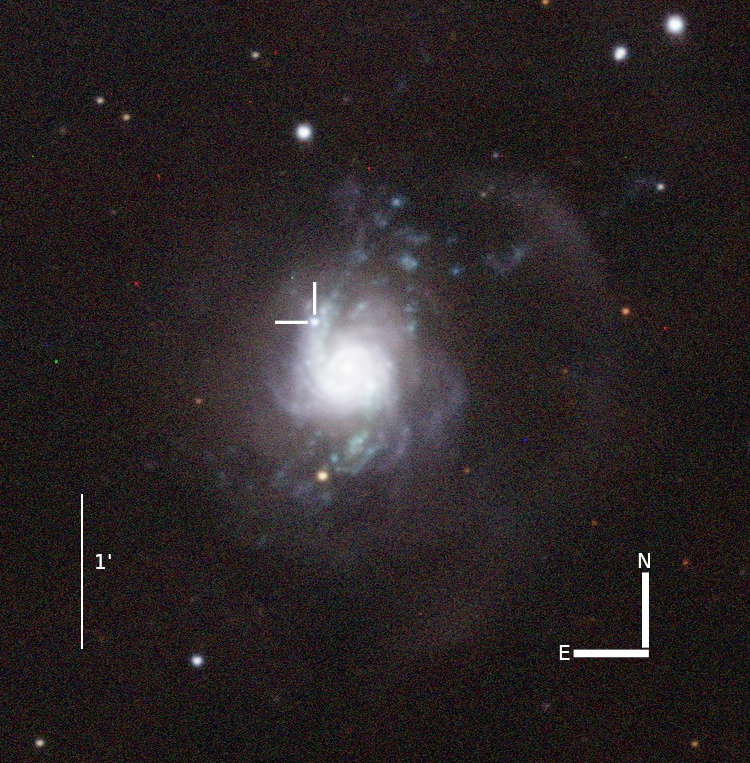
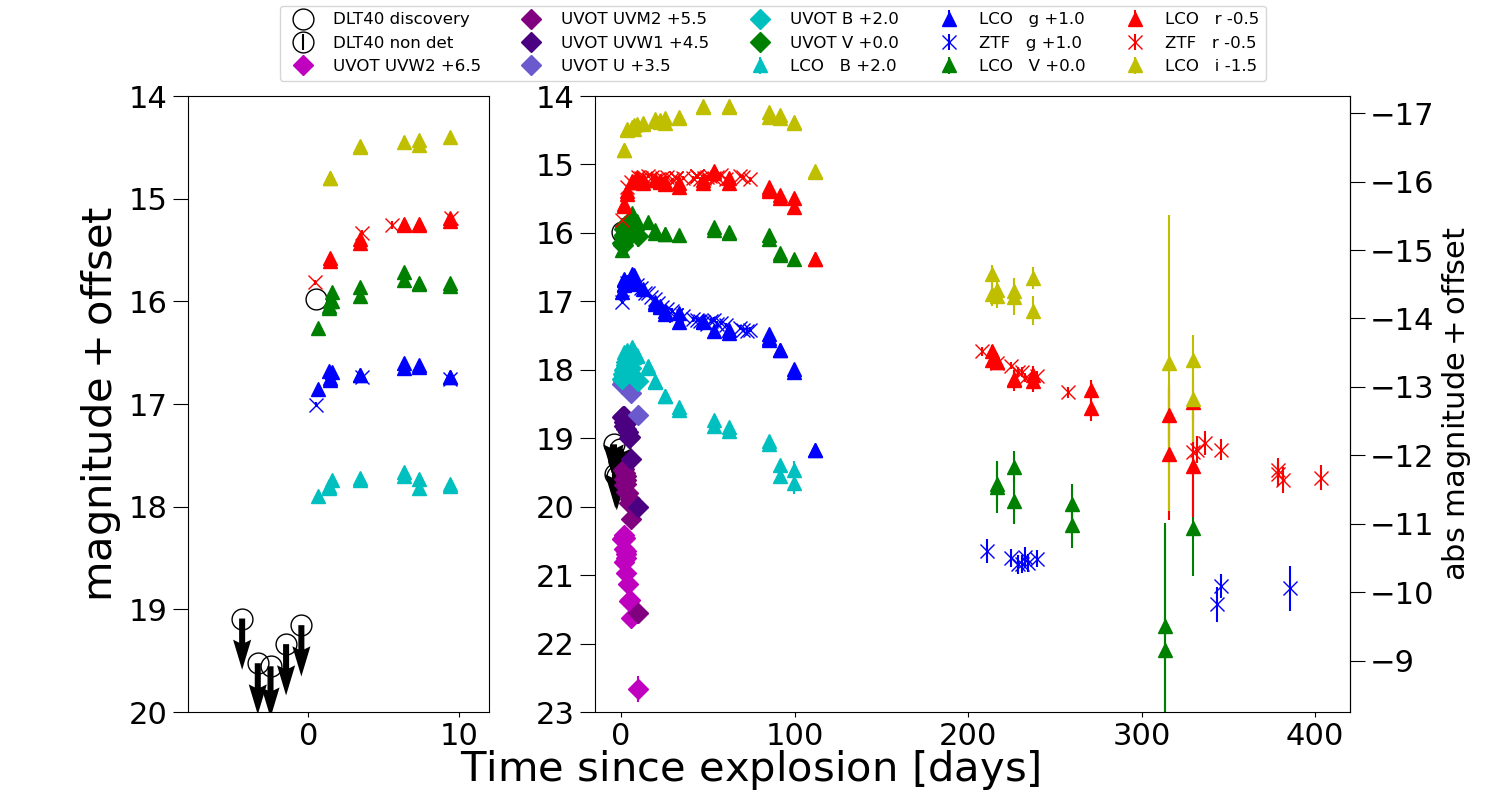
We present comprehensive optical observations of SN~2021gmj, a Type II supernova (SN~II) discovered within a day of explosion by the Distance Less Than 40~Mpc (DLT40) survey. Follow-up observations show that SN~2021gmj is a low-luminosity SN~II (LL~SN~II), with a peak magnitude $M_V = -15.45$ and Fe~II velocity of $\sim 1800 \ \mathrm{km} \ \mathrm{s}^{-1}$ at 50 days past explosion. Using the expanding photosphere method, we derive a distance of $17.8^{+0.6}_{-0.4}$~Mpc. From the tail of the light curve we obtain a radioactive nickel mass of $0.014 \pm 0.001$ M$_{\odot}$. The presence of circumstellar material (CSM) is suggested by the early-time light curve, early spectra, and high-velocity H$α$ in absorption. Analytical shock-cooling models of the light curve cannot reproduce the fast rise, supporting the idea that the early-time emission is partially powered by the interaction of the SN ejecta and CSM. The inferred low CSM mass of 0.025 M$_{\odot}$ in our hydrodynamic-modeling light curve analysis is also consistent with our spectroscopy. We observe a broad feature near 4600 Å, which may be high-ionization lines of C, N, or/and He~II. This feature is reproduced by radiation-hydrodynamic simulations of red supergiants with extended atmospheres. Several LL~SNe~II show similar spectral features, implying that high-density material around the progenitor may be common among them.
Motivation & Objective
- To characterize the photometric and spectroscopic evolution of the low-luminosity Type II supernova SN 2021gmj.
- To investigate the presence and properties of circumstellar material (CSM) around the progenitor star through light-curve and spectral analysis.
- To determine the progenitor mass, explosion energy, and 56Ni mass through hydrodynamic modeling and the expanding photosphere method.
- To explore whether high-ionization emission features in the spectrum are indicative of widespread CSM interaction in low-luminosity SNe II.
Proposed method
- Photometric light curves were collected from multiple observatories, including DLT40, Keck, MMT, and Las Cumbres Observatory, to model early shock-cooling and plateau phases.
- Spectroscopic data from LRIS, DEIMOS, Binospec, and FLOYDS instruments were used to identify high-ionization lines and measure velocity shifts.
- The expanding photosphere method was applied to derive a distance of 17.8⁺⁰.⁶₋₀.⁴ Mpc using V-band magnitude and photospheric temperature.
- Radioactive ⁵⁶Ni mass was estimated from the tail of the light curve, yielding M₅₆Ni = 0.014 ± 0.001 M☉.
- Hydrodynamic modeling with SNEC was used to fit the light curve, assuming a steady-state wind CSM, to infer CSM mass and explosion energy.
- Radiation hydrodynamic simulations of red supergiants with extended atmospheres were compared to the 4600 Å broad feature to interpret its origin.
Experimental results
Research questions
- RQ1What is the nature and mass of circumstellar material (CSM) surrounding the progenitor of SN 2021gmj?
- RQ2How does the early light curve of SN 2021gmj deviate from standard shock-cooling models, and what does this imply about energy sources?
- RQ3What causes the broad emission feature near 4600 Å, and is it consistent with high-ionization lines from C, N, or He II?
- RQ4Is the presence of CSM interaction signatures common among low-luminosity Type II supernovae?
- RQ5What are the progenitor mass and explosion energy of SN 2021gmj, and how do they compare to standard models?
Key findings
- SN 2021gmj has a peak V-band magnitude of MV = -15.45, classifying it as a low-luminosity Type II supernova.
- The 56Ni mass synthesized in the explosion is 0.014 ± 0.001 M☉, consistent with low-energy, moderate-mass progenitor models.
- The distance to SN 2021gmj is 17.8⁺⁰.⁶₋₀.⁴ Mpc, derived using the expanding photosphere method.
- Early light-curve modeling indicates a fast rise inconsistent with standard shock-cooling, supporting energy input from CSM interaction.
- Hydrodynamic modeling yields a CSM mass of 0.025 M☉ and explosion energy of 0.294 foe for a 10 M☉ progenitor.
- A broad feature near 4600 Å is identified as a probable blend of high-ionization lines (C, N, He II), consistent with radiation hydrodynamic simulations of extended red supergiants with CSM.
Read this paper
Open the full text in the Nubint reader and ask about any passage as you read.
Read this paper on NubintThis review was generated by AI from the original paper. Please check the paper before citing it.