
[Paper Review] Classical Shadows for Quantum Process Tomography on Near-term Quantum Computers
This paper introduces ShadowQPT, a classical shadow-based method for quantum process tomography on near-term quantum computers. By leveraging the Jamio´lkowski isomorphism and stochastic measurements, ShadowQPT enables efficient reconstruction of quantum channels with sample complexity scaling logarithmically in system size, achieving high-fidelity process estimation and overlap prediction using only a few hundred to a few thousand measurements on up to 4-qubit systems on IonQ hardware.
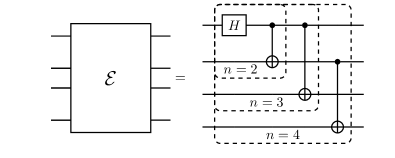
Quantum process tomography is a powerful tool for understanding quantum channels and characterizing properties of quantum devices. Inspired by recent advances using classical shadows in quantum state tomography [H.-Y. Huang, R. Kueng, and J. Preskill, Nat. Phys. 16, 1050 (2020).], we have developed ShadowQPT, a classical shadow method for quantum process tomography. We introduce two related formulations with and without ancilla qubits. ShadowQPT stochastically reconstructs the Choi matrix of the device allowing for an a-posteri classical evaluation of the device on arbitrary inputs with respect to arbitrary outputs. Using shadows we then show how to compute overlaps, generate all $k$-weight reduced processes, and perform reconstruction via Hamiltonian learning. These latter two tasks are efficient for large systems as the number of quantum measurements needed scales only logarithmically with the number of qubits. A number of additional approximations and improvements are developed including the use of a pair-factorized Clifford shadow and a series of post-processing techniques which significantly enhance the accuracy for recovering the quantum channel. We have implemented ShadowQPT using both Pauli and Clifford measurements on the IonQ trapped ion quantum computer for quantum processes up to $n=4$ qubits and achieved good performance.
Motivation & Objective
- To develop a scalable, efficient method for quantum process tomography on near-term quantum devices.
- To extend classical shadow techniques—previously used in quantum state tomography—to quantum process tomography via the Jamio´lkowski isomorphism.
- To enable a-posteriori evaluation of quantum channels on arbitrary inputs and outputs using minimal quantum measurements.
- To demonstrate practical implementation and performance on real quantum hardware, including IonQ trapped-ion systems.
- To enable efficient Hamiltonian learning with logarithmic scaling in system size using classical post-processing.
Proposed method
- Utilizes the Jamio´lkowski process-state isomorphism to map quantum processes to density matrices, enabling application of classical shadow techniques.
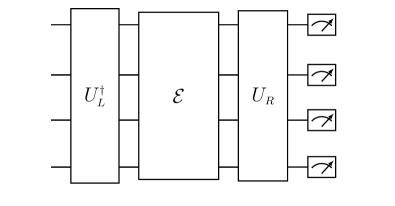
- Employs two formulations: an ancilla-based scheme and a two-sided unitary scheme, both enabling stochastic reconstruction of the Choi matrix.
- Applies random Pauli or Clifford measurements to generate classical shadows of the process, allowing prediction of multiple observables from a single set of measurements.
- Implements post-processing techniques including projection onto physical channels and output purification to enhance reconstruction accuracy.
- Uses a pair-factorized Clifford shadow to reduce circuit depth and improve performance on near-term devices.
- Employs multiple circuit repetitions and classical optimization to reduce statistical errors and improve fidelity.
Experimental results
Research questions
- RQ1Can classical shadow techniques be extended from quantum state tomography to quantum process tomography with minimal quantum resource overhead?
- RQ2What is the sample complexity scaling of process reconstruction and overlap prediction using classical shadows?
- RQ3How do different measurement schemes—Pauli vs. Clifford—perform in practice on near-term quantum hardware?
- RQ4Can post-processing techniques like purification and physical projection significantly improve the accuracy of reconstructed quantum channels?
- RQ5What is the optimal trade-off between systematic and statistical errors in Hamiltonian learning using ShadowQPT?
Key findings
- ShadowQPT achieves accurate process reconstruction and overlap prediction for up to 4-qubit systems on the IonQ trapped-ion platform with fewer than 10,000 measurements per process.
- The method enables a-posteriori evaluation of the channel on arbitrary input-output pairs with high fidelity, even for non-ideal or non-unitary processes.
- Post-processing with purification and physical projection reduces reconstruction errors by up to an order of magnitude compared to unprocessed shadows.
- Hamiltonian learning via ShadowQPT shows logarithmic scaling in system size, with sample complexity scaling as O(log N) for a given error threshold.
- The optimal error in Hamiltonian learning scales as O(1/ε³), achieved when systematic and statistical errors are balanced, outperforming fixed-time methods in total measurement cost.
- The ancilla-based ShadowQPT scheme with multiple repetitions outperforms the two-sided scheme in experimental benchmarks on IonQ hardware.
Read this paper
Open the full text in the Nubint reader and ask about any passage as you read.
Read this paper on NubintThis review was generated by AI from the original paper. Please check the paper before citing it.