
[Paper Review] Client Selection in Federated Learning: Principles, Challenges, and Opportunities
This paper provides a comprehensive survey of client selection in Federated Learning (FL), addressing system and data heterogeneity through principled algorithms that improve model accuracy, convergence speed, and fairness. It synthesizes recent advances, identifies key challenges, and outlines research opportunities for optimizing client selection in real-world FL deployments.
As a privacy-preserving paradigm for training Machine Learning (ML) models, Federated Learning (FL) has received tremendous attention from both industry and academia. In a typical FL scenario, clients exhibit significant heterogeneity in terms of data distribution and hardware configurations. Thus, randomly sampling clients in each training round may not fully exploit the local updates from heterogeneous clients, resulting in lower model accuracy, slower convergence rate, degraded fairness, etc. To tackle the FL client heterogeneity problem, various client selection algorithms have been developed, showing promising performance improvement. In this paper, we systematically present recent advances in the emerging field of FL client selection and its challenges and research opportunities. We hope to facilitate practitioners in choosing the most suitable client selection mechanisms for their applications, as well as inspire researchers and newcomers to better understand this exciting research topic.
Motivation & Objective
- Address the critical challenge of client heterogeneity in federated learning, where clients vary in data distribution and system capabilities.
- Systematically review existing client selection algorithms to identify design principles, performance trade-offs, and limitations.
- Highlight the lack of theoretical guarantees and standardized benchmarks in current client selection methods.
- Identify research gaps in fairness, robustness, and scalability, especially in large-scale and dynamic FL environments.
- Promote the development of standardized evaluation metrics and large-scale open testbeds for reproducible FL research.
Proposed method
- Categorize client selection algorithms based on their handling of system heterogeneity (e.g., computation, bandwidth) and data heterogeneity (e.g., non-IID data).
- Analyze 14 representative works from 2019–2023, focusing on explicit utility functions and scheduling decisions for client participation.
- Propose a framework to evaluate client selection based on utility functions that consider model contribution, update quality, and resource constraints.
- Introduce a classification of client selection strategies into greedy, bandit-based, reinforcement learning, and utility-optimized approaches.
- Emphasize the importance of joint consideration of data and system heterogeneity, as seen in methods like Oort and POWER-OF-CHOICE.
- Advocate for adaptive and dynamic selection mechanisms that account for client availability, update age, and communication efficiency.
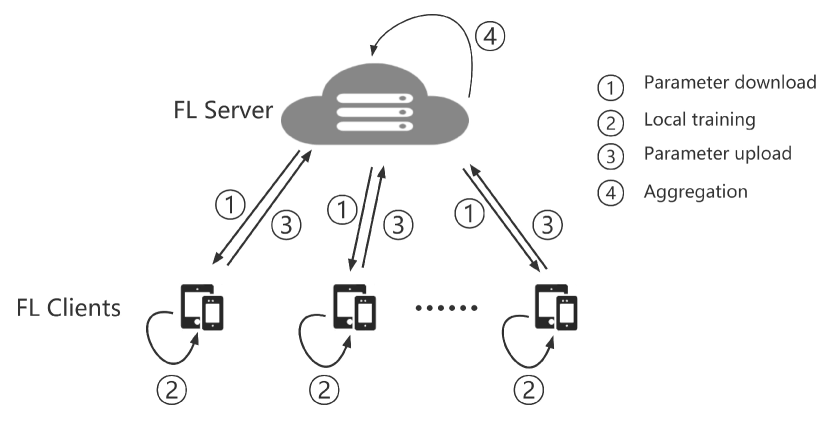
Experimental results
Research questions
- RQ1How do system and data heterogeneity in FL clients impact model convergence, accuracy, and fairness?
- RQ2What are the key design principles and performance trade-offs in existing client selection algorithms for FL?
- RQ3Why do many client selection methods lack theoretical guarantees, and how does this affect real-world deployment?
- RQ4What are the main limitations in current evaluation practices, including metrics and experimental settings?
- RQ5How can large-scale, open testbeds and standardized benchmarks improve reproducibility and fairness in client selection research?
Key findings
- Client selection significantly improves FL performance by mitigating the negative effects of data and system heterogeneity.
- Algorithms like Oort and POWER-OF-CHOICE achieve faster convergence by jointly modeling data and system heterogeneity.
- Many client selection methods are heuristic and lack theoretical guarantees for convergence rate, accuracy, or fairness.
- There is no consensus on optimal client selection criteria—some works favor clients with divergent models, while others prefer similar ones, depending on context.
- Existing evaluation metrics such as round-to-accuracy and time-to-accuracy are not comparable due to conflicting trade-offs with communication load and round duration.
- The community urgently needs large-scale, open FL testbeds to enable reproducible and fair benchmarking of client selection algorithms.
Read this paper
Open the full text in the Nubint reader and ask about any passage as you read.
Read this paper on NubintThis review was generated by AI from the original paper. Please check the paper before citing it.