
[Paper Review] Clinfo.ai: An Open-Source Retrieval-Augmented Large Language Model System for Answering Medical Questions using Scientific Literature
Clinfo.ai is an open-source, retrieval-augmented large language model system that answers clinical questions by dynamically retrieving and synthesizing relevant scientific literature. It outperforms other OpenQA systems on the PubMedRS-200 benchmark, achieving up to 14.9% higher UniEval overall scores, especially in TL;DR summarization, demonstrating robust and accurate medical question-answering capabilities without relying on source systematic reviews.
The quickly-expanding nature of published medical literature makes it challenging for clinicians and researchers to keep up with and summarize recent, relevant findings in a timely manner. While several closed-source summarization tools based on large language models (LLMs) now exist, rigorous and systematic evaluations of their outputs are lacking. Furthermore, there is a paucity of high-quality datasets and appropriate benchmark tasks with which to evaluate these tools. We address these issues with four contributions: we release Clinfo.ai, an open-source WebApp that answers clinical questions based on dynamically retrieved scientific literature; we specify an information retrieval and abstractive summarization task to evaluate the performance of such retrieval-augmented LLM systems; we release a dataset of 200 questions and corresponding answers derived from published systematic reviews, which we name PubMed Retrieval and Synthesis (PubMedRS-200); and report benchmark results for Clinfo.ai and other publicly available OpenQA systems on PubMedRS-200.
Motivation & Objective
- To address the challenge of clinicians and researchers struggling to keep up with the rapidly expanding medical literature, which exceeds 1 million papers annually in PubMed.
- To overcome the lack of high-quality datasets and standardized benchmark tasks for evaluating retrieval-augmented LLMs in clinical question-answering.
- To develop and release Clinfo.ai, an open-source, end-to-end system that retrieves relevant literature and generates abstractive summaries for clinical questions.
- To introduce PubMedRS-200, a dataset of 200 clinical questions with answers derived from systematic reviews, enabling reproducible evaluation of LLM-based systems.
- To provide a standardized evaluation framework combining information retrieval and abstractive summarization tasks, with both gold-standard and source-free metrics.
Proposed method
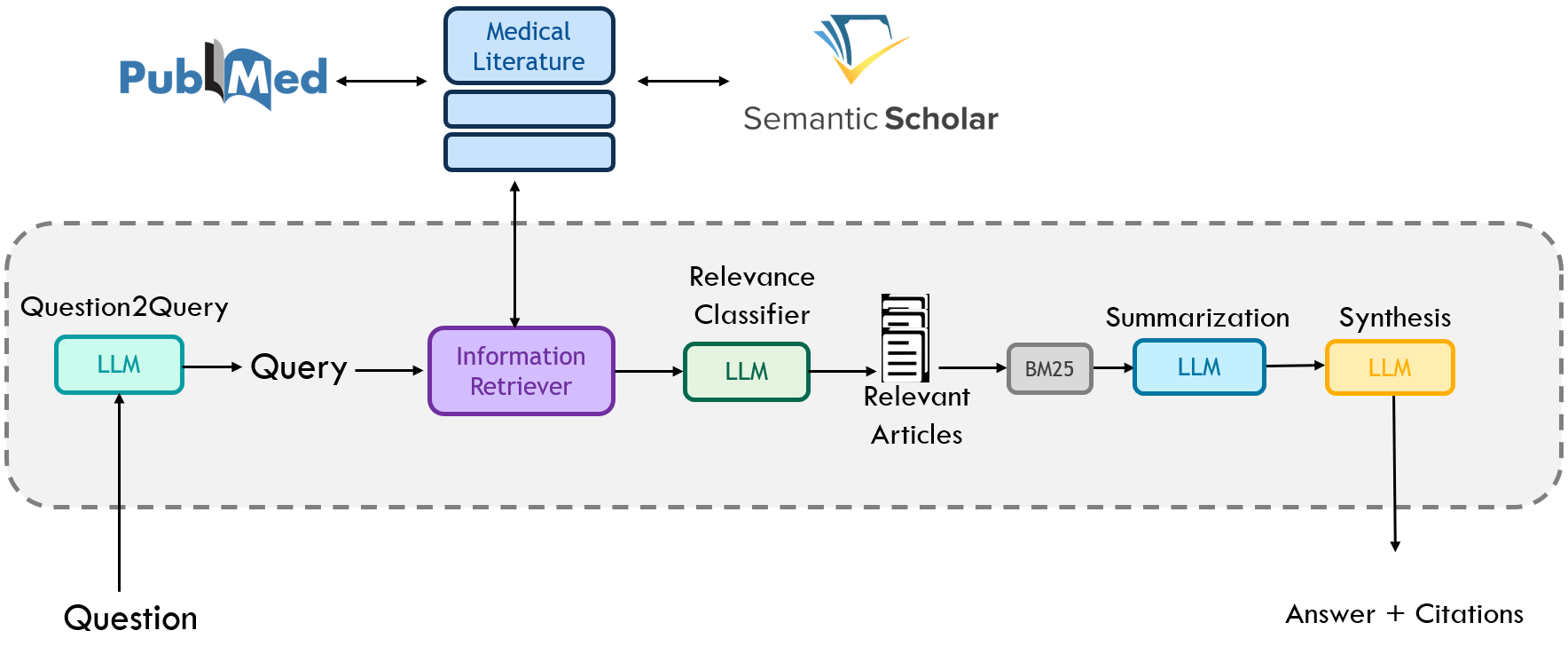
- Clinfo.ai employs a retrieval-augmented generation (RAG) pipeline that first retrieves relevant PubMed articles using LLM-generated queries.
- It uses a fine-tuned LLM to generate concise, abstractive summaries (TL;DR) and more detailed syntheses from the retrieved literature.
- The system is evaluated using a dual-task benchmark: information retrieval and abstractive summarization, both compared to human-generated gold standards.
- The evaluation includes multiple regimes: unrestricted, restricted, and source-free search, to simulate real-world deployment conditions.
- Automated metrics such as UniEval, BERTScore, ROUGE-L, METEOR, and CTC are used to assess summary quality and relevance.
- The PubMedRS-200 dataset is constructed from 200 questions extracted from published systematic reviews, with answers and references curated for accuracy and representativeness.

Experimental results
Research questions
- RQ1Can a retrieval-augmented LLM system like Clinfo.ai outperform existing closed-source tools in answering clinical questions using scientific literature?
- RQ2How does the performance of Clinfo.ai vary across different evaluation regimes, including unrestricted, restricted, and source-free search conditions?
- RQ3To what extent does Clinfo.ai’s performance depend on access to the source systematic review, and can it still generate high-quality summaries without it?
- RQ4How well do automated evaluation metrics correlate with human preferences in the context of medical question-answering and summarization?
- RQ5What role does the TL;DR (too long; didn’t read) summary format play in improving model performance compared to full abstractive synthesis?
Key findings
- Clinfo.ai achieved up to 14.9% higher UniEval overall score compared to other systems, demonstrating superior performance in retrieval-augmented question answering.
- The TL;DR summarization mode of Clinfo.ai significantly outperformed both full synthesis and combined synthesis+TL;DR modes, even when using the same retrieved articles.
- Even without access to the source systematic review, Clinfo.ai produced summaries that were more aligned with the gold-standard conclusions than those from other systems.
- The system maintained consistent performance across different output lengths, with improvements observed in both shorter (TL;DR) and longer (Synthesis) outputs.
- Evaluation under the unrestricted search regime yielded the best performance, as the source systematic review was retrieved in 96.5% of cases.
- Discrepancies in metric rankings—e.g., Elicit outperforming Clinfo.ai on BERTScore and ROUGE-L, but Clinfo.ai excelling on METEOR and CTC (SF)—highlight the limitations of automated metrics and the need for multi-metric evaluation.
Read this paper
Open the full text in the Nubint reader and ask about any passage as you read.
Read this paper on NubintThis review was generated by AI from the original paper. Please check the paper before citing it.