
[Paper Review] Colour-Flavour Locked Quark Stars in Light of the Compact Object in HESS J1731-347 and the GW190814 Event
This paper investigates whether colour-flavour-locked (CFL) quark stars can explain the compact object in HESS J1731-347 and the secondary companion in GW190814. Using a flavour-independent MIT bag model with perturbative QCD corrections, it shows that CFL quark stars with a quartic coefficient $\alpha_4 \leq 0.594$ can achieve $M_{\text{TOV}} \geq 2.6\,M_\odot$ without violating the conformal bound or positive trace anomaly, favoring $w \geq 0$ parameter space.
The central compact object within HESS J1731- 347 possesses unique mass and radius properties that renders it a compelling candidate for a self-bound star. In this research, we examine the capability of quark stars composed of colour superconducting quark matter to explain the latter object by using its marginalised posterior distribution and imposing it as a constraint on the relevant parameter space. Namely, we investigate quark matter for $N_f=2,3$ in the colour superconducting phase, incorporating perturbative QCD corrections, and we derive their properties accordingly. The utilised thermodynamic potential of this work possesses an MIT bag model formalism with the parameters being established as flavour-independent. In this instance, we conclude the favour of 3-flavour over 2-flavour colour superconducting quark matter, isolating our interest on the former. The parameter space is further confined due to the additional requirement for a high maximum mass ($M_{ ext{TOV}} \geq 2.6 M_{\odot}$), accounting for GW$190814$'s secondary companion. We pay a significant attention on the speed of sound and the trace anomaly (proposed as a measure of conformality [\href{https://journals.aps.org/prl/abstract/10.1103/PhysRevLett.129.252702}{10.1103/PhysRevLett.129.252702}]). We conclude that it is possible for colour-flavour locked quark stars to reach high masses without violating the conformal bound or the $\langle Θ angle _{μ_B} \geq 0$ if the quartic coefficient value $α_4$ does not exceed an upper limit which is solely dependent on the established $M_{ ext{TOV}}$. For $M_{ ext{TOV}}=2.6 M_{\odot}$, we find that the limit reads $α_4 \leq 0.594$. Lastly, a further study takes place on the agreement of colour-flavour locked quark stars with additional astrophysical objects including the GW$170817$ and GW$190425$ events, followed by a relevant discussion.
Motivation & Objective
- To assess whether colour-flavour-locked (CFL) quark stars can explain the mass and radius of the central compact object in HESS J1731-347.
- To constrain the parameter space of CFL quark matter using the marginalised posterior distribution of the HESS J1731-347 object.
- To ensure compatibility with the high mass ($\geq 2.6\,M_\odot$) secondary companion observed in GW190814.
- To examine the behavior of the speed of sound and trace anomaly as indicators of conformality and EoS stiffness.
- To evaluate consistency with additional gravitational wave events, including GW170817 and GW190425.
Proposed method
- Employing a thermodynamic potential within the MIT bag model formalism with flavour- and density-independent parameters.
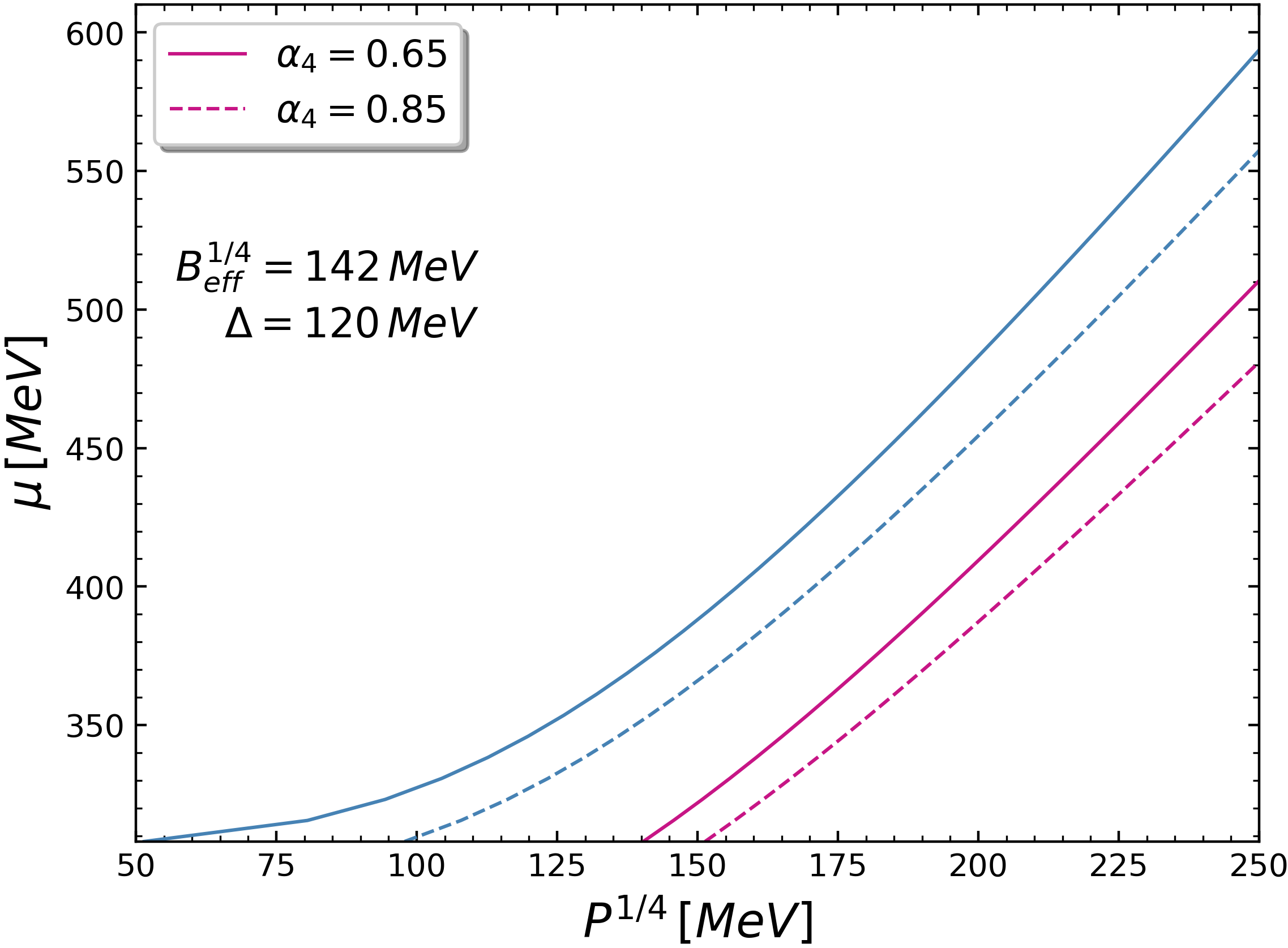
- Incorporating perturbative QCD corrections to model the equation of state (EoS) of CFL quark matter for $N_f = 2,3$.
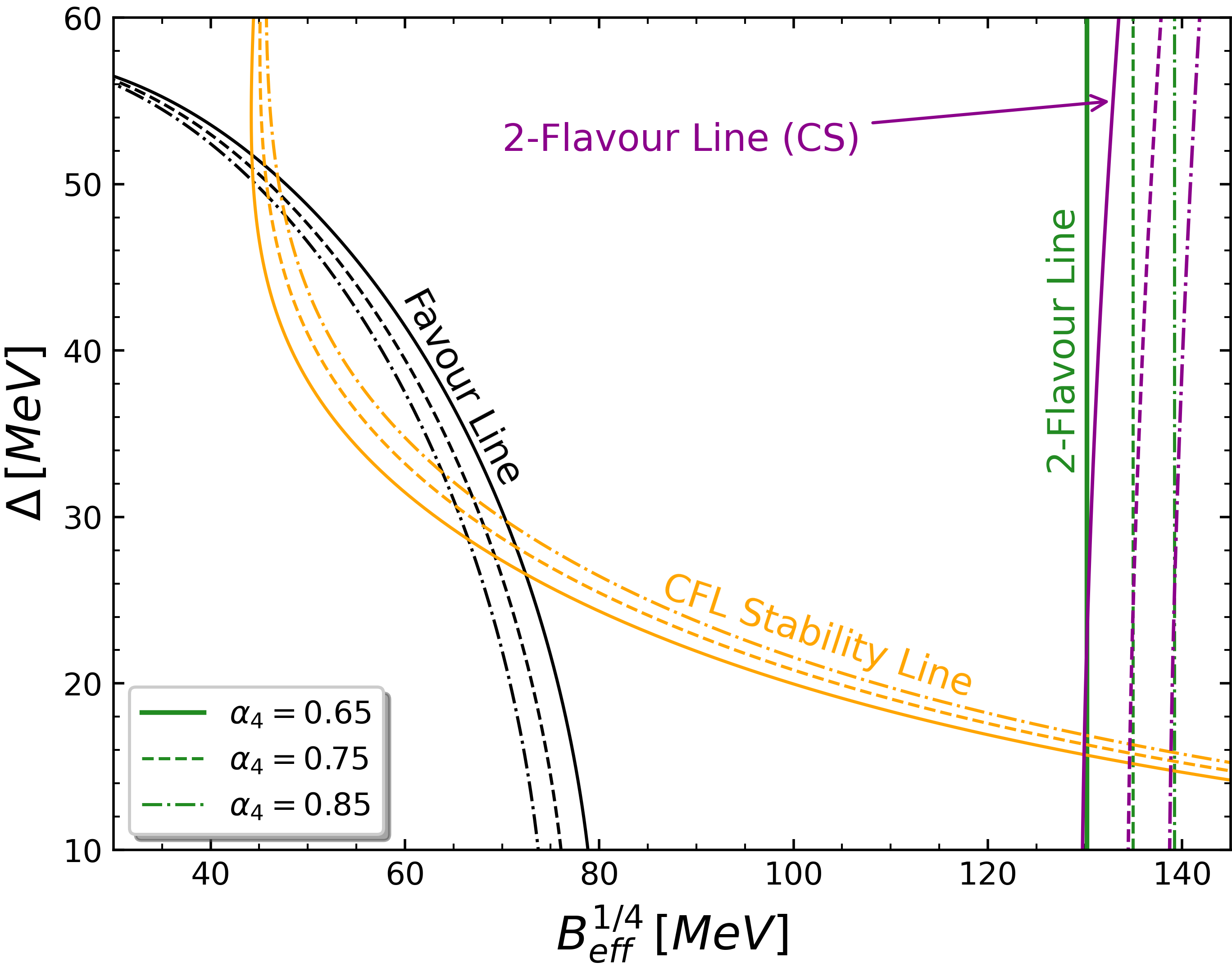
- Using the marginalised posterior distribution of HESS J1731-347’s mass and radius as a constraint on the $\Delta$-$B_{\text{eff}}^{1/4}$ parameter space.
- Imposing a $M_{\text{TOV}} \geq 2.6\,M_0$ requirement to match GW190814’s secondary companion mass.
- Analyzing the speed of sound and normalised trace anomaly $\langle\Theta\rangle_{\mu_B}$ as probes of conformality and EoS stiffness.
- Comparing predicted tidal deformabilities with observational constraints from GW170817, GW190425, and GW190814.
Experimental results
Research questions
- RQ1Can CFL quark stars with $M_{\text{TOV}} \geq 2.6\,M_\odot$ explain the compact object in HESS J1731-347?
- RQ2What constraints does the HESS J1731-347 posterior distribution place on the $\Delta$-$B_{\text{eff}}^{1/4}$ parameter space of CFL quark matter?
- RQ3Does the EoS of CFL quark matter remain compatible with the conformal bound and $\langle\Theta\rangle_{\mu_B} \geq 0$ under high-mass constraints?
- RQ4How does the sign of the parameter $w$ (related to $a_2$) affect the viability of the EoS in explaining astrophysical observations?
- RQ5Can CFL quark stars with $w \geq 0$ reproduce tidal deformability constraints from GW170817 and GW190425?
Key findings
- For $M_{\text{TOV}} = 2.6\,M_\odot$, the quartic coefficient must satisfy $\alpha_4 \leq 0.594$ to avoid violating the conformal bound or the positive trace anomaly condition.
- The $w \geq 0$ parameter space avoids violations of the conformal limit and positive trace anomaly, making it more viable than $w < 0$ for high-mass CFL quark stars.
- For $M_{\text{TOV}} \geq 2.5\,M_\odot$, the upper bound on $\alpha_4$ increases to $0.643$, bringing it closer to the expected value of $\approx 0.65$.
- The softest equation of state in the $w \geq 0$ space yields a tidal deformability of $\Lambda_{2.6} = 22.11$ for a $2.6\,M_\odot$ star.
- In contrast, the softest EoS in the $w < 0$ space yields $\Lambda_{2.6} = 5.96$, which lies within the GW190814 constraint window of $4.6 < \Lambda_{2.6} < 26.3$.
- The study finds that $w \geq 0$ is favored not only for avoiding theoretical violations but also due to consistency with surface temperature estimates and low $B_{\text{eff}}$ values for CFL phase stability.
Read this paper
Open the full text in the Nubint reader and ask about any passage as you read.
Read this paper on NubintThis review was generated by AI from the original paper. Please check the paper before citing it.