
[Paper Review] Comparing the statistics of interstellar turbulence in simulations and observations: Solenoidal versus compressive turbulence forcing
This study compares solenoidal and compressive turbulence forcing in hydrodynamic simulations of the interstellar medium, finding that compressive forcing produces significantly denser structures with three times higher density PDF standard deviation than solenoidal forcing. Observational comparisons reveal region-dependent forcing mixtures, with compressive modes dominant in shell-like structures, and suggest the sonic scale as a key scale for protostellar core formation due to subsonic core velocity dispersions.
We study two limiting cases of turbulence forcing in numerical experiments: solenoidal (divergence-free) forcing, and compressive (curl-free) forcing, and compare our results to observations reported in the literature. We solve the equations of hydrodynamics on grids with up to 1024^3 cells for purely solenoidal and purely compressive forcing. Eleven lower-resolution models with mixtures of both forcings are also analysed. We find velocity dispersion--size relations consistent with observations and independent numerical simulations, irrespective of the type of forcing. However, compressive forcing yields stronger turbulent compression at the same RMS Mach number than solenoidal forcing, resulting in a three times larger standard deviation of volumetric and column density probability distributions (PDFs). We conclude that the strong dependence of the density PDF on the type of forcing must be taken into account in any theory using the PDF to predict properties of star formation. We supply a quantitative description of this dependence. We find that different observed regions show evidence of different mixtures of compressive and solenoidal forcing, with more compressive forcing occurring primarily in swept-up shells.
Motivation & Objective
- To determine how different turbulence forcing mechanisms—solenoidal (divergence-free) vs. compressive (curl-free)—affect the statistical properties of interstellar turbulence.
- To compare simulation results with observational data from molecular clouds such as Perseus, Polaris Flare, G216-2.5, and Rosette MC.
- To quantify the impact of forcing type on density probability distribution functions (PDFs), velocity dispersion–size relations, and fractal structures.
- To assess the role of the sonic scale in regulating protostellar core formation through velocity dispersion transitions.
- To provide a quantitative framework for incorporating forcing-type dependence into star formation models.
Proposed method
- Numerical simulations of supersonic isothermal hydrodynamics using grids up to 1024³ cells with purely solenoidal and purely compressive forcing.
- Analysis of Fourier spectra and Δ-variance to characterize velocity and density fluctuations across scales.
- Comparison of simulated velocity dispersion–size relations and density PDFs with observational data from Perseus MC, Polaris Flare, G216-2.5, and Rosette MC.
- Use of principal component analysis to compare simulated turbulence structure with observed column density maps.
- Integration of velocity power spectra to define the sonic scale and assess its role in core formation.
- Quantification of local Mach number–density correlations to assess turbulence behavior in dense regions.
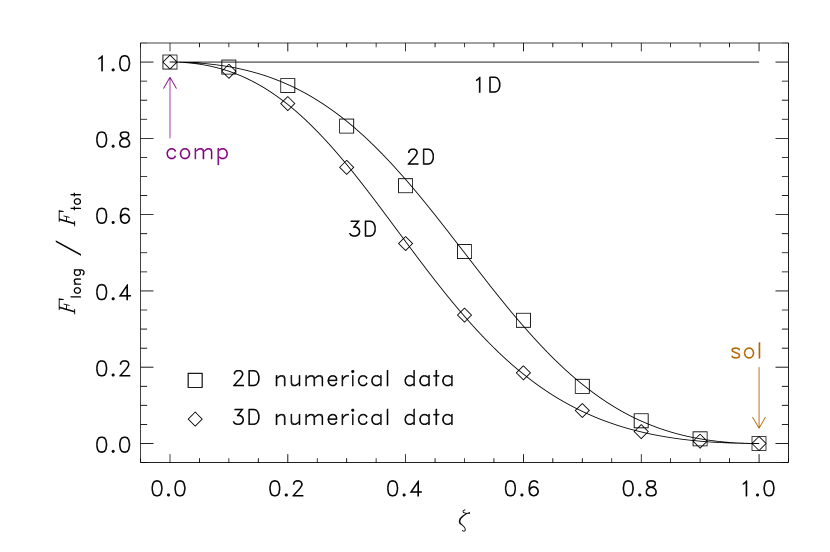
Experimental results
Research questions
- RQ1How do solenoidal and compressive turbulence forcing differ in their impact on the shape and width of the density PDF?
- RQ2To what extent do observed velocity dispersion–size relations and Δ-variance spectra match those from simulations with different forcing types?
- RQ3What evidence exists in observed molecular clouds for a mixture of solenoidal and compressive forcing, and where is compressive forcing dominant?
- RQ4How does the sonic scale influence the transition from supersonic to subsonic velocity dispersions in dense gas, and what does this imply for core formation?
- RQ5Why do protostellar cores exhibit subsonic internal velocity dispersions, and can this be explained by turbulence at the sonic scale?
Key findings
- Compressive forcing produces a density PDF with roughly three times the standard deviation compared to solenoidal forcing at the same RMS Mach number.
- Velocity dispersion–size relations in simulations match observations and independent numerical studies, regardless of forcing type.
- Column density PDFs in the Perseus MC show non-Gaussian skewness and kurtosis consistent with compressive forcing, likely driven by a massive star's ionization front.
- Δ-variance analysis of the Polaris Flare indicates large-scale compressive forcing, though intermediate-scale centroid velocity increments align with solenoidal forcing.
- Principal component analysis of G216-2.5 and most of the Rosette MC supports solenoidal forcing, but the ionized shell interior shows clear compressive signatures.
- The sonic scale marks a transition in density fluctuation spectra and correlates with the observed subsonic velocity dispersions of protostellar cores, suggesting core formation occurs near this scale.

Read this paper
Open the full text in the Nubint reader and ask about any passage as you read.
Read this paper on NubintThis review was generated by AI from the original paper. Please check the paper before citing it.