
[Paper Review] Comparing the willingness to share for human-generated vs. AI-generated fake news
This pre-registered online experiment with 988 participants compares sharing behavior toward human-generated vs. AI-generated fake news using GPT-4–created and human-written COVID-19 misinformation. Despite perceiving AI-generated fake news as less accurate, participants showed no significant difference in willingness to share, highlighting a critical risk for viral spread. Socioeconomic factors like political orientation and cognitive reflection scores further predicted susceptibility to AI-generated disinformation.
Generative artificial intelligence (AI) presents large risks for society when it is used to create fake news. A crucial factor for fake news to go viral on social media is that users share such content. Here, we aim to shed light on the sharing behavior of users across human-generated vs. AI-generated fake news. Specifically, we study: (1) What is the perceived veracity of human-generated fake news vs. AI-generated fake news? (2) What is the user's willingness to share human-generated fake news vs. AI-generated fake news on social media? (3) What socio-economic characteristics let users fall for AI-generated fake news? To this end, we conducted a pre-registered, online experiment with $N=$ 988 subjects and 20 fake news from the COVID-19 pandemic generated by GPT-4 vs. humans. Our findings show that AI-generated fake news is perceived as less accurate than human-generated fake news, but both tend to be shared equally. Further, several socio-economic factors explain who falls for AI-generated fake news.
Motivation & Objective
- To investigate how users perceive the veracity of human-generated versus AI-generated fake news.
- To examine whether users differ in their willingness to share human-generated versus AI-generated fake news.
- To identify socio-economic characteristics that predict susceptibility to AI-generated fake news.
- To inform evidence-based strategies for mitigating the risks of AI-generated disinformation in social media.
Proposed method
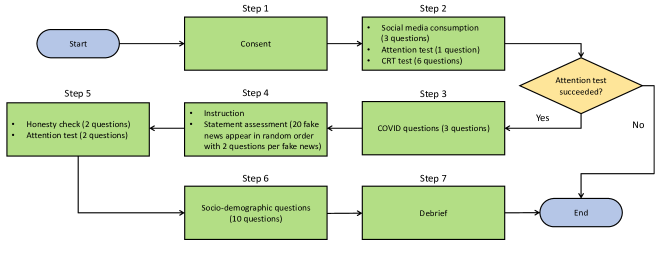
- Conducted a pre-registered, online experiment with 988 participants from diverse backgrounds.
- Presented participants with 20 fake news items—10 human-written and 10 GPT-4-generated—on COVID-19 topics.
- Measured perceived veracity using a 7-point scale and willingness to share using a 7-point Likert scale.
- Collected demographic and socio-economic data, including age, political orientation, and cognitive reflection test scores.
- Used multivariate regression models to analyze the impact of individual characteristics on susceptibility to AI-generated fake news.
- Controlled for confounding variables and ensured ethical standards by measuring willingness to share, not actual sharing behavior.
Experimental results
Research questions
- RQ1What is the perceived veracity of human-generated fake news versus AI-generated fake news?
- RQ2What is the willingness to share of human-generated fake news versus AI-generated fake news?
- RQ3Which socio-economic characteristics explain why some users fall for AI-generated fake news?
- RQ4How do perceived accuracy and sharing behavior correlate in the context of AI-generated disinformation?
Key findings
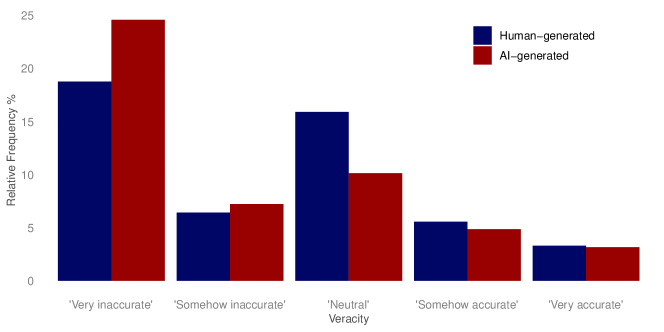
- AI-generated fake news was perceived as significantly less accurate than human-generated fake news, with a mean perceived veracity score of 3.8 compared to 4.5 for human-generated content.
- Despite lower perceived accuracy, there was no statistically significant difference in willingness to share between AI-generated and human-generated fake news.
- Participants who identified as conservative were significantly more likely to fall for AI-generated fake news, indicating political orientation as a key predictor.
- Lower cognitive reflection test scores were associated with higher susceptibility to AI-generated fake news, suggesting reduced critical thinking increases vulnerability.
- The correlation between perceived veracity and willingness to share was weak, indicating that belief in accuracy does not strongly predict sharing behavior.
- Age and education level also showed significant but nuanced relationships with susceptibility, with younger users and those with lower education being more vulnerable.
Read this paper
Open the full text in the Nubint reader and ask about any passage as you read.
Read this paper on NubintThis review was generated by AI from the original paper. Please check the paper before citing it.