
[Paper Review] Conclusive evidence for a population of water-worlds around M-dwarfs remains elusive
This study demonstrates that mass-radius relations for sub-Neptunes with rocky cores and H/He atmospheres are degenerate with those of water-worlds (1:1 silicate-to-ice ratio), making it impossible to distinguish composition from radius and mass alone. The authors conclude that conclusive evidence for a distinct population of water-worlds around M-dwarfs remains elusive due to this degeneracy and the strong influence of atmospheric escape processes on observed demographics.
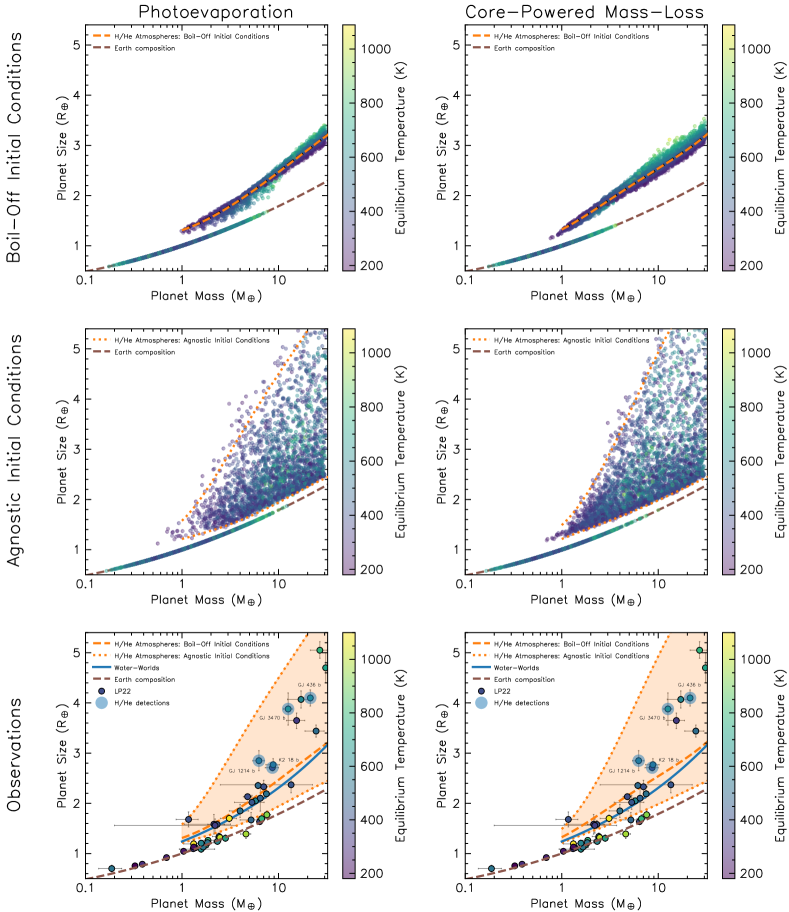
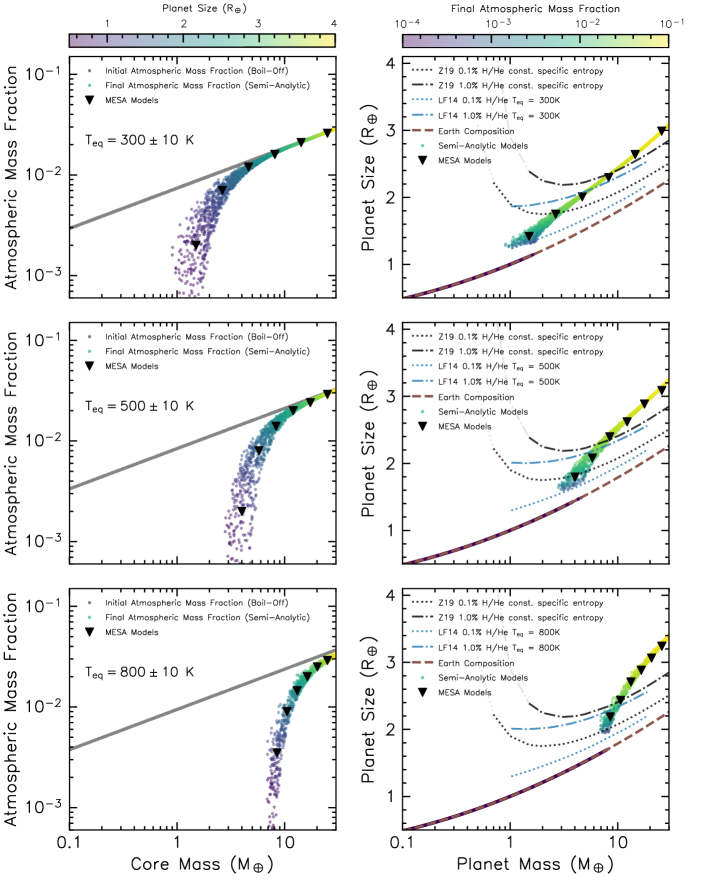
The population of small, close-in exoplanets is bifurcated into super-Earths and sub-Neptunes. We calculate physically motivated mass-radius relations for sub-Neptunes, with rocky cores and H/He dominated atmospheres, accounting for their thermal evolution, irradiation and mass-loss. For planets $\lesssim 10~$M$_\oplus$, we find that sub-Neptunes retain atmospheric mass fractions that scale with planet mass and show that the resulting mass-radius relations are degenerate with results for `water-worlds' consisting of a 1:1 silicate-to-ice composition ratio. We further demonstrate that our derived mass-radius relation is in excellent agreement with the observed exoplanet population orbiting M-dwarfs and that planet mass and radii alone are insufficient to determine the composition of some sub-Neptunes. Finally, we highlight that current exoplanet demographics show an increase in the ratio of super-Earths to sub-Neptunes with both stellar mass (and therefore luminosity) and age, which are both indicative of thermally driven atmospheric escape processes. Therefore, such processes should not be ignored when making compositional inferences in the mass-radius diagram.
Motivation & Objective
- To assess whether observed sub-Neptunes around M-dwarfs are best explained by H/He-atmosphere planets or water-worlds with 1:1 silicate-to-ice composition.
- To evaluate the degeneracy between mass-radius relations of H/He-dominated sub-Neptunes and water-worlds under physical models.
- To determine whether current exoplanet demographics support atmospheric escape as a driver of the super-Earth/sub-Neptune bifurcation.
- To examine whether observed trends in super-Earth/sub-Neptune ratios with stellar mass and age are consistent with thermal escape models.
- To assess the feasibility of distinguishing water-worlds from H/He-dominated planets using only mass and radius measurements.
Proposed method
- Developed physically motivated mass-radius relations for sub-Neptunes with rocky cores and H/He atmospheres, incorporating thermal evolution, irradiation, and mass-loss.
- Calculated atmospheric mass fractions as a function of planet mass, showing scaling consistent with observed sub-Neptune radii.
- Compared derived mass-radius relations with observed exoplanet populations around M-dwarfs to test agreement.
- Assessed degeneracy between H/He-atmosphere models and 1:1 silicate-ice water-world models using synthetic mass-radius diagrams.
- Analyzed occurrence rate trends from Petigura et al. (2022) to examine the dependence of super-Earth/sub-Neptune ratios on stellar mass and age.
- Evaluated the role of XUV photoevaporation and core-powered mass-loss in shaping the observed radius gap and population bifurcation.
Experimental results
Research questions
- RQ1Can mass and radius alone distinguish between H/He-atmosphere sub-Neptunes and 1:1 silicate-to-ice water-worlds?
- RQ2To what extent are the observed mass-radius relations of sub-Neptunes around M-dwarfs consistent with physical models of H/He-atmosphere evolution?
- RQ3Does the observed increase in the super-Earth/sub-Neptune ratio with stellar mass and age support thermally driven atmospheric escape as the dominant evolutionary mechanism?
- RQ4What constraints does the observed radius gap place on the allowed compositional spread in water-rich planets?
- RQ5Can current observational data rule out a significant population of water-worlds with 1:1 silicate-to-ice ratios around M-dwarfs?
Key findings
- Mass-radius relations for H/He-atmosphere sub-Neptunes with masses ≤10 M⊕ are degenerate with those of 1:1 silicate-to-ice water-worlds.
- The derived mass-radius relation for H/He-dominated sub-Neptunes shows excellent agreement with the observed exoplanet population around M-dwarfs.
- Planet mass and radius alone are insufficient to determine the composition of sub-Neptunes due to the degeneracy with water-world models.
- The observed increase in the super-Earth/sub-Neptune ratio with stellar mass and age is consistent with thermally driven atmospheric escape processes.
- Current exoplanet demographics do not provide conclusive evidence for a distinct population of water-worlds with 1:1 silicate-to-ice ratios.
- The lack of planets in the radius gap constrains the allowed compositional spread, but does not rule out water-worlds if their water mass fraction is tightly constrained.
Read this paper
Open the full text in the Nubint reader and ask about any passage as you read.
Read this paper on NubintThis review was generated by AI from the original paper. Please check the paper before citing it.