
[Paper Review] Constraining cosmology with the Gaia-unWISE Quasar Catalog and CMB lensing: structure growth
This study uses the Gaia–unWISE Quasar Catalog (Quaia) and cross-correlations with Planck CMB lensing maps to constrain cosmological parameters, measuring σ₈ = 0.766 ± 0.034 and Ωₘ = 0.343⁺⁰.⁰¹⁷₋₀.⁰¹⁹. The results are consistent with Planck at ~1.4σ, with a slightly lower σ₈ driven by high-redshift quasars, possibly due to CIB foreground contamination in the CMB lensing map.
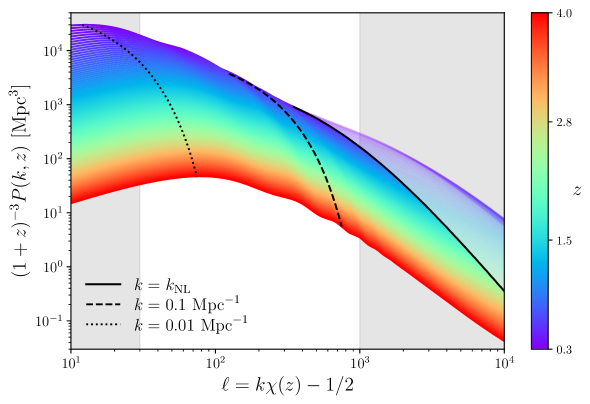
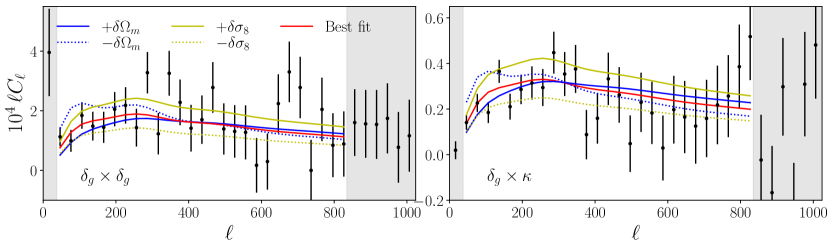
We study the angular clustering of Quaia, a Gaia- and unWISE-based catalog of over a million quasars with an exceptionally well-defined selection function. With it, we derive cosmology constraints from the amplitude and growth of structure across cosmic time. We divide the sample into two redshift bins, centered at $z=1.0$ and $z=2.1$, and measure both overdensity auto-correlations and cross-correlations with maps of the Cosmic Microwave Background convergence measured by Planck. From these data, and including a prior from measurements of the baryon acoustic oscillations scale, we place constraints on the amplitude of the matter power spectrum $σ_8=0.766\pm 0.034$, and on the matter density parameter $Ω_m=0.343^{+0.017}_{-0.019}$. These measurements are in reasonable agreement with \planck at the $\sim$ 1.4$σ$ level, and are found to be robust with respect to observational and theoretical uncertainties. We find that our slightly lower value of $σ_8$ is driven by the higher-redshift sample, which favours a low amplitude of matter fluctuations. We present plausible arguments showing that this could be driven by contamination of the CMB lensing map by high-redshift extragalactic foregrounds, which should also affect other cross-correlations with tracers of large-scale structure beyond $z\sim1.5$. Our constraints are competitive with those from state-of-the-art 3$ imes$2-point analyses, but arise from a range of scales and redshifts that is highly complementary to those covered by cosmic shear data and most galaxy clustering samples. This, coupled with the unprecedented combination of volume and redshift precision achieved by Quaia allows us to break the usual degeneracy between $Ω_m$ and $σ_8$.
Motivation & Objective
- To constrain cosmological parameters using the angular clustering of quasars from the Quaia catalog across cosmic time.
- To test the robustness of cosmological constraints derived from cross-correlations between quasars and CMB lensing maps.
- To investigate potential systematics, particularly foreground contamination in CMB lensing maps, affecting high-redshift quasar cross-correlations.
- To break the degeneracy between Ωₘ and σ₈ using a high-redshift, high-volume quasar sample with precise redshift calibration.
Proposed method
- The Quaia catalog, containing over a million quasars with a well-defined selection function, is divided into two redshift bins centered at z = 1.0 and z = 2.1.
- Overdensity auto-correlations and cross-correlations with Planck CMB lensing convergence maps (κ) are measured across multiple angular scales.
- Cosmological constraints are derived using a joint likelihood analysis that includes baryon acoustic oscillation (BAO) scale priors.
- A data-driven null model and Monte Carlo simulations with PR3 and PR4 CMB lensing reconstruction maps (MV, Pol, TT) are used to test for systematic biases.
- Bandpower shifts between different lensing reconstruction methods (e.g., MV vs. Pol) are evaluated via χ² tests to assess consistency with statistical fluctuations.
- The analysis accounts for lensing normalization corrections and uses constrained Gaussian realizations of quasar overdensity maps to model signal and noise components.
Experimental results
Research questions
- RQ1Does the cross-correlation between high-redshift quasars and CMB lensing provide robust constraints on σ₈ and Ωₘ?
- RQ2Is the observed tension between the derived σ₈ and Planck’s value driven by systematics in the CMB lensing map?
- RQ3Can the Quaia catalog break the degeneracy between Ωₘ and σ₈ due to its high redshift precision and large volume?
- RQ4To what extent do extragalactic foregrounds, particularly the cosmic infrared background (CIB), affect the quasar–CMB lensing cross-correlation at z > 1.5?
- RQ5Are the observed bandpower differences between CMB lensing reconstructions (e.g., MV vs. Pol) consistent with statistical fluctuations or indicative of residual systematics?
Key findings
- The analysis yields σ₈ = 0.766 ± 0.034 and Ωₘ = 0.343⁺⁰.⁰¹⁷₋₀.⁰¹⁹, which are in reasonable agreement with Planck at approximately 1.4σ.
- The slightly lower σ₈ value is primarily driven by the high-redshift quasar sample at z ≈ 2.1, which favors a lower amplitude of matter fluctuations.
- A consistency test using PR3 and PR4 CMB lensing maps shows a PTE of 6% for the full χ² test, indicating mild tension but not strong evidence against statistical fluctuations.
- The bin at ℓ ≈ 100 and ℓ ≈ 370 shows PTEs of ~2%, suggesting possible inconsistencies that may point to residual systematics.
- The observed bandpower shifts between MV and Pol lensing reconstructions are consistent with statistical fluctuations, but the CIB is identified as the most likely foreground contaminant affecting high-redshift quasar–CMB lensing cross-correlations.
- The results are robust against observational and theoretical uncertainties, and the Quaia sample provides a highly complementary probe to cosmic shear and galaxy clustering in 3×2-point analyses.
Read this paper
Open the full text in the Nubint reader and ask about any passage as you read.
Read this paper on NubintThis review was generated by AI from the original paper. Please check the paper before citing it.