
[Paper Review] Constraints on the velocity of gravitational waves from NANOGrav 15-year data set
This paper constrains the speed of gravitational waves using the NANOGrav 15-year pulsar timing array data by analyzing deviations in the overlap reduction function (ORF) of the stochastic gravitational-wave background (SGWB). It finds a robust lower bound of $ v \gtrsim 0.87c $, indicating strong consistency with general relativity’s prediction of light-speed propagation, while the posterior flattens for superluminal velocities, limiting constraints in that regime.
General relativity predicts that gravitational waves propagate at the speed of light. Although ground-based gravitational-wave detectors have successfully constrained the velocity of gravitational waves in the high-frequency range, extending this constraint to the lower frequency range remains a challenge. In this work, we utilize the deviations in the overlap reduction function for a gravitational-wave background within pulsar timing arrays to investigate the velocity of gravitational waves in the nanohertz frequency band. By analyzing the NANOGrav 15-year data set, we obtain a well-constrained lower bound for the velocity of gravitational waves that $v \gtrsim 0.87\,c$, where $c$ is the speed of light.
Motivation & Objective
- To test the propagation speed of gravitational waves in the nanohertz frequency band, where general relativity predicts they travel at the speed of light.
- To investigate whether deviations in the overlap reduction function (ORF) of the stochastic gravitational-wave background (SGWB) can constrain the GW velocity beyond general relativity.
- To address limitations in prior studies that ignored the energy density spectrum of the SGWB when fitting spatial correlations.
- To provide a generic constraint on GW velocity that is not restricted to massive gravity models or specific dispersion relations.
Proposed method
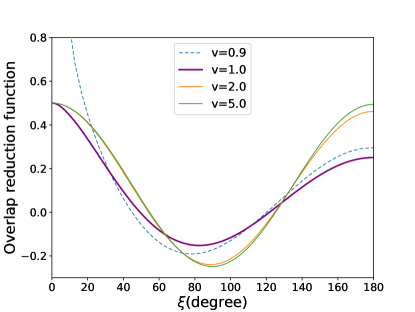
- The study models the overlap reduction function (ORF) as a function of GW propagation speed $ v $, using a parameterized dispersion relation $ \omega = vk $, where phase and group velocities are equal.
- It incorporates both the spatial correlations (via ORF) and the energy density spectrum of the SGWB in a joint likelihood analysis using the Enterprise software package.
- Markov Chain Monte Carlo (MCMC) sampling with PTMCMCSampler is employed to constrain the velocity $ v $, marginalizing over timing model parameters and noise parameters.
- The analysis uses the NANOGrav 15-year data set, including 67 millisecond pulsars, with white noise (EFAC, EQUAD, ECORR), red noise, and common-spectrum processes modeled.
- A kernel density estimation (KDE) with bandwidth 0.09 and mirroring boundary correction is applied to the posterior distribution of $ v $ to assess confidence intervals.
- A confidence level is estimated via the $ 1/e^2 $ width of the posterior peak, assuming Gaussianity on the left side of the peak.
Experimental results
Research questions
- RQ1What constraints can be placed on the propagation speed of gravitational waves in the nanohertz band using the NANOGrav 15-year data set?
- RQ2How do deviations in the overlap reduction function (ORF) due to non-luminal GW speed affect the detection of the stochastic gravitational-wave background (SGWB)?
- RQ3Can the energy density spectrum of the SGWB improve constraints on GW velocity beyond spatial correlation analysis alone?
- RQ4To what extent can the data distinguish between subluminal and superluminal GW propagation speeds?
- RQ5Does the observed posterior distribution of $ v $ support a lower bound or allow for superluminal propagation?
Key findings
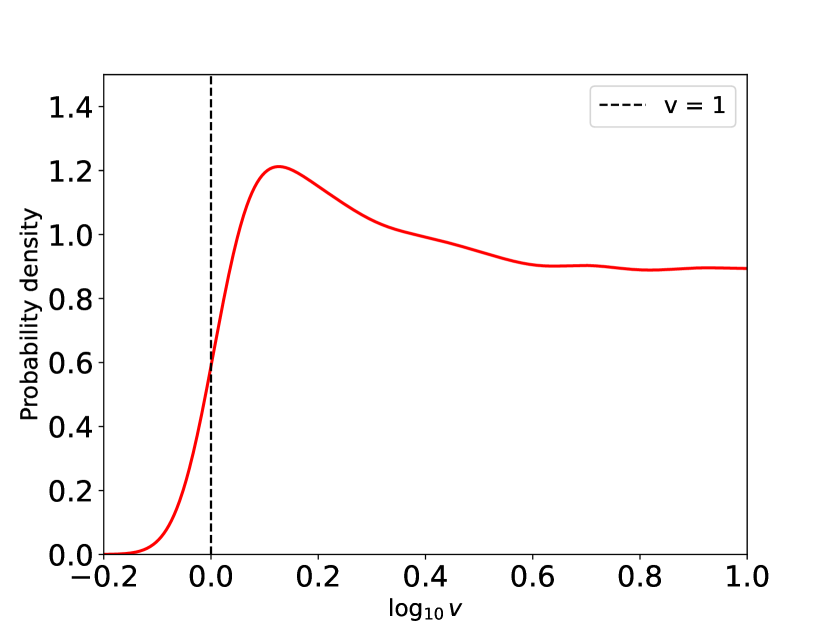
- The posterior distribution for the GW velocity $ v $ exhibits a sharp truncation at subluminal speeds, indicating a strong lower bound.
- The analysis yields a lower bound of $ v \gtrsim 0.87c $, corresponding to $ \log_{10}v \gtrsim -0.059 $, derived from the $ 1/e^2 $ width of the posterior peak.
- The posterior remains relatively flat for velocities greater than $ c $, indicating that superluminal propagation cannot be ruled out with current data.
- The constraint is robust for subluminal velocities but weakens significantly for superluminal cases due to degeneracy in the ORF response.
- The method is generic and not restricted to massive gravity models, allowing exploration of a broader class of modified gravity theories with altered GW dispersion relations.
- The results are consistent with general relativity’s prediction of $ v = c $, and the observed ORF variations align with theoretical expectations for different $ v $.
Read this paper
Open the full text in the Nubint reader and ask about any passage as you read.
Read this paper on NubintThis review was generated by AI from the original paper. Please check the paper before citing it.