
[Paper Review] Content-Adaptive Variable Framerate Encoding Scheme for Green Live Streaming
This paper proposes a content-adaptive variable framerate (CVFR) encoding scheme for green live streaming that dynamically selects optimal framerates and encoding presets per bitrate layer using low-complexity DCT-based spatiotemporal features. CVFR-ECO reduces encoding and storage energy by 34.54% and 76.24%, respectively, while CVFR-HQ improves quality by 2.43 dB PSNR and 10.14 VMAF points with 83.18% lower storage energy, all under low-latency constraints.
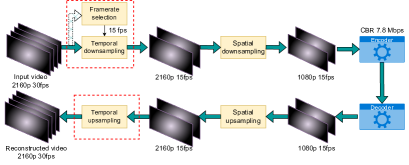
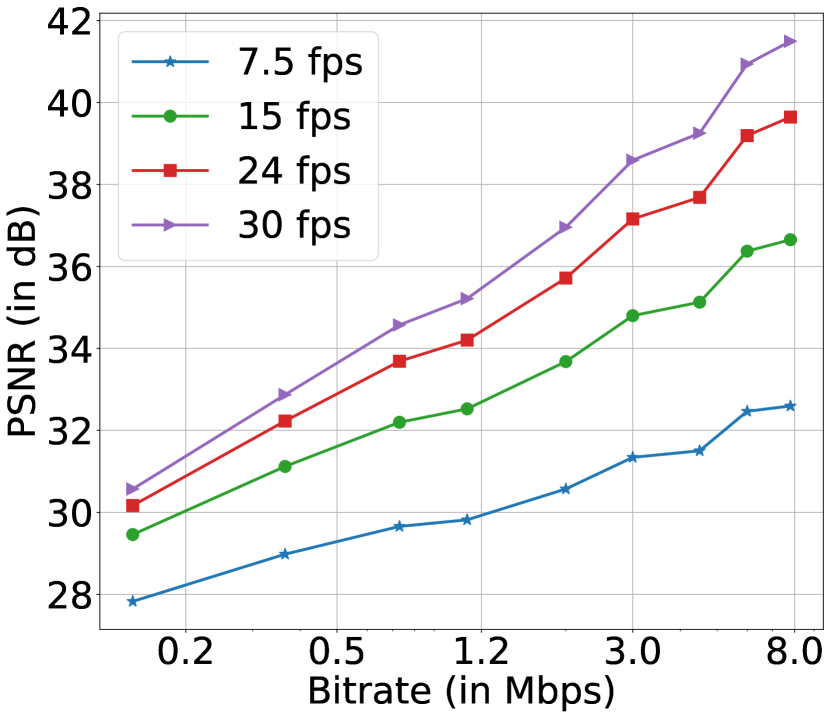
Adaptive live video streaming applications use a fixed predefined configuration for the bitrate ladder with constant framerate and encoding presets in a session. However, selecting optimized framerates and presets for every bitrate ladder representation can enhance perceptual quality, improve computational resource allocation, and thus, the streaming energy efficiency. In particular, low framerates for low-bitrate representations reduce compression artifacts and decrease encoding energy consumption. In addition, an optimized preset may lead to improved compression efficiency. To this light, this paper proposes a Content-adaptive Variable Framerate (CVFR) encoding scheme, which offers two modes of operation: ecological (ECO) and high-quality (HQ). CVFR-ECO optimizes for the highest encoding energy savings by predicting the optimized framerate for each representation in the bitrate ladder. CVFR-HQ takes it further by predicting each representation's optimized framerate-encoding preset pair using low-complexity discrete cosine transform energy-based spatial and temporal features for compression efficiency and sustainable storage. We demonstrate the advantage of CVFR using the x264 open-source video encoder. The results show that CVFR-ECO yields an average PSNR and VMAF increase of 0.02 dB and 2.50 points, respectively, for the same bitrate, compared to the fastest preset highest framerate encoding. CVFR-ECO also yields an average encoding and storage energy consumption reduction of 34.54% and 76.24%, considering a just noticeable difference (JND) of six VMAF points. In comparison, CVFR-HQ yields an average increase in PSNR and VMAF of 2.43 dB and 10.14 points, respectively, for the same bitrate. Finally, CVFR-HQ resulted in an average reduction in storage energy consumption of 83.18%, considering a JND of six VMAF points.
Motivation & Objective
- To address the high energy consumption of adaptive live video streaming by optimizing encoding parameters for sustainability.
- To reduce computational and storage energy costs in data centers without compromising perceptual quality in live streaming.
- To enable low-latency encoding with dynamic framerate and preset selection tailored to video content characteristics.
- To minimize perceptual redundancy through a Just Noticeable Difference (JND)-based representation elimination algorithm.
- To provide two operational modes: energy-optimized (CVFR-ECO) and quality-optimized (CVFR-HQ) for diverse streaming service needs.
Proposed method
- A random forest model predicts the optimal framerate and encoding preset for each representation in the bitrate ladder based on low-complexity DCT energy features from spatial and temporal domains.
- The method uses a JND-based representation elimination algorithm to remove perceptually redundant representations, reducing data size and energy consumption.
- Two modes are implemented: CVFR-ECO uses the fastest preset with optimized framerates to minimize encoding energy; CVFR-HQ jointly optimizes framerate and preset for maximum compression efficiency.
- The approach is evaluated using the x264 encoder on standard live streaming content, comparing against fixed-framerate, fastest-preset baseline encoding.
- Energy savings are quantified in encoding and storage energy consumption, with quality preserved using PSNR and VMAF metrics.
- A JND threshold of six VMAF points is used to define perceptual quality equivalence for energy and bitrate savings calculations.
Experimental results
Research questions
- RQ1Can content-adaptive variable framerate encoding reduce encoding and storage energy consumption in live streaming without sacrificing perceptual quality?
- RQ2How does dynamic selection of framerate and encoding preset per bitrate layer affect compression efficiency and energy consumption?
- RQ3What is the trade-off between perceptual quality and energy efficiency when optimizing for either encoding energy (CVFR-ECO) or compression efficiency (CVFR-HQ)?
- RQ4To what extent can perceptual redundancy be reduced via JND-based representation elimination while maintaining quality?
- RQ5Can the proposed scheme be applied to live streaming with low-latency constraints and minimal changes to existing HTTP adaptive streaming (HAS) architectures?
Key findings
- CVFR-ECO reduces average encoding energy consumption by 34.54% and storage energy by 76.24% compared to fixed-framerate, fastest-preset encoding, with a JND threshold of six VMAF points.
- CVFR-ECO achieves bitrate savings of 17.91% to maintain the same PSNR and 13.54% for the same VMAF, relative to the baseline.
- CVFR-HQ increases average PSNR by 2.43 dB and VMAF by 10.14 points at the same bitrate, outperforming the baseline in quality.
- CVFR-HQ reduces storage energy consumption by 83.18% compared to the baseline, under the same JND threshold of six VMAF points.
- Despite higher encoding energy (282.94% above baseline), CVFR-HQ delivers superior compression efficiency and significant savings in storage and transmission energy.
- The proposed JND-based representation elimination effectively reduces data size and energy consumption while preserving perceptual quality.
Read this paper
Open the full text in the Nubint reader and ask about any passage as you read.
Read this paper on NubintThis review was generated by AI from the original paper. Please check the paper before citing it.