
[Paper Review] Cooperative Data Collection with Multiple UAVs for Information Freshness in the Internet of Things
This paper proposes a cooperative multi-UAV data collection framework for IoT networks to minimize Age of Information (AoI) using a QMIX-based multi-agent deep reinforcement learning algorithm with centralized training and decentralized execution. The approach jointly optimizes UAV trajectories and sensor scheduling under kinematic, energy, collision avoidance, and trajectory constraints, achieving a 140 total average AoI—significantly lower than baselines—while using action masks to enforce constraints and accelerate convergence.
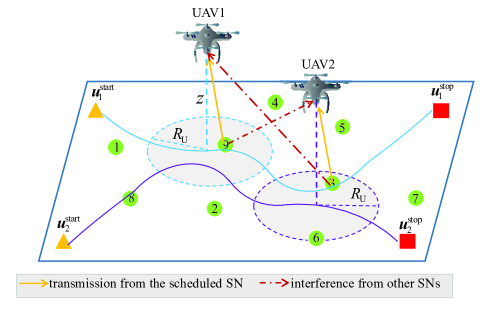
Maintaining the freshness of information in the Internet of Things (IoT) is a critical yet challenging problem. In this paper, we study cooperative data collection using multiple Unmanned Aerial Vehicles (UAVs) with the objective of minimizing the total average Age of Information (AoI). We consider various constraints of the UAVs, including kinematic, energy, trajectory, and collision avoidance, in order to optimize the data collection process. Specifically, each UAV, which has limited on-board energy, takes off from its initial location and flies over sensor nodes to collect update packets in cooperation with the other UAVs. The UAVs must land at their final destinations with non-negative residual energy after the specified time duration to ensure they have enough energy to complete their missions. It is crucial to design the trajectories of the UAVs and the transmission scheduling of the sensor nodes to enhance information freshness. We model the multi-UAV data collection problem as a Decentralized Partially Observable Markov Decision Process (Dec-POMDP), as each UAV is unaware of the dynamics of the environment and can only observe a part of the sensors. To address the challenges of this problem, we propose a multi-agent Deep Reinforcement Learning (DRL)-based algorithm with centralized learning and decentralized execution. In addition to the reward shaping, we use action masks to filter out invalid actions and ensure that the constraints are met. Simulation results demonstrate that the proposed algorithms can significantly reduce the total average AoI compared to the baseline algorithms, and the use of the action mask method can improve the convergence speed of the proposed algorithm.
Motivation & Objective
- To address the challenge of maintaining information freshness in UAV-assisted IoT networks with limited onboard energy and dynamic environments.
- To minimize the total average Age of Information (AoI) in multi-UAV cooperative data collection under kinematic, energy, trajectory, and collision avoidance constraints.
- To enable decentralized UAV operation with partial observability, where each UAV acts based on local observations and limited global coordination.
- To design a scalable and constraint-compliant learning framework that ensures feasible trajectories and transmission schedules.
- To evaluate the trade-off between increased UAVs and mutual interference in optimizing AoI.
Proposed method
- Models the multi-UAV data collection problem as a Decentralized Partially Observable Markov Decision Process (Dec-POMDP) due to partial state observability and non-stationary environments.
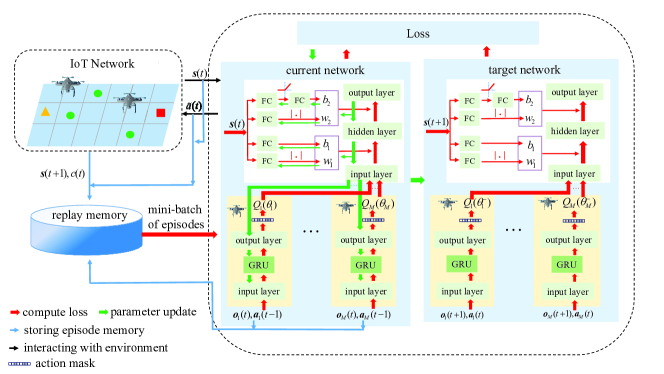
- Proposes a QMIX-based multi-agent deep reinforcement learning algorithm with centralized training and decentralized execution to jointly optimize UAV trajectories and sensor scheduling.
- Introduces action masks to filter out invalid actions (e.g., violating energy or collision constraints), ensuring feasible policy learning.
- Employs reward shaping to guide agents toward minimizing AoI and improving convergence speed.
- Uses a global value function during training to coordinate multi-agent policies while enabling individual execution based on local observations.
- Incorporates a time-slot-based model where UAVs move and collect data in discrete steps, with energy and velocity constraints modeled per time slot.
Experimental results
Research questions
- RQ1How can multiple UAVs cooperatively collect data from IoT sensors to minimize the total average Age of Information (AoI) under energy and kinematic constraints?
- RQ2What is the impact of mutual interference and collision avoidance on UAV trajectory planning and transmission scheduling in cooperative data collection?
- RQ3How does centralized training with decentralized execution improve performance in partially observable, non-stationary multi-agent UAV systems?
- RQ4To what extent do action masks and reward shaping enhance learning convergence and constraint satisfaction in UAV trajectory optimization?
- RQ5What is the optimal number of UAVs that minimizes AoI, balancing increased data collection opportunities against higher interference?
Key findings
- The proposed QMIX-based algorithm achieves a total average AoI of 140, significantly outperforming baseline methods such as cluster-based (168.1), nearest scheduling (208), and IDQN-based (233).
- The use of action masks improves the convergence speed of the QMIX-based algorithm by enforcing constraints during learning, preventing invalid actions.
- Simulation results show that UAVs in the QMIX-based approach effectively divide workloads and can even collaborate on collecting data from the same sensor node.
- An optimal number of UAVs exists that minimizes total average AoI, due to the trade-off between increased transmission opportunities and higher mutual interference.
- The algorithm successfully maintains non-negative residual energy for all UAVs at mission end, satisfying the energy constraint across all simulations.
- The theoretical analysis confirms that the age-related state variables φₘ(t) and ψₘ(t) do not decrease too rapidly, ensuring bounded AoI growth under worst-case maneuvers.
Read this paper
Open the full text in the Nubint reader and ask about any passage as you read.
Read this paper on NubintThis review was generated by AI from the original paper. Please check the paper before citing it.