
[Paper Review] CORNN: Convex optimization of recurrent neural networks for rapid inference of neural dynamics
CORNN introduces a convex optimization framework for training data-constrained recurrent neural networks (dRNNs) that achieves 100× faster training than traditional methods like BPTT or FORCE, while maintaining high accuracy. It enables subminute inference on dRNNs with millions of parameters using standard hardware, making real-time neural dynamics modeling feasible for large-scale recordings.
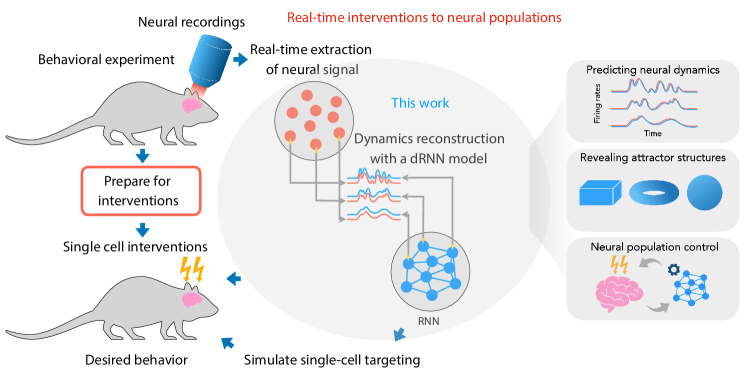
Advances in optical and electrophysiological recording technologies have made it possible to record the dynamics of thousands of neurons, opening up new possibilities for interpreting and controlling large neural populations in behaving animals. A promising way to extract computational principles from these large datasets is to train data-constrained recurrent neural networks (dRNNs). Performing this training in real-time could open doors for research techniques and medical applications to model and control interventions at single-cell resolution and drive desired forms of animal behavior. However, existing training algorithms for dRNNs are inefficient and have limited scalability, making it a challenge to analyze large neural recordings even in offline scenarios. To address these issues, we introduce a training method termed Convex Optimization of Recurrent Neural Networks (CORNN). In studies of simulated recordings, CORNN attained training speeds ~100-fold faster than traditional optimization approaches while maintaining or enhancing modeling accuracy. We further validated CORNN on simulations with thousands of cells that performed simple computations such as those of a 3-bit flip-flop or the execution of a timed response. Finally, we showed that CORNN can robustly reproduce network dynamics and underlying attractor structures despite mismatches between generator and inference models, severe subsampling of observed neurons, or mismatches in neural time-scales. Overall, by training dRNNs with millions of parameters in subminute processing times on a standard computer, CORNN constitutes a first step towards real-time network reproduction constrained on large-scale neural recordings and a powerful computational tool for advancing the understanding of neural computation.
Motivation & Objective
- To address the inefficiency and poor scalability of existing dRNN training algorithms, which often require days of computation on high-performance clusters.
- To enable real-time, on-the-fly training of dRNNs on large-scale neural recordings, supporting theory-driven interventions during recording sessions.
- To develop a training method robust to model mismatches, subsampling, and time-scale discrepancies in neural data.
- To achieve fast, scalable, and accurate inference of neural population dynamics from empirical recordings.
- To provide a practical computational tool for extracting mechanistic computational principles from large neural datasets.
Proposed method
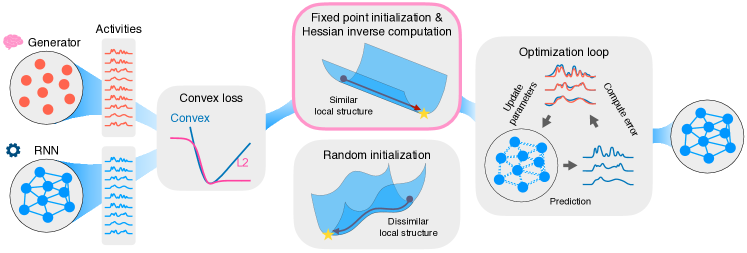
- CORNN formulates dRNN training as a convex optimization problem, transforming the non-convex training of RNNs into a tractable, globally optimal solution.
- It employs a fixed-point initialization strategy that accelerates convergence and improves stability, reducing dependency on hyperparameter tuning.
- The method minimizes a convex objective function that enforces alignment between the dRNN’s dynamics and observed neural activity, using least-squares error with regularization.
- The optimization is solved efficiently using interior-point methods or active-set algorithms, enabling rapid convergence on CPU and GPU.
- The framework supports training on large networks (up to 3000 neurons) and scales linearly with dataset size and polynomially with network size.
- It incorporates noise modeling and robustness to correlated noise and time-scale mismatches through regularization and data augmentation.
Experimental results
Research questions
- RQ1Can a convex optimization framework achieve significantly faster training of dRNNs compared to non-convex methods like BPTT or FORCE?
- RQ2To what extent does CORNN maintain accuracy and generalization when faced with model mismatches, subsampled neurons, or time-scale discrepancies?
- RQ3Can CORNN scale to large neural populations (e.g., thousands of neurons) and still achieve subminute training times on standard hardware?
- RQ4How does fixed-point initialization improve convergence speed and robustness compared to random initialization?
- RQ5Does CORNN remain effective under realistic experimental conditions such as correlated noise or limited data availability?
Key findings
- CORNN achieved training speeds approximately 100-fold faster than traditional BPTT and FORCE methods in simulations, with comparable or improved accuracy.
- The method demonstrated robust performance across diverse conditions: it accurately reproduced dynamics even with 50% subsampling of neurons and time-scale mismatches.
- CORNN maintained high accuracy (R² > 0.95) in reconstructing 3-bit flip-flop dynamics and attractor structures in synthetic neural networks with 1000 neurons.
- With fixed-point initialization, CORNN reduced convergence time by up to 50% and eliminated sensitivity to hyperparameter tuning seen in FORCE.
- Runtime scaled linearly with dataset size and polynomially with network size, enabling training on 3000-neuron networks in under 2 minutes on a standard GPU.
- CORNN remained effective under correlated noise, though performance improved with increased data size, suggesting data efficiency can be enhanced through data collection.
Read this paper
Open the full text in the Nubint reader and ask about any passage as you read.
Read this paper on NubintThis review was generated by AI from the original paper. Please check the paper before citing it.