
[Paper Review] Costly Features Classification using Monte Carlo Tree Search
This paper proposes a two-stage reinforcement learning method combining Advantage Actor-Critic (A2C) and Monte Carlo Tree Search (MCTS) for costly features classification, where feature acquisition incurs non-trivial costs. The approach balances classification accuracy and cost by learning an adaptive feature selection policy, achieving state-of-the-art performance on both balanced and imbalanced datasets, with MCTS significantly improving A2C's sub-optimal policy while maintaining efficiency.
We consider the problem of costly feature classification, where we sequentially select the subset of features to make a balance between the classification error and the feature cost. In this paper, we first cast the task into a MDP problem and use Advantage Actor Critic algorithm to solve it. In order to further improve the agent's performance and make the policy explainable, we employ the Monte Carlo Tree Search to update the policy iteratively. During the procedure, we also consider its performance on the unbalanced dataset and its sensitivity to the missing value. We evaluate our model on multiple datasets and find it outperforms other methods.
Motivation & Objective
- To address the costly features classification problem where acquiring features incurs non-trivial costs such as time, energy, or human effort.
- To develop a sequential feature selection strategy that optimally trades off classification error and feature acquisition cost.
- To improve model stability and explainability by integrating A2C with MCTS for policy refinement.
- To handle class imbalance in datasets by designing a reward function that adjusts for minority class impact.
- To outperform existing methods like DQN, Adapt-Gbrt, and BudgetPrune in accuracy-cost trade-offs on real-world classification tasks.
Proposed method
- Formulate the costly features classification problem as a Markov Decision Process (MDP), enabling sequential decision-making over feature acquisition.
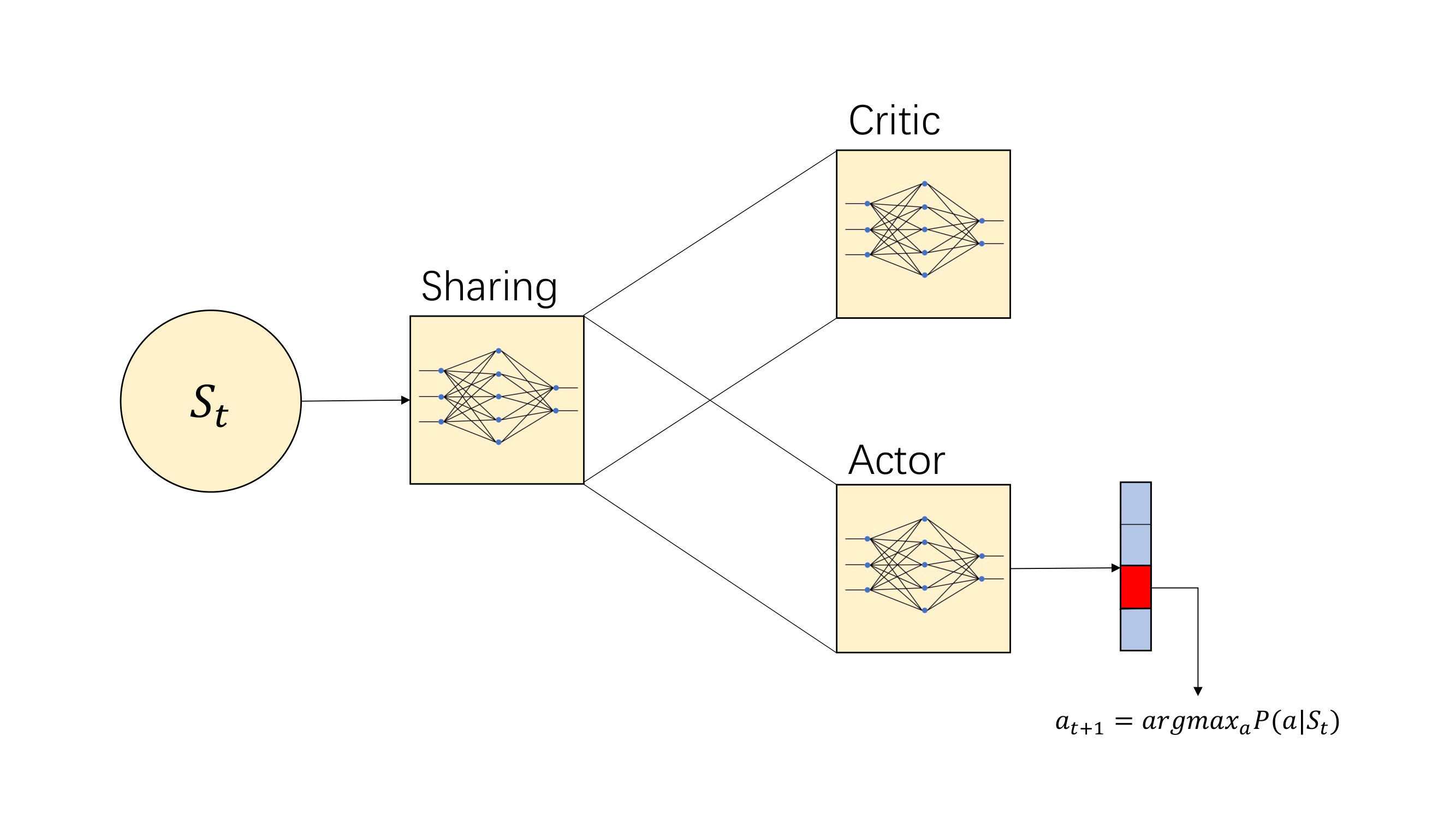
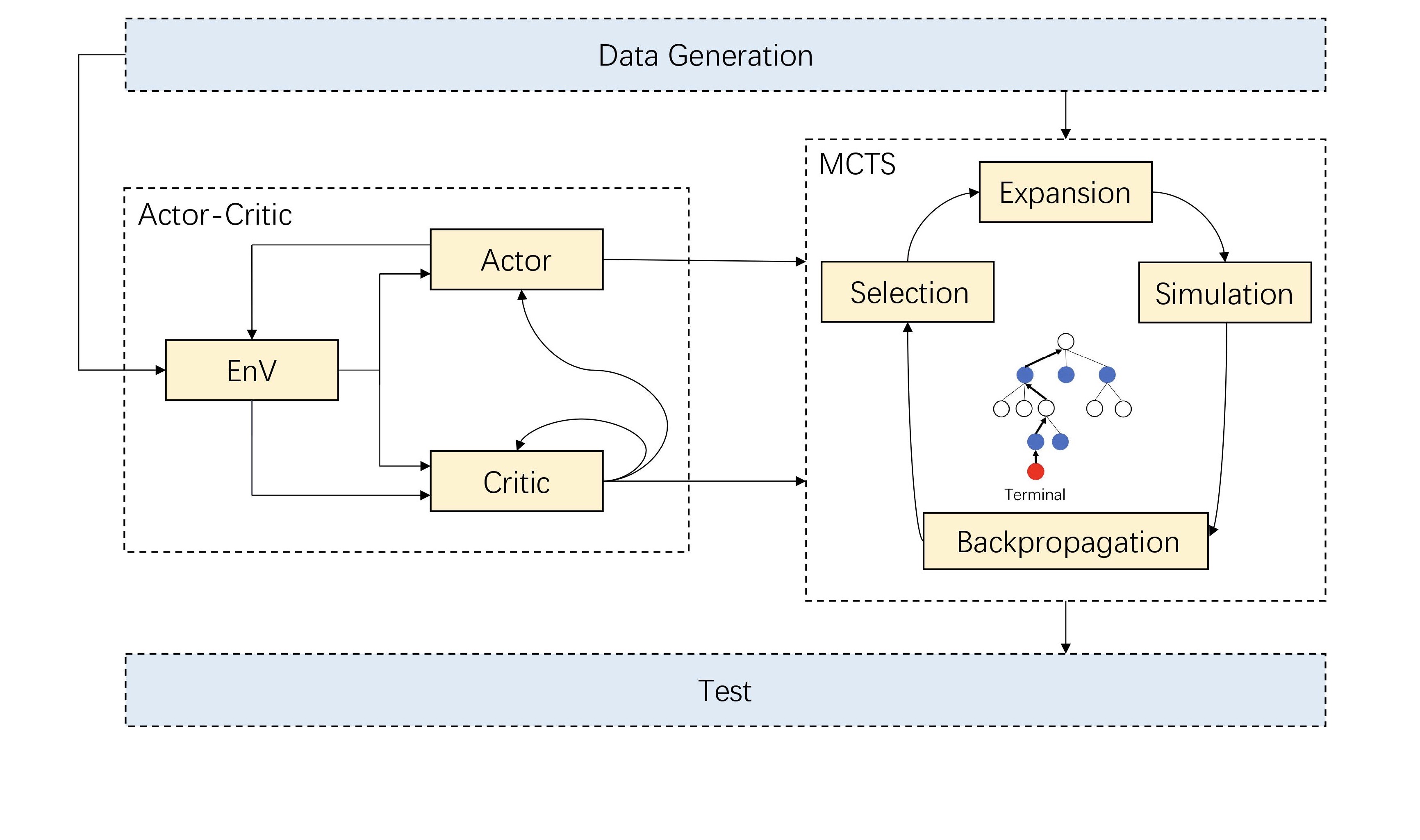
- Use the Advantage Actor-Critic (A2C) algorithm to pre-train a policy network that balances exploration and exploitation in feature selection.
- Introduce a custom reward function that incorporates class imbalance by scaling the reward for majority samples by a factor δ, tuned to ρ (imbalance ratio).
- Apply Monte Carlo Tree Search (MCTS) to iteratively refine the A2C policy, using the neural network’s value estimates as a guide for tree expansion and selection.
- Use the A2C value network as a heuristic for tree node selection, enabling efficient pruning and faster convergence during MCTS search.
- Combine A2C pretraining with MCTS to achieve a stable, high-performing, and explainable feature selection policy.
Experimental results
Research questions
- RQ1Can a deep reinforcement learning approach effectively balance classification accuracy and feature acquisition cost in real-world scenarios?
- RQ2How does integrating MCTS with A2C improve the policy learned from A2C alone in costly feature selection?
- RQ3What reward function design enables robust performance on imbalanced datasets in the context of costly feature acquisition?
- RQ4How does the proposed method compare to existing methods like DQN, Adapt-Gbrt, and BudgetPrune in terms of accuracy and cost efficiency?
- RQ5To what extent does the A2C+MCTS framework maintain performance on incomplete or imbalanced data compared to Q-learning-based baselines?
Key findings
- On balanced datasets, A2C+MCTS achieves higher accuracy than DQN and Adapt-Gbrt while maintaining a similar cost budget, with G-mean scores of 0.85 (9.3) on Cir and 0.88 (9.3) on Rng at 20% cost.
- On imbalanced datasets, A2C+MCTS outperforms DQN and Adapt-Gbrt, achieving a G-mean of 0.65 (6.1) on Cir at 5% cost, where DQN and Adapt-Gbrt fail to converge or degrade significantly.
- The ablation study confirms that MCTS significantly improves the A2C policy, increasing G-mean from 0.57 (8.5) to 0.65 (6.1) on Cir and from 0.63 (4.2) to 0.79 (3.4) on Pid.
- The MCTS search time is orders of magnitude faster when guided by the A2C value network, demonstrating the effectiveness of the neural network as a pruning heuristic.
- Optimal performance is achieved when the reward scaling factor δ is slightly less than the imbalance ratio ρ, indicating that slightly increasing minority class influence improves G-mean.
- The method achieves high accuracy with a small subset of features—comparable to DNN and RF—while using significantly fewer features, demonstrating cost efficiency.
Read this paper
Open the full text in the Nubint reader and ask about any passage as you read.
Read this paper on NubintThis review was generated by AI from the original paper. Please check the paper before citing it.