
[Paper Review] Critical behavior of Fredenhagen-Marcu string order parameters at topological phase transitions with emergent higher-form symmetries
This paper demonstrates that the Fredenhagen-Marcu (FM) string order parameter exhibits universal scaling behavior near topological phase transitions in the toric code model with a magnetic field, using infinite Projected Entangled Pair States (iPEPS) to compute the infinite-string-length limit. It identifies a novel critical exponent consistent with the (2+1)D XY universality class under electric-magnetic duality, and shows the FM order parameter only reliably detects transitions in regions with emergent 1-form Wilson loop symmetry.
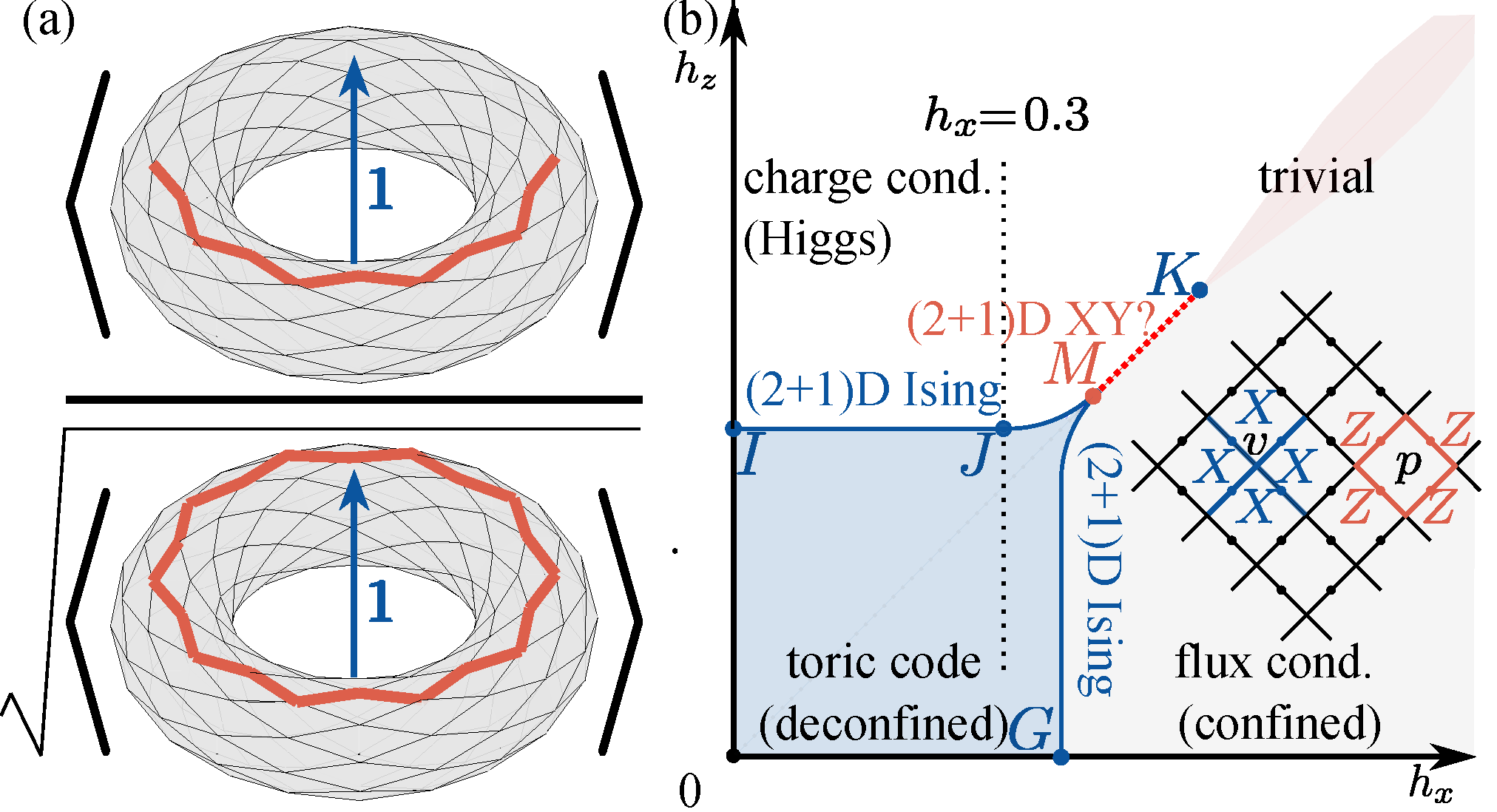
A nonlocal string order parameter detecting topological order and deconfinement has been proposed by Fredenhagen and Marcu (FM). However, due to the lack of exact internal symmetries for lattice models and the nonlinear dependence of the FM string order parameter on ground states, it is a priori not guaranteed that it is a genuine order parameter for topological phase transitions. In this work, we find that the FM string order parameter exhibits universal scaling behavior near critical points of charge condensation transitions, by directly evaluating the FM string order parameter in the infinite string-length limit using infinite Projected Entangled Pair States (iPEPS) for the toric code in a magnetic field. Our results thus demonstrate that the FM string order parameter represents a quantitatively well-behaved order parameter. We find that only in the presence of an emergent 1-form symmetry the corresponding FM string order parameter can faithfully detect topological transitions.
Motivation & Objective
- To investigate the critical behavior of the Fredenhagen-Marcu (FM) string order parameter near topological phase transitions in the toric code model with a magnetic field.
- To determine under which conditions the FM string order parameter remains a valid probe of topological order, particularly in the presence of emergent symmetries.
- To establish whether the FM order parameter exhibits universal scaling behavior in the infinite string-length limit, indicating its suitability as a quantitative order parameter.
- To clarify the role of emergent 1-form Wilson and 't Hooft loop symmetries in enabling the FM order parameter to detect topological phase transitions.
- To resolve the debate on the universality class of the multi-critical point in the toric code model under electric-magnetic duality symmetry.
Proposed method
- The study employs infinite Projected Entangled Pair States (iPEPS) with energy gradient optimization and automatic differentiation to approximate ground states of the toric code Hamiltonian in a magnetic field.
- The infinite-string-length limit of the FM string order parameter is computed using transfer matrix techniques applied to the iPEPS ansatz.
- Critical exponents are extracted from the scaling behavior of the FM string order parameter near phase transitions, particularly in the vicinity of the topological transition point.
- The analysis includes both the standard FM order parameter for electric charges and a dual version for magnetic fluxes, to assess their respective detection capabilities.
- The presence of electric-magnetic duality symmetry is leveraged to identify a new critical exponent distinct from those of local order parameters.
- The emergence of 1-form Wilson loop symmetry is analytically and numerically assessed as a necessary condition for the FM order parameter to remain non-zero and meaningful.
Experimental results
Research questions
- RQ1Does the Fredenhagen-Marcu string order parameter exhibit universal scaling behavior near topological phase transitions in the toric code model?
- RQ2What is the critical exponent associated with the FM string order parameter in the presence of electric-magnetic duality symmetry, and how does it compare to known universality classes?
- RQ3In which regions of the phase diagram is the FM string order parameter a reliable indicator of topological phase transitions?
- RQ4Under what conditions does the FM string order parameter lose its physical meaning, particularly in the absence of emergent 1-form symmetries?
- RQ5How do emergent 1-form Wilson and 't Hooft loop symmetries govern the detectability of topological transitions via the FM order parameter?
Key findings
- The FM string order parameter exhibits universal scaling behavior near the topological phase transition in the toric code model, confirming its validity as a quantitative order parameter.
- In the presence of electric-magnetic duality symmetry, the FM string order parameter displays a critical exponent consistent with the (2+1)D XY universality class, distinct from the (2+1)D Ising exponent observed without duality.
- The FM string order parameter only faithfully detects topological phase transitions in regions with emergent 1-form Wilson loop symmetry, as confirmed by both the toric code model and a deformed toric code state.
- In the flux condensation phase, the FM string order parameter is discontinuous and vanishes due to the absence of emergent Wilson loop symmetry, indicating its breakdown as a probe.
- The study confirms that a dual FM string order parameter associated with magnetic fluxes is required to detect transitions in regions with emergent 't Hooft loop symmetry.
- The results support the conjecture that the boundary of the charge condensation region in the trivial phase is governed by a percolation transition, which determines the onset of emergent 1-form symmetry.

Read this paper
Open the full text in the Nubint reader and ask about any passage as you read.
Read this paper on NubintThis review was generated by AI from the original paper. Please check the paper before citing it.