
[Paper Review] CulturaX: A Cleaned, Enormous, and Multilingual Dataset for Large Language Models in 167 Languages
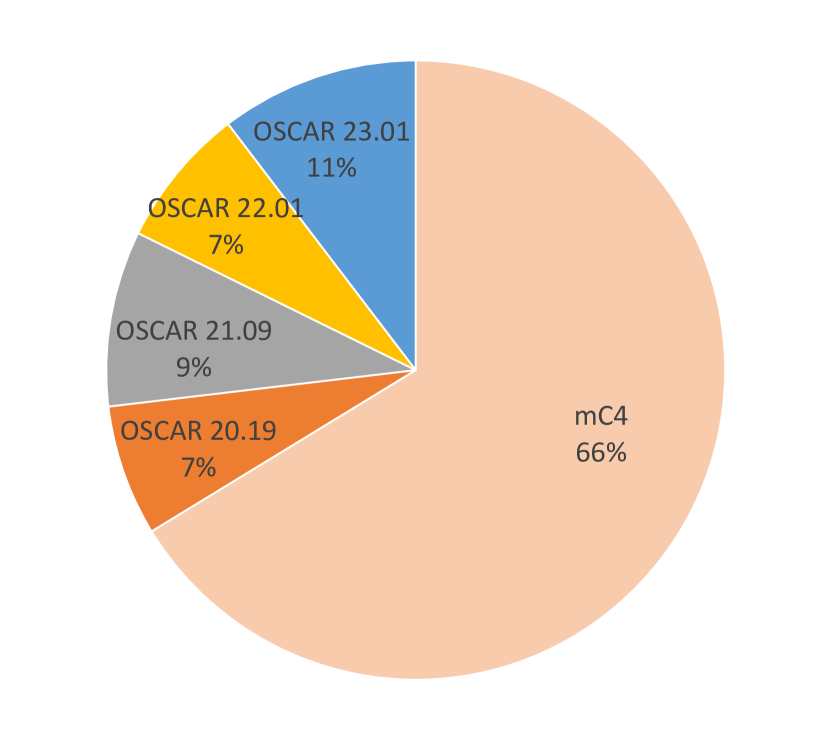
CulturaX is a publicly released, 6.3-trillion-token multilingual dataset spanning 167 languages, extensively cleaned and deduplicated for training high-quality LLMs. It combines mC4 v3.1.0 and OSCAR corpora with a rigorous cleaning/deduplication pipeline and is available on HuggingFace.
The driving factors behind the development of large language models (LLMs) with impressive learning capabilities are their colossal model sizes and extensive training datasets. Along with the progress in natural language processing, LLMs have been frequently made accessible to the public to foster deeper investigation and applications. However, when it comes to training datasets for these LLMs, especially the recent state-of-the-art models, they are often not fully disclosed. Creating training data for high-performing LLMs involves extensive cleaning and deduplication to ensure the necessary level of quality. The lack of transparency for training data has thus hampered research on attributing and addressing hallucination and bias issues in LLMs, hindering replication efforts and further advancements in the community. These challenges become even more pronounced in multilingual learning scenarios, where the available multilingual text datasets are often inadequately collected and cleaned. Consequently, there is a lack of open-source and readily usable dataset to effectively train LLMs in multiple languages. To overcome this issue, we present CulturaX, a substantial multilingual dataset with 6.3 trillion tokens in 167 languages, tailored for LLM development. Our dataset undergoes meticulous cleaning and deduplication through a rigorous pipeline of multiple stages to accomplish the best quality for model training, including language identification, URL-based filtering, metric-based cleaning, document refinement, and data deduplication. CulturaX is fully released to the public in HuggingFace to facilitate research and advancements in multilingual LLMs: https://huggingface.co/datasets/uonlp/CulturaX.
Motivation & Objective
- Address transparency and democratization of LLM training data by providing a large-scale, open multilingual dataset.
- Merge and update multilingual resources (mC4 and OSCAR) to maximize language coverage beyond English.
- Apply rigorous cleaning and deduplication to ensure high-quality training data across languages.
- Enable multilingual LLM research and development with readily usable data across 167 languages.
Proposed method
- Combine latest mC4 (v3.1.0) with OSCAR corpora up to 2023.01 distributions.
- Apply a multi-stage data cleaning pipeline including language identification re-prediction, URL-based filtering, metric-based cleaning, and document refinement.
- Perform language-specific thresholding for cleaning using a variant of the Interquartile Range (IQR) to determine filtering thresholds.
- Execute document-level deduplication using MinHashLSH and URL-based deduplication per language.
- Utilize substantial computational resources (600 AWS EC2 instances) for preprocessing and deduplication.
- Release KenLM models publicly to assist future research.
Experimental results
Research questions
- RQ1Can CulturaX provide a scalable, multilingual, and openly accessible dataset suitable for training high-quality LLMs across 167 languages?
- RQ2Does the proposed cleaning and deduplication pipeline (language re-prediction, URL filtering, metric-based filtering, document refinement, and MinHash-based deduplication) yield a significantly higher-quality multilingual corpus compared to prior open datasets?
- RQ3What are the language coverage, size, and quality trade-offs achieved by combining mC4 v3.1.0 with OSCAR and applying rigorous multilingual cleaning?
Key findings
- CulturaX contains 6.3 trillion tokens across 167 languages, making it a large-scale multilingual resource for LLM training.
- Over 46% of initial documents are removed through the cleaning/deduplication pipeline, indicating substantial quality gains.
- The dataset emphasizes non-English content, with over half of the data allocated to non-English languages to support multilingual training.
- Document-level deduplication via MinHashLSH and URL-based deduplication reduce redundancy and memorization risks in training data.
- The pipeline uses language identification re-prediction (FastText over cld3) to improve language labeling accuracy and data quality.
- Public availability on HuggingFace enables replication and broader use in multilingual NLP research.
Read this paper
Open the full text in the Nubint reader and ask about any passage as you read.
Read this paper on NubintThis review was generated by AI from the original paper. Please check the paper before citing it.