
[Paper Review] Dark Branches of Immortal Stars at the Galactic Center
The paper proposes that dark matter annihilation in stars near the Galactic Center can power a new population of long-lived, stable stars forming a 'dark main sequence' on the Hertzsprung-Russell diagram. These stars, fueled continuously by dark matter capture, remain at low temperatures and high luminosities indefinitely, explaining observed anomalies like the paradox of youth and top-heavy initial mass function in the inner Galaxy.
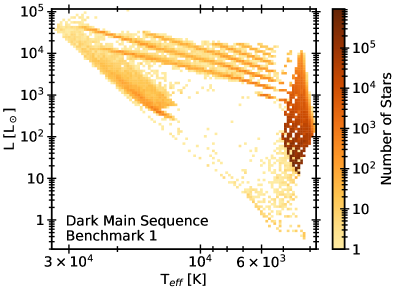
We show that stars in the inner parsec of the Milky Way can be significantly affected by dark matter annihilation, producing population-level effects that are visible in a Hertzsprung-Russell (HR) diagram. We establish the dark HR diagram, where stars lie on a new stable $ extit{dark main sequence}$ with similar luminosities, but lower temperatures, than the standard main sequence. The dark matter density in these stars continuously replenishes, granting these stars immortality and solving multiple stellar anomalies. Upcoming telescopes could detect the dark main sequence, offering a new dark matter discovery avenue.
Motivation & Objective
- To explain persistent stellar anomalies in the Galactic Center, such as the paradox of youth and the conundrum of old age, using dark matter as a sustained energy source.
- To model how dark matter annihilation affects stellar evolution, particularly in high-density regions near the central black hole.
- To predict a new population of stars—stable, long-lived, and observationally distinct—on a dark main sequence in the HR diagram.
- To reconcile discrepancies between observed stellar populations and standard stellar evolution models in the inner parsec of the Milky Way.
- To identify testable signatures of dark matter through future high-resolution observations of the Galactic Center.
Proposed method
- Construct a population-level model of stellar evolution under significant dark matter energy injection, using hydrostatic equilibrium and energy balance equations.
- Integrate dark matter capture rates that depend on stellar radius, mass, and dark matter scattering cross section, accounting for stellar evolution effects.
- Simulate stellar structure using modified equations of state and energy generation, replacing nuclear fusion with dark matter annihilation as the dominant energy source.
- Compare the resulting dark main sequence with the standard main sequence in the Hertzsprung-Russell diagram, identifying distinct luminosity-temperature tracks.
- Use benchmark parameters: 1 GeV dark matter mass, 3×10⁻³⁵ cm² scattering cross section, and NFW dark matter profile with γ=1.5.
- Assess detectability using upcoming thirty-meter class telescopes, which will resolve individual stars in the inner parsec.
Experimental results
Research questions
- RQ1Can dark matter annihilation sustain long-lived stars in the inner Galactic Center, where nuclear fusion is inefficient?
- RQ2How does dark matter energy injection alter the standard Hertzsprung-Russell diagram, and what new stellar evolutionary tracks emerge?
- RQ3Why do observed stars near the Galactic Center appear young despite their advanced age, and can dark matter explain this paradox of youth?
- RQ4What explains the top-heavy initial mass function observed in the inner parsec, and is it consistent with dark matter-powered stellar evolution?
- RQ5Can the absence of evolved stars in the inner Galactic Center be explained by dark matter-induced stabilization on the dark main sequence?
Key findings
- A new 'dark main sequence' emerges in the Hertzsprung-Russell diagram, characterized by stars with similar luminosities but lower temperatures than standard main sequence stars.
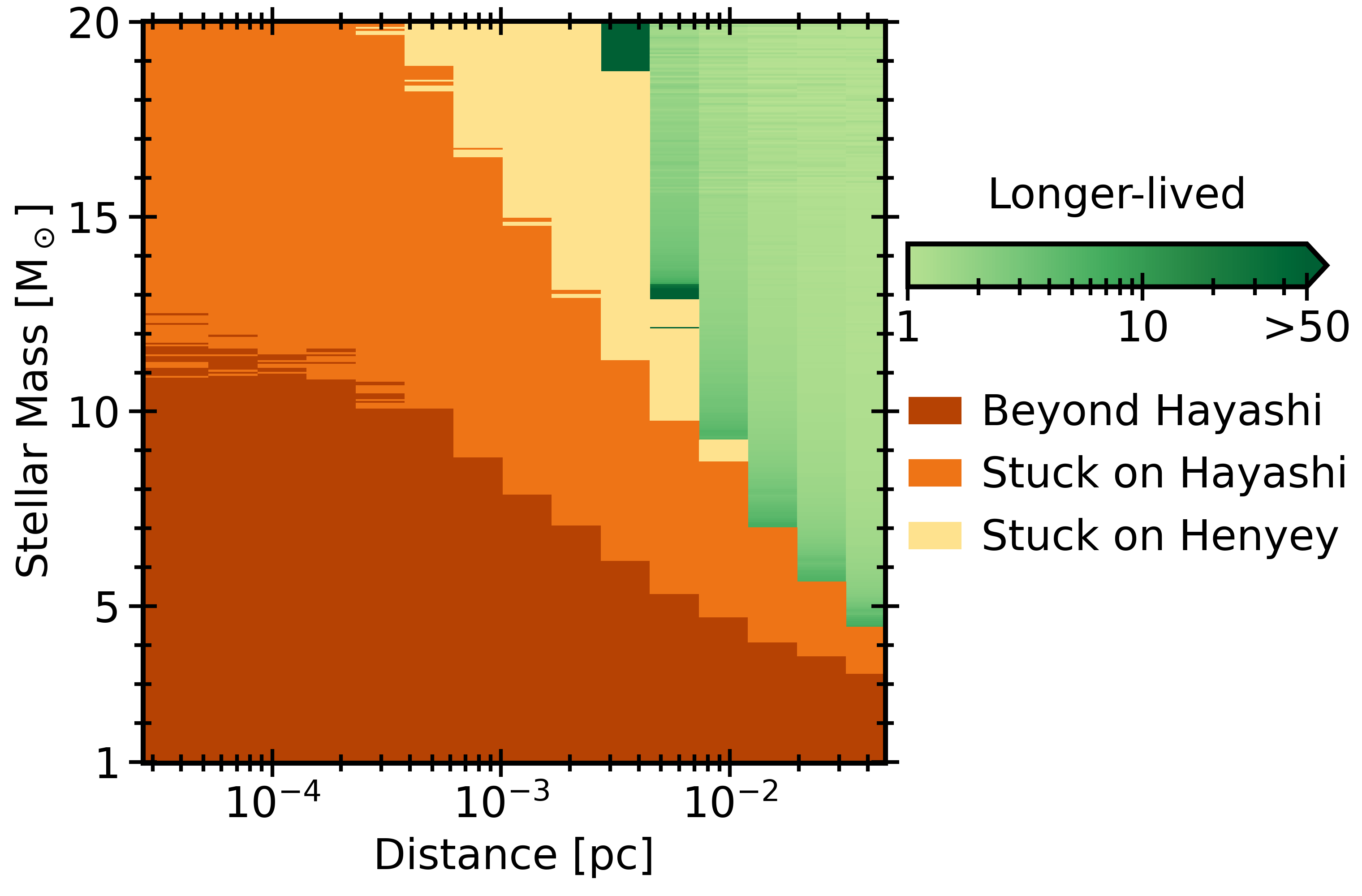
- Stars on the dark main sequence are stabilized by continuous dark matter capture and annihilation, granting them near-immortality and preventing evolution off the main sequence.
- Low-mass stars are destabilized and may be disrupted or driven backwards along the Hayashi track due to excessive dark matter heating, explaining the lack of low-mass stars.
- The observed top-heavy initial mass function (with indices between M⁻¹.⁷ and M⁻⁰.⁴⁵) is naturally reproduced, as only higher-mass stars remain stable on the dark main sequence.
- The paradox of youth—stars appearing young despite old ages—is resolved, as dark matter-powered stars remain luminous and hot for extended periods.
- Upcoming thirty-meter class telescopes are expected to resolve individual stars in the inner parsec, enabling direct detection of the dark main sequence and a new avenue for dark matter discovery.
Read this paper
Open the full text in the Nubint reader and ask about any passage as you read.
Read this paper on NubintThis review was generated by AI from the original paper. Please check the paper before citing it.