
[Paper Review] DAS-N2N: Machine learning Distributed Acoustic Sensing (DAS) signal denoising without clean data
DAS-N2N is a weakly supervised deep learning method for denoising Distributed Acoustic Sensing (DAS) signals without requiring clean training data. By leveraging two spliced fibres in a single cable to provide paired noisy inputs, the model learns to suppress incoherent noise while preserving true signals, achieving near-instantaneous denoising (under 1 second for 30 seconds of 985-channel data) and significantly enhancing signal-to-noise ratios for microseismic events in Antarctic field data.
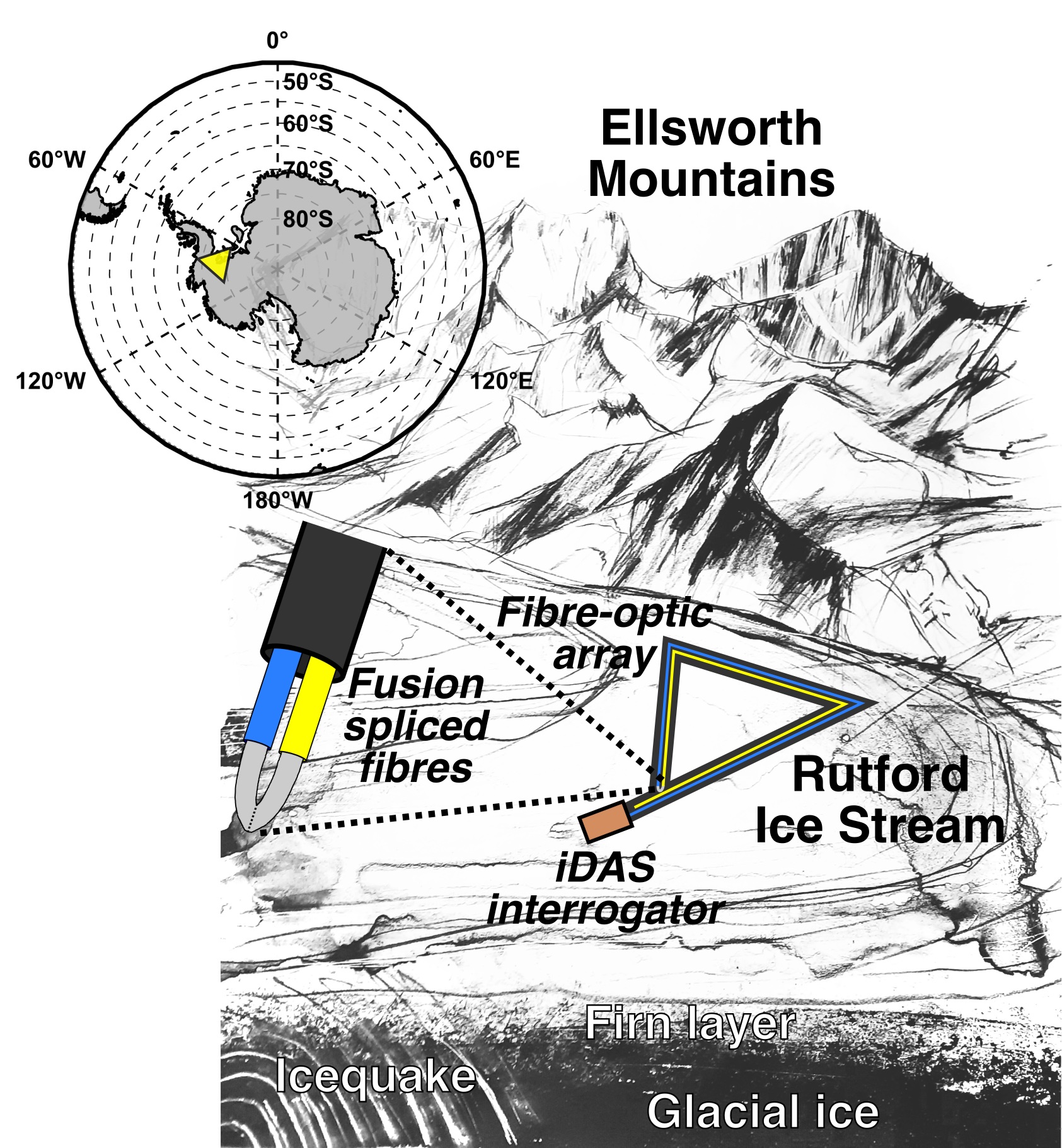
This article presents a weakly supervised machine learning method, which we call DAS-N2N, for suppressing strong random noise in distributed acoustic sensing (DAS) recordings. DAS-N2N requires no manually produced labels (i.e., pre-determined examples of clean event signals or sections of noise) for training and aims to map random noise processes to a chosen summary statistic, such as the distribution mean, median or mode, whilst retaining the true underlying signal. This is achieved by splicing (joining together) two fibres hosted within a single optical cable, recording two noisy copies of the same underlying signal corrupted by different independent realizations of random observational noise. A deep learning model can then be trained using only these two noisy copies of the data to produce a near fully-denoised copy. Once the model is trained, only noisy data from a single fibre is required. Using a dataset from a DAS array deployed on the surface of the Rutford Ice Stream in Antarctica, we demonstrate that DAS-N2N greatly suppresses incoherent noise and enhances the signal-to-noise ratios (SNR) of natural microseismic icequake events. We further show that this approach is inherently more efficient and effective than standard stop/pass band and white noise (e.g., Wiener) filtering routines, as well as a comparable self-supervised learning method based on masking individual DAS channels. Our preferred model for this task is lightweight, processing 30 seconds of data recorded at a sampling frequency of 1000 Hz over 985 channels (approx. 1 km of fiber) in $<$1 s. Due to the high noise levels in DAS recordings, efficient data-driven denoising methods, such as DAS-N2N, will prove essential to time-critical DAS earthquake detection, particularly in the case of microseismic monitoring.
Motivation & Objective
- Address the challenge of high random noise in DAS recordings, which hinders detection of weak microseismic signals in remote or harsh environments.
- Develop a denoising method that does not require manually curated clean signal examples or labels, enabling scalable deployment.
- Leverage the inherent redundancy of dual-fibre configurations in existing optical cables to train a model using only noisy data from two independent noise realizations.
- Achieve real-time, efficient, and lightweight denoising suitable for edge deployment in time-critical applications like earthquake monitoring and treaty verification.
- Demonstrate the method’s effectiveness on real-world DAS data from the Rutford Ice Stream in Antarctica, where signal-to-noise ratios are severely degraded by environmental noise.
Proposed method
- Utilize a single optical cable with two spliced fibres to record two independent, noisy copies of the same underlying seismic signal, each corrupted by different realizations of random noise.
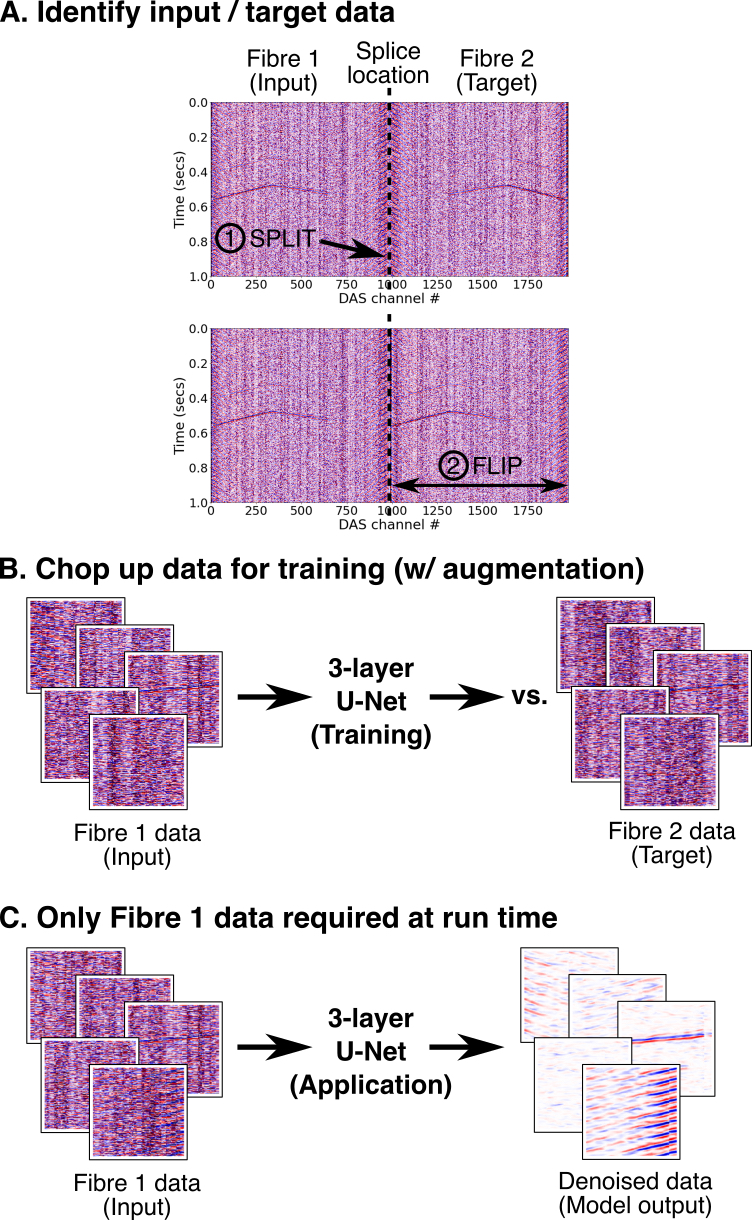
- Train a deep neural network using the two noisy fibre recordings as input and target, respectively, enabling end-to-end learning without any clean signal labels.
- Apply a 1-to-1 mapping strategy where the model learns to transform one noisy input into a denoised version by minimizing the difference from the other noisy copy, effectively learning the noise distribution.
- Use a lightweight, shallow network architecture (e.g., three layers) optimized for speed and low computational cost, enabling real-time inference on standard hardware.
- Process data in a sliding-window fashion across the 985 channels of a 1 km fibre segment sampled at 1000 Hz, with inference completed in under 1 second.
- Deploy the trained model on single-fibre data post-training, eliminating the need for dual-fibre recording in operational use.
Experimental results
Research questions
- RQ1Can a machine learning model denoise DAS signals effectively without requiring any manually labeled clean data or signal examples?
- RQ2How does the performance of DAS-N2N compare to conventional filtering techniques (e.g., bandpass, Wiener) in suppressing incoherent noise within the signal bandwidth?
- RQ3Can DAS-N2N outperform self-supervised learning methods based on channel masking in terms of speed, accuracy, and noise suppression in high-noise environments?
- RQ4To what extent can a lightweight DAS-N2N model achieve real-time processing for time-critical applications like microseismic monitoring and early warning systems?
- RQ5Is the DAS-N2N approach generalizable and applicable to existing DAS deployments with un-spliced fibres through retroactive model retraining using spliced configurations?
Key findings
- DAS-N2N successfully suppresses incoherent noise in DAS recordings from the Rutford Ice Stream, significantly enhancing the signal-to-noise ratio of natural microseismic icequake events.
- The model processes 30 seconds of 985-channel, 1000 Hz DAS data in less than 1 second on a single GPU, making it suitable for real-time or near real-time applications.
- DAS-N2N is more than an order of magnitude faster than comparable self-supervised learning methods based on masking, due to the absence of a masking and reconstruction procedure.
- Unlike frequency-based filters, DAS-N2N effectively suppresses noise that lies within the same frequency band as the signal of interest, a limitation of traditional filtering.
- The method preserves the true signal through a 1-to-1 mapping between input and target, avoiding the interpolation challenges inherent in self-supervised masking approaches as noise levels increase.
- The trained model can be deployed on single-fibre data after training, requiring no additional data storage or processing overhead in operational use.
Read this paper
Open the full text in the Nubint reader and ask about any passage as you read.
Read this paper on NubintThis review was generated by AI from the original paper. Please check the paper before citing it.