
[Paper Review] Decentralized Federated Learning for UAV Networks: Architecture, Challenges, and Opportunities
This paper proposes DFL-UN, a decentralized federated learning architecture for UAV networks that eliminates the need for a central server by enabling UAVs to collaboratively train machine learning models through local aggregation with neighboring drones. The approach enhances robustness and scalability in dynamic, unreliable UAV networks, with preliminary simulations confirming its feasibility and effectiveness compared to centralized FL.
Unmanned aerial vehicles (UAVs), or say drones, are envisioned to support extensive applications in next-generation wireless networks in both civil and military fields. Empowering UAVs networks intelligence by artificial intelligence (AI) especially machine learning (ML) techniques is inevitable and appealing to enable the aforementioned applications. To solve the problems of traditional cloud-centric ML for UAV networks such as privacy concern, unacceptable latency, and resource burden, a distributed ML technique, extit(i.e.), federated learning (FL), has been recently proposed to enable multiple UAVs to collaboratively train ML model without letting out raw data. However, almost all existing FL paradigms are still centralized, extit{i.e.}, a central entity is in charge of ML model aggregation and fusion over the whole network, which could result in the issue of a single point of failure and are inappropriate to UAV networks with both unreliable nodes and links. Thus motivated, in this article, we propose a novel architecture called DFL-UN (\underline{D}ecentralized \underline{F}ederated \underline{L}earning for \underline{U}AV \underline{N}etworks), which enables FL within UAV networks without a central entity. We also conduct a preliminary simulation study to validate the feasibility and effectiveness of the DFL-UN architecture. Finally, we discuss the main challenges and potential research directions in the DFL-UN.
Motivation & Objective
- To address the limitations of centralized federated learning in UAV networks, such as single point of failure and high latency.
- To enable privacy-preserving, energy-efficient, and low-latency machine learning in dynamic UAV networks with unreliable links and heterogeneous nodes.
- To design a fully decentralized FL architecture that eliminates reliance on a central entity for model aggregation.
- To validate the feasibility and effectiveness of decentralized FL in UAV networks through simulation.
- To identify key challenges and future research directions in decentralized FL for UAVs.
Proposed method
- Proposes DFL-UN, a decentralized federated learning architecture where each UAV trains a local model and aggregates models from one-hop neighbors without a central server.
- Uses local model aggregation among neighboring UAVs to iteratively update the global model in a distributed manner.
- Employs a peer-to-peer communication model where UAVs exchange and fuse model parameters directly via A2A (air-to-air) links.
- Designs a fully distributed learning protocol that maintains model consistency despite dynamic topology and intermittent connectivity.
- Introduces a simulation framework to evaluate DFL-UN under realistic UAV network conditions, including mobility and link unreliability.
- Adapts standard FL training procedures (e.g., FedAvg) to a decentralized setting with neighbor-based aggregation instead of central aggregation.
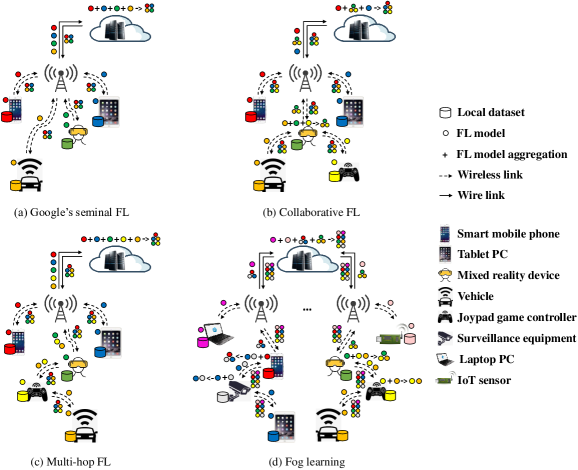
Experimental results
Research questions
- RQ1How can federated learning be made fully decentralized in UAV networks to eliminate reliance on a central server?
- RQ2What are the key challenges in maintaining model convergence and robustness in a decentralized UAV FL system with dynamic topology and unreliable links?
- RQ3How does the performance of decentralized FL compare to centralized FL in UAV networks under realistic constraints?
- RQ4What are the communication and energy efficiency trade-offs in decentralized UAV FL due to extensive A2A model exchanges?
- RQ5What future research directions can enhance security, scalability, and efficiency in decentralized UAV FL?
Key findings
- DFL-UN successfully enables decentralized federated learning in UAV networks without a central entity, demonstrating feasibility through simulation.
- The proposed architecture achieves comparable learning performance to centralized FL while significantly improving robustness against node and link failures.
- Preliminary simulations confirm that DFL-UN maintains model convergence even under dynamic topology and intermittent A2A links.
- The decentralized approach reduces latency and bandwidth overhead compared to cloud-centric ML, especially for real-time UAV applications.
- The architecture effectively handles UAV heterogeneity in computation, communication, and energy resources through localized model aggregation.
- The study identifies critical challenges such as convergence analysis, secure model exchange, and energy-efficient communication, highlighting open research problems.

Read this paper
Open the full text in the Nubint reader and ask about any passage as you read.
Read this paper on NubintThis review was generated by AI from the original paper. Please check the paper before citing it.