
[Paper Review] Decision support for sustainable forest harvest planning using multi-scenario multiobjective robust optimization
This paper proposes a novel multi-scenario multiobjective robust optimization approach for sustainable forest harvest scheduling under deep uncertainty, using a mixed-integer programming model with 108 objectives to minimize period-wise deviations between timber production and demand across three assortments. The method generates 109 Pareto-optimal solutions, stress-tested across 1,000 scenarios, enabling planners to identify robust, preferred solutions that perform well across diverse uncertain futures.
Reproducibility artifacts for: Shavazipour, B., & Sundström, L. E. (2024). Decision support for sustainable forest harvest planning using multi-scenario multiobjective robust optimization. arXiv preprint arXiv:2405.16612. Abstract. Sustainable forest management requires handling uncertainty introduced from various sources, considering different conflicting economic, environmental, and social objectives, and involving multiple decision-making periods. This study proposes an interactive and intuitive decision-support approach for sustainable, robust forest harvest scheduling in multiple periods in a short-term (6-12 months) planning horizon. The approach includes a novel multi-scenario multiobjective mixed-integer optimization problem that allows forest planners to separately study the trade-offs between demand satisfactions for multiple assortments in different planning periods. Moreover, it provides an intuitive robust analysis to support forest planners in dealing with uncertainty and investigating potential variations of the outcomes as the consequences of uncertainty in tactical forest planning problems.We validate the proposed decision-support approach in a Swedish case study with 250 forest stands, three assortments (pine, spruce, deciduous trees), and a twelve-month harvest planning horizon. We demonstrate how the proposed approach supports a forest practitioner in trade-offs and robust analyses and finding the most preferred robust solution.
Motivation & Objective
- Address the challenge of deep uncertainty in tactical forest harvest scheduling, where timber volumes for different assortments are unpredictable and not well-modeled by probabilistic distributions.
- Overcome the limitations of traditional harvest scheduling models that aggregate demand satisfaction across periods, thereby masking monthly mismatches that lead to industrial losses.
- Develop an interactive decision-support framework that enables forest planners to analyze trade-offs between conflicting objectives—economic (demand satisfaction), environmental, and social—across multiple time periods.
- Integrate robustness analysis into the decision-making process to identify solutions that perform consistently well across a wide range of plausible future scenarios, rather than optimizing for a single average-case scenario.
- Provide a practical, validated tool for forest practitioners to reduce cognitive load and improve decision quality by stress-testing candidate plans under uncertainty.
Proposed method
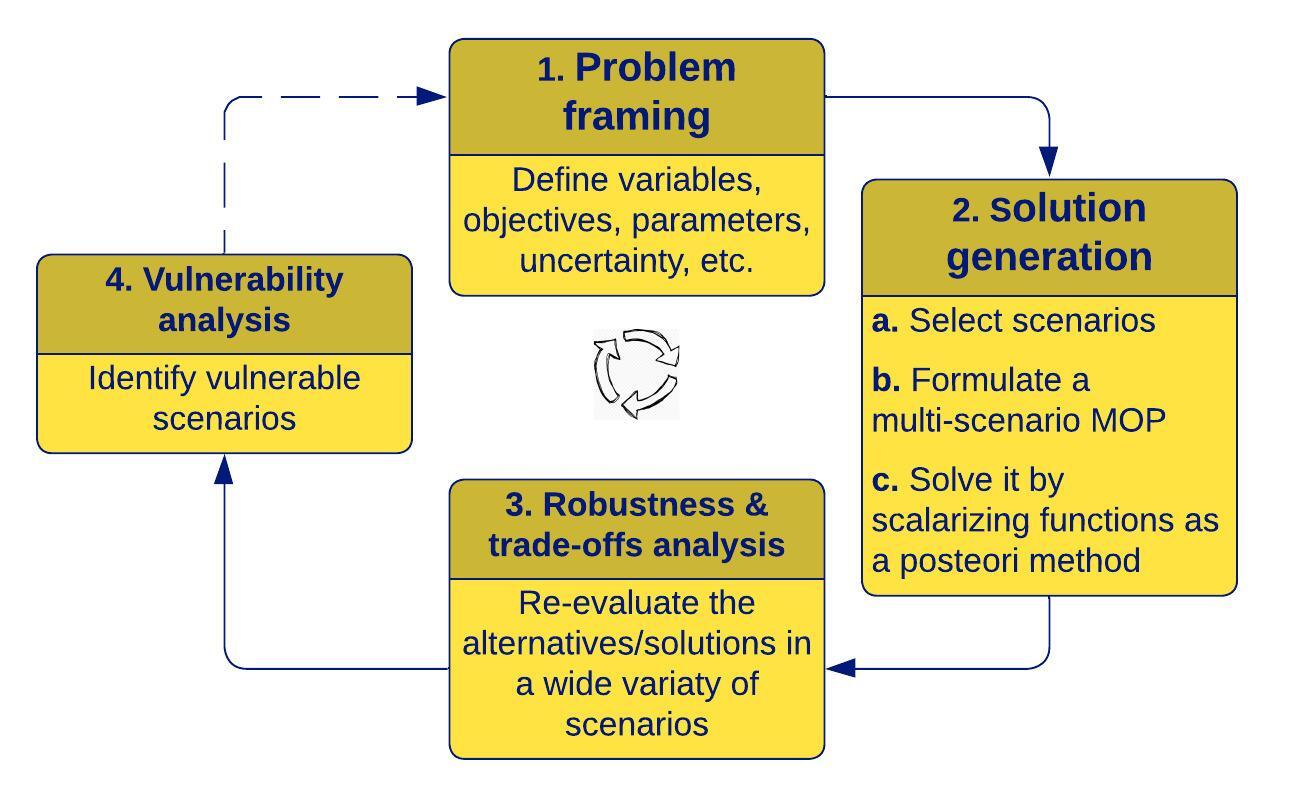
- Formulate a multi-scenario multiobjective robust optimization (MORO) model using a mixed-integer programming framework with 108 objectives, one for each combination of assortment, period, and scenario (3 assortments × 12 periods × 3 scenarios).
- Employ an achievement scalarizing function to generate 109 Pareto-optimal solutions by solving the multi-objective problem iteratively, balancing trade-offs between demand deviations across all periods and scenarios.
- Apply a domain criterion robustness measure to evaluate each candidate solution across an ensemble of 1,000 randomly generated scenarios, assessing performance stability under deep uncertainty.
- Implement an interactive decision-support interface allowing planners to explore trade-offs, compare solutions, and select the most preferred robust solution based on their preferences.
- Use three distinct scenarios per stand—lowest, average, and highest possible timber volume—for each assortment to represent deep uncertainty, avoiding reliance on assumed probability distributions.
- Structure the model to minimize the absolute deviation between scheduled production and demand for each assortment in every planning period, ensuring monthly precision and reducing industrial losses from mismatches.
Experimental results
Research questions
- RQ1How can forest harvest scheduling be improved to handle deep uncertainty in timber volume estimates for multiple assortments across multiple planning periods?
- RQ2What is the impact of modeling demand deviation per period and per assortment, rather than aggregating across time, on the quality and robustness of harvest schedules?
- RQ3How can multi-scenario multiobjective optimization be used to generate and evaluate a diverse set of robust, Pareto-optimal solutions under deep uncertainty?
- RQ4To what extent can stress-testing across 1,000 randomly generated scenarios improve the reliability of candidate harvest plans in real-world tactical planning?
- RQ5Can an interactive decision-support system effectively reduce cognitive load and enhance planner confidence in selecting a preferred robust solution among complex trade-offs?
Key findings
- The proposed approach successfully generated 109 Pareto-optimal solutions through multi-scenario multiobjective optimization, enabling comprehensive trade-off analysis across 12 periods and three timber assortments.
- Stress-testing across 1,000 randomly generated scenarios revealed significant variation in solution performance, demonstrating that nominal or average-case solutions often fail under real-world uncertainty.
- The most preferred robust solution identified through the interactive system showed consistent performance across diverse scenarios, minimizing both production shortfalls and surpluses in each period.
- The method outperformed traditional single-scenario or aggregated-demand models by capturing monthly mismatches that would otherwise be hidden, reducing the risk of industrial losses.
- The prototype was validated with a domain expert, confirming its practical usability and potential for real-world adoption in tactical forest planning.
- The study demonstrates, for the first time, a viable decision-support framework for deep uncertainty in tactical forest harvest scheduling, extending beyond strategic planning and stochastic models.

Read this paper
Open the full text in the Nubint reader and ask about any passage as you read.
Read this paper on NubintThis review was generated by AI from the original paper. Please check the paper before citing it.