
[Paper Review] DEDGAT: Dual Embedding of Directed Graph Attention Networks for Detecting Financial Risk
This paper proposes DEDGAT, a dual-embedding graph neural network that explicitly models in-degree and out-degree representations in directed graphs for financial risk detection. By separating attention computation for incoming and outgoing edges, DEDGAT mitigates the directional bias of standard GAT, achieving state-of-the-art performance on financial risk datasets with improved interpretability via GNNExplainer visualization.
Graph representation plays an important role in the field of financial risk control, where the relationship among users can be constructed in a graph manner. In practical scenarios, the relationships between nodes in risk control tasks are bidirectional, e.g., merchants having both revenue and expense behaviors. Graph neural networks designed for undirected graphs usually aggregate discriminative node or edge representations with an attention strategy, but cannot fully exploit the out-degree information when used for the tasks built on directed graph, which leads to the problem of a directional bias. To tackle this problem, we propose a Directed Graph ATtention network called DGAT, which explicitly takes out-degree into attention calculation. In addition to having directional requirements, the same node might have different representations of its input and output, and thus we further propose a dual embedding of DGAT, referred to as DEDGAT. Specifically, DEDGAT assigns in-degree and out-degree representations to each node and uses these two embeddings to calculate the attention weights of in-degree and out-degree nodes, respectively. Experiments performed on the benchmark datasets show that DGAT and DEDGAT obtain better classification performance compared to undirected GAT. Also,the visualization results demonstrate that our methods can fully use both in-degree and out-degree information.
Motivation & Objective
- To address the directional bias in Graph Attention Networks (GAT) when applied to directed graphs in financial risk control.
- To improve the representation of directed graph structures by explicitly distinguishing in-degree and out-degree information.
- To enhance model performance and interpretability in financial risk detection tasks using a dual-embedding mechanism.
Proposed method
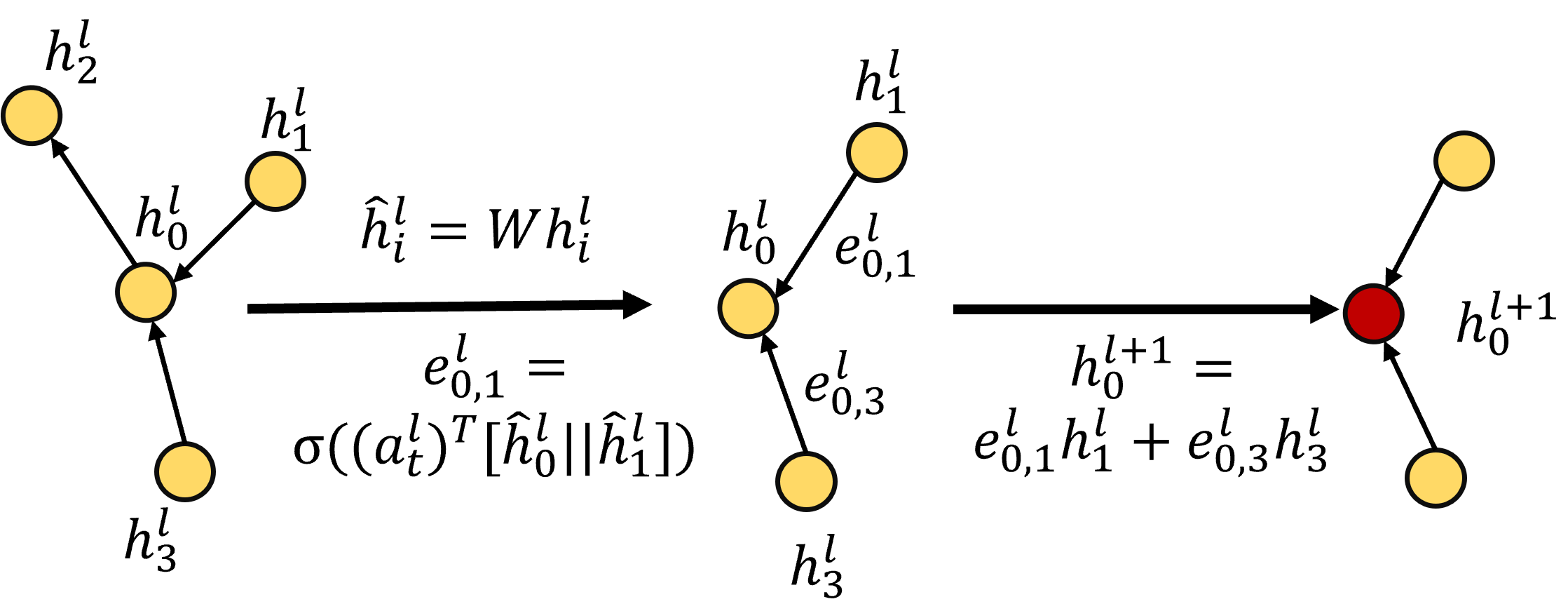
- Proposes DGAT, a directed graph attention network that separately computes attention weights for in-degree and out-degree edges.
- Introduces dual node embeddings—separately learning representations for incoming and outgoing connections at each node.
- Uses distinct attention mechanisms for in-degree and out-degree neighbors, enabling balanced aggregation of directional information.
- Applies GNNExplainer to visualize and validate the model's attention distribution on key edges.
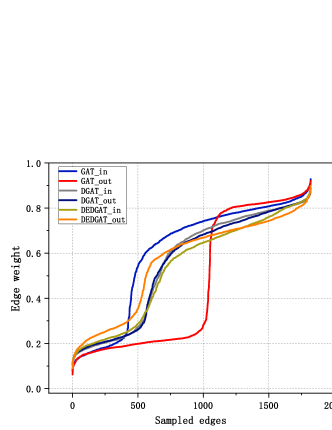
- Employs a threshold-based statistical analysis (λ = 0.5) to compare importance scores of in-degree and out-degree edges.
- Trains and evaluates on three benchmark financial risk control datasets to validate performance and bias mitigation.
Experimental results
Research questions
- RQ1How does standard GAT perform on directed financial transaction graphs, and what directional bias emerges in its attention mechanism?
- RQ2Can separating in-degree and out-degree attention computation reduce directional bias in graph neural networks for risk detection?
- RQ3To what extent does dual embedding improve node representation learning and downstream classification performance on directed graphs?
- RQ4How do DGAT and DEDGAT compare to GAT in terms of attention distribution and feature importance on real financial risk datasets?
- RQ5Can the proposed models achieve better interpretability and robustness in detecting financial risk through edge importance visualization?
Key findings
- DEDGAT achieves state-of-the-art performance on three financial risk control benchmark datasets, outperforming standard GAT and DGAT.
- The importance score distribution of edge weights shows that GAT exhibits a 1.73× bias toward in-degree edges, while DEDGAT balances in-degree and out-degree attention.
- GNNExplainer visualization confirms that DEDGAT leverages all four critical out-degree edges ignored by GAT, improving model interpretability.
- DGAT and DEDGAT achieve nearly equal proportions of in-degree and out-degree edge weights above the 0.5 threshold, indicating balanced attention.
- The dual embedding mechanism in DEDGAT effectively separates and enhances representations for incoming and outgoing connections, reducing directional bias.
- Visualization and statistical analysis confirm that DEDGAT fully utilizes both in-degree and out-degree information, unlike GAT which underutilizes out-degree edges.
Read this paper
Open the full text in the Nubint reader and ask about any passage as you read.
Read this paper on NubintThis review was generated by AI from the original paper. Please check the paper before citing it.