
[Paper Review] Deep Cropping via Attention Box Prediction and Aesthetics Assessment
This paper proposes a deep learning-based photo cropping method that first predicts an attention box to identify the visually important region and then generates and selects the optimal crop from candidates around it using aesthetics assessment. The approach achieves state-of-the-art performance with 5 fps inference speed by sharing features across tasks and leveraging large-scale attention and aesthetics datasets for training.
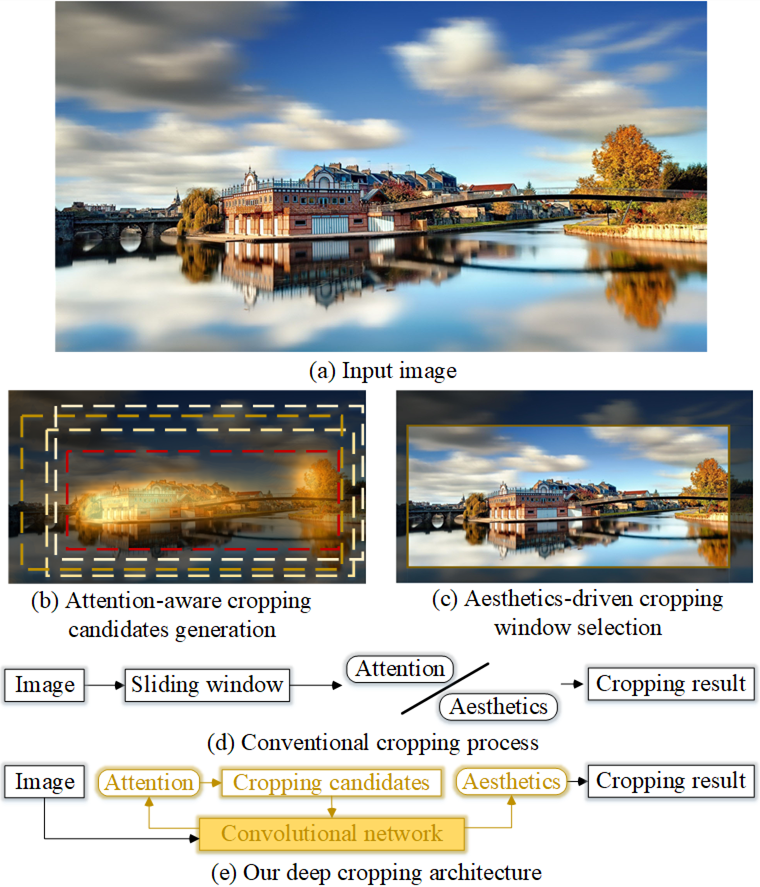
We model the photo cropping problem as a cascade of attention box regression and aesthetic quality classification, based on deep learning. A neural network is designed that has two branches for predicting attention bounding box and analyzing aesthetics, respectively. The predicted attention box is treated as an initial crop window where a set of cropping candidates are generated around it, without missing important information. Then, aesthetics assessment is employed to select the final crop as the one with the best aesthetic quality. With our network, cropping candidates share features within full-image convolutional feature maps, thus avoiding repeated feature computation and leading to higher computation efficiency. Via leveraging rich data for attention prediction and aesthetics assessment, the proposed method produces high-quality cropping results, even with the limited availability of training data for photo cropping. The experimental results demonstrate the competitive results and fast processing speed (5 fps with all steps).
Motivation & Objective
- To address the inefficiency and unnatural search strategy of conventional sliding-window cropping methods.
- To improve cropping quality by integrating human visual attention and aesthetic judgment in a unified deep learning framework.
- To reduce reliance on scarce, expert-annotated cropping datasets by leveraging abundant attention and aesthetics data.
- To achieve high computational efficiency through feature sharing and localized candidate generation.
- To model cropping as a natural, two-stage process: determining an initial crop based on attention, then refining it via aesthetics.
Proposed method
- Uses a fully convolutional neural network with two shared-bottom branches for attention box prediction (ABP) and aesthetics assessment (AA).
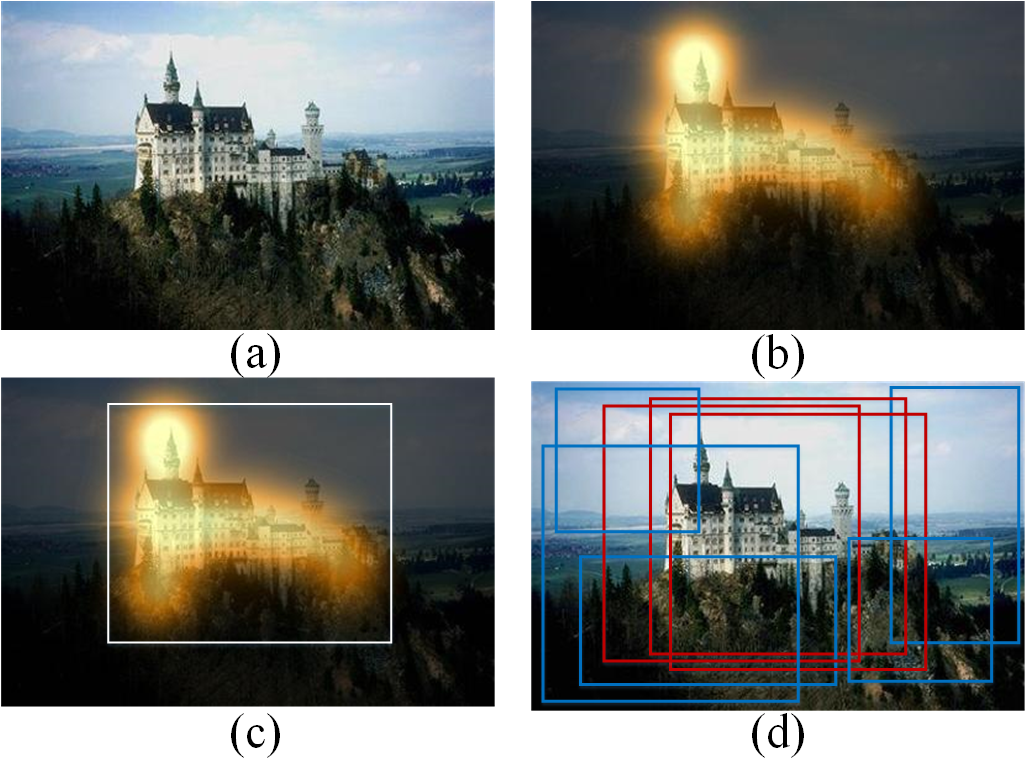
- Predicts an attention bounding box via regression to identify the most visually salient region as the initial crop.
- Generates a small set (~1000) of cropping candidates centered around the predicted attention box to limit search space.
- Shares early convolutional features between ABP and AA networks to reduce computation cost at inference time.
- Applies the network once on the full image to extract shared feature maps, then crops features for each candidate without reprocessing.
- Selects the final crop as the candidate with the highest predicted aesthetic score from the AA network.
Experimental results
Research questions
- RQ1Can a cascaded approach of attention-guided candidate generation followed by aesthetics-based selection outperform traditional sliding-window methods in photo cropping?
- RQ2How effective is feature sharing between attention prediction and aesthetics assessment in improving efficiency without sacrificing accuracy?
- RQ3To what extent can pre-trained models on large-scale attention and aesthetics datasets compensate for limited cropping-specific annotations?
- RQ4Does modeling cropping as a determining-adjusting process better reflect human cropping behavior than end-to-end sliding-window optimization?
- RQ5What is the trade-off between computational efficiency and cropping accuracy in real-time applications?
Key findings
- The proposed method achieves the highest IoU score of 0.813 on the MSR-ICD dataset, significantly outperforming prior methods such as LCC (0.748) and ATC (0.605).
- On the FLMS dataset, the method achieves an IoU of 0.810 and BDE of 0.057, surpassing all compared methods including VBC (IoU: 0.74) and MPC (IoU: 0.41).
- The method processes images at 5 frames per second, demonstrating high computational efficiency suitable for real-time applications.
- The shared feature architecture reduces redundant computation, enabling fast inference while maintaining high accuracy.
- The model generalizes well despite limited cropping-specific training data, leveraging rich pre-existing datasets for attention and aesthetics.
- Qualitative results show that the predicted attention boxes align well with human-annotated salient regions, and the final crops are visually pleasing and compositionally balanced.
Read this paper
Open the full text in the Nubint reader and ask about any passage as you read.
Read this paper on NubintThis review was generated by AI from the original paper. Please check the paper before citing it.