
[Paper Review] Deep Imputation of Missing Values in Time Series Health Data: A Review with Benchmarking
This paper benchmarks state-of-the-art deep learning methods for imputing missing values in multivariate time series health data across five real-world datasets. It demonstrates that hybrid deep learning models combining cross-sectional and longitudinal imputation outperform traditional methods like MICE, especially at higher missing rates and under non-random missingness, though performance varies significantly by data type and structure.
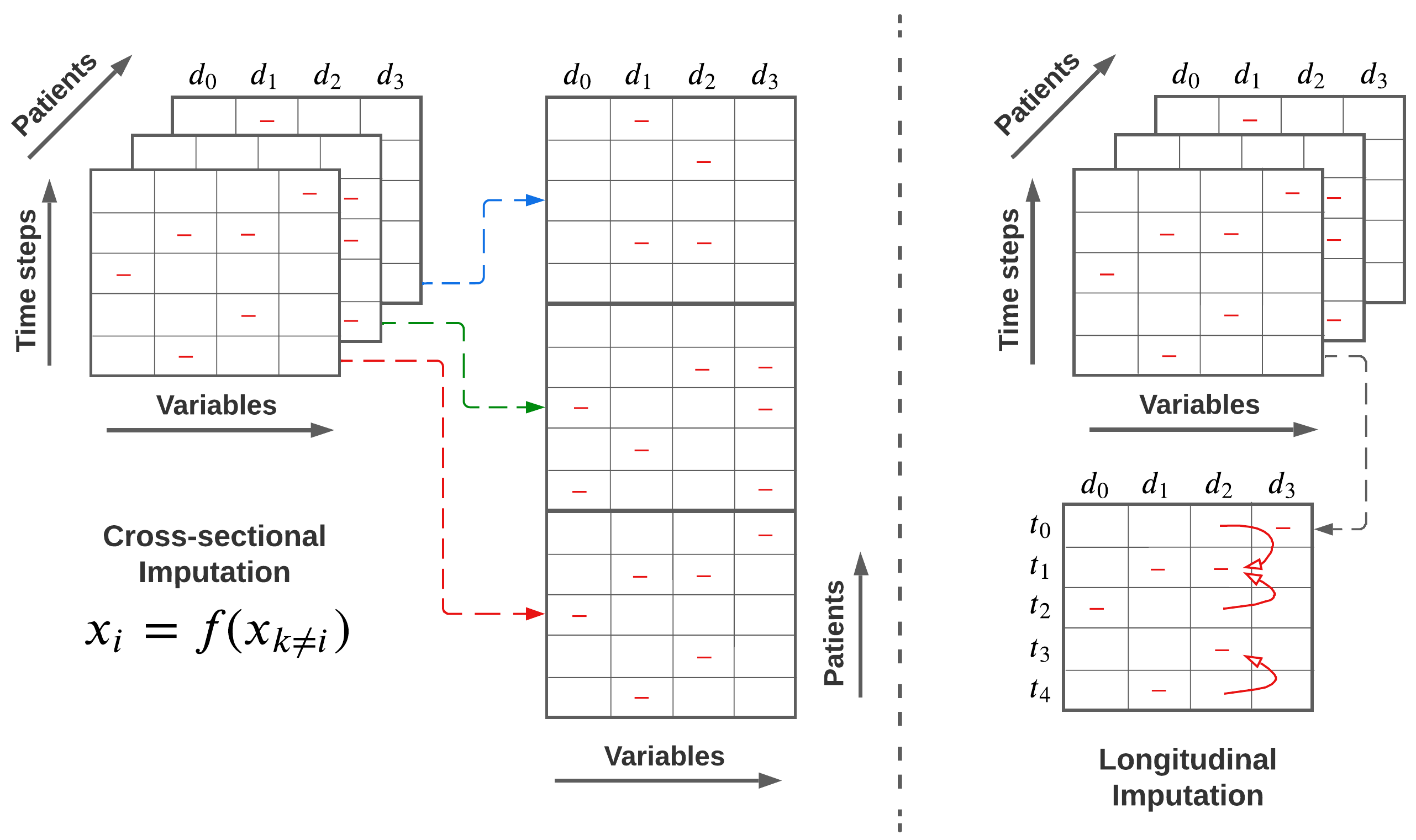
The imputation of missing values in multivariate time series (MTS) data is critical in ensuring data quality and producing reliable data-driven predictive models. Apart from many statistical approaches, a few recent studies have proposed state-of-the-art deep learning methods to impute missing values in MTS data. However, the evaluation of these deep methods is limited to one or two data sets, low missing rates, and completely random missing value types. This survey performs six data-centric experiments to benchmark state-of-the-art deep imputation methods on five time series health data sets. Our extensive analysis reveals that no single imputation method outperforms the others on all five data sets. The imputation performance depends on data types, individual variable statistics, missing value rates, and types. Deep learning methods that jointly perform cross-sectional (across variables) and longitudinal (across time) imputations of missing values in time series data yield statistically better data quality than traditional imputation methods. Although computationally expensive, deep learning methods are practical given the current availability of high-performance computing resources, especially when data quality and sample size are highly important in healthcare informatics. Our findings highlight the importance of data-centric selection of imputation methods to optimize data-driven predictive models.
Motivation & Objective
- To evaluate the performance of state-of-the-art deep learning imputation methods on real-world multivariate time series health data.
- To investigate how data characteristics—such as missing rate, missing type (MCAR, MAR, MNAR), variable statistics, and time series length—affect imputation quality.
- To compare deep learning methods with conventional imputation techniques (e.g., MICE, mean/median imputation) in terms of data quality and downstream predictive performance.
- To provide evidence-based recommendations for health scientists on selecting optimal imputation strategies based on data-specific factors.
- To highlight the importance of data-centric method selection over arbitrary adoption of imputation techniques in healthcare informatics.
Proposed method
- Conducted six data-centric experiments across five multivariate time series health datasets: PPG, ECG, Heartbeat, NIH, and IEEEPPG.
- Evaluated 13 imputation methods, including deep learning models (CATSI, BRITS, TAME, DETROIT) and traditional baselines (MICE, mean/median, KNN, etc.).
- Used multiple metrics: RMSE, MAE, and classification accuracy on downstream tasks to assess imputation quality.
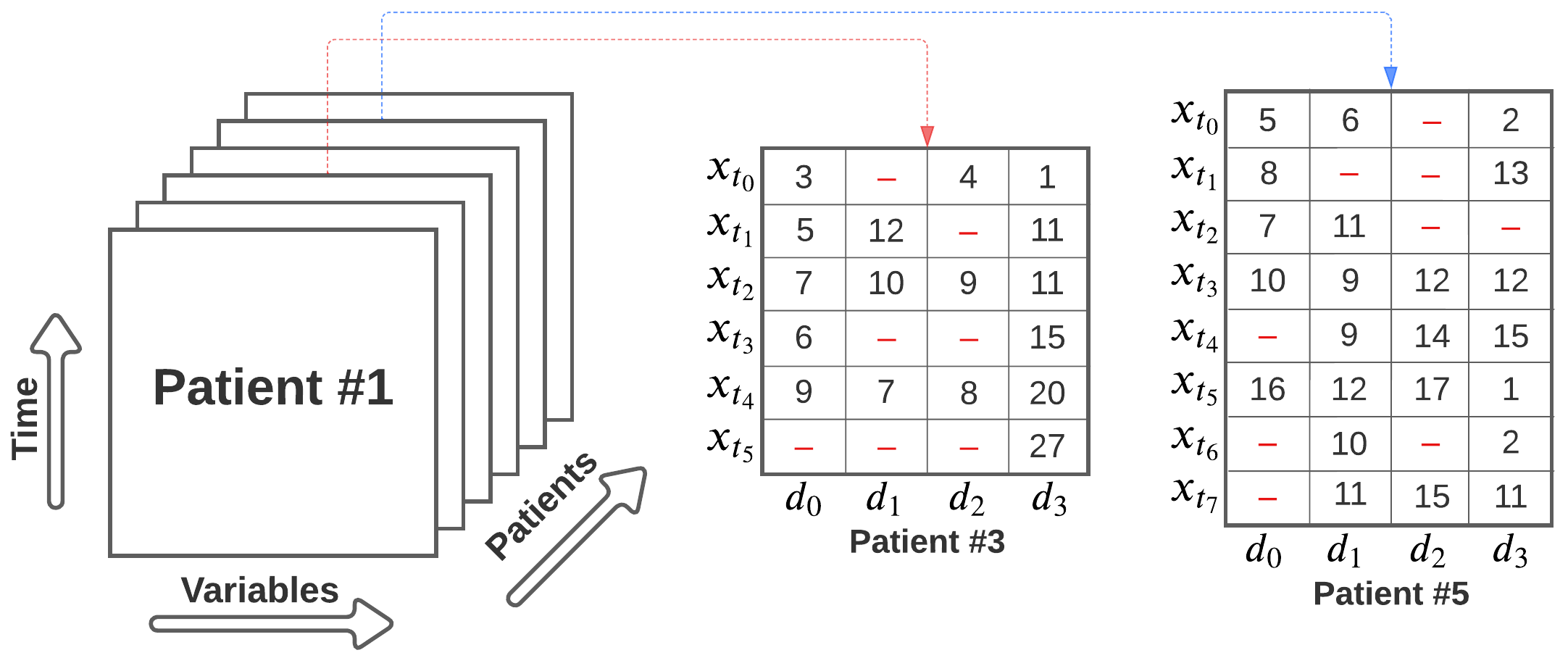
- Applied hybrid deep learning models that jointly model cross-sectional (variable) and longitudinal (temporal) dependencies in missing data.
- Employed time-series-aware architectures such as RNN-based models (e.g., BRITS) and generative models (e.g., GAN-based TAME) to capture temporal dynamics.
- Performed ablation studies under varying missing value rates (5–50%) and missingness mechanisms (MCAR, MAR, MNAR) to assess robustness.
Experimental results
Research questions
- RQ1How do deep learning imputation methods compare to traditional methods (e.g., MICE, mean imputation) in terms of imputation accuracy across diverse health time series datasets?
- RQ2How does missing value rate and type (MCAR, MAR, MNAR) influence the performance of deep learning imputation models?
- RQ3Which imputation methods yield the highest downstream classification accuracy on real-world health data after imputation?
- RQ4To what extent do hybrid deep learning models that jointly model cross-sectional and longitudinal dependencies improve imputation quality compared to models focusing on only one dimension?
- RQ5What are the computational trade-offs of using deep learning imputation methods in clinical data science, and are they justifiable given their performance gains?
Key findings
- No single imputation method outperformed all others across all five datasets, indicating performance is highly dependent on data-specific characteristics.
- Hybrid deep learning models that jointly model cross-sectional and longitudinal dependencies (e.g., CATSI, BRITS) achieved statistically superior data quality compared to traditional methods like MICE.
- The best-performing models (e.g., CATSI, BRITS) reduced RMSE by up to 36.6% on the IEEEPPG dataset and improved classification accuracy by up to 1% relative gain, which translates to 100 additional correct predictions in 10,000 patients.
- Deep learning methods were significantly more computationally expensive than MICE, but the authors argue this cost is justified by improved data quality and reliability in healthcare applications.
- Imputation performance varied substantially by data type: sensor data (e.g., PPG, ECG) showed lower missingness and higher imputation quality, while EHR data with irregular sampling and high heterogeneity posed greater challenges.
- Even when improvements were not statistically significant, a 1% relative increase in classification accuracy was deemed clinically meaningful, suggesting that advanced imputation should not be dismissed solely based on p-values.
Read this paper
Open the full text in the Nubint reader and ask about any passage as you read.
Read this paper on NubintThis review was generated by AI from the original paper. Please check the paper before citing it.