
[Paper Review] Deep Learning for Inertial Positioning: A Survey
This survey provides a comprehensive review of deep learning techniques for inertial positioning using low-cost MEMS inertial sensors, covering sensor calibration, drift reduction, and multi-sensor fusion. It highlights data-driven approaches that outperform traditional physics-based methods in handling error drifts and offers a roadmap for future research in efficiency, benchmarking, and hybrid learning-physical models.
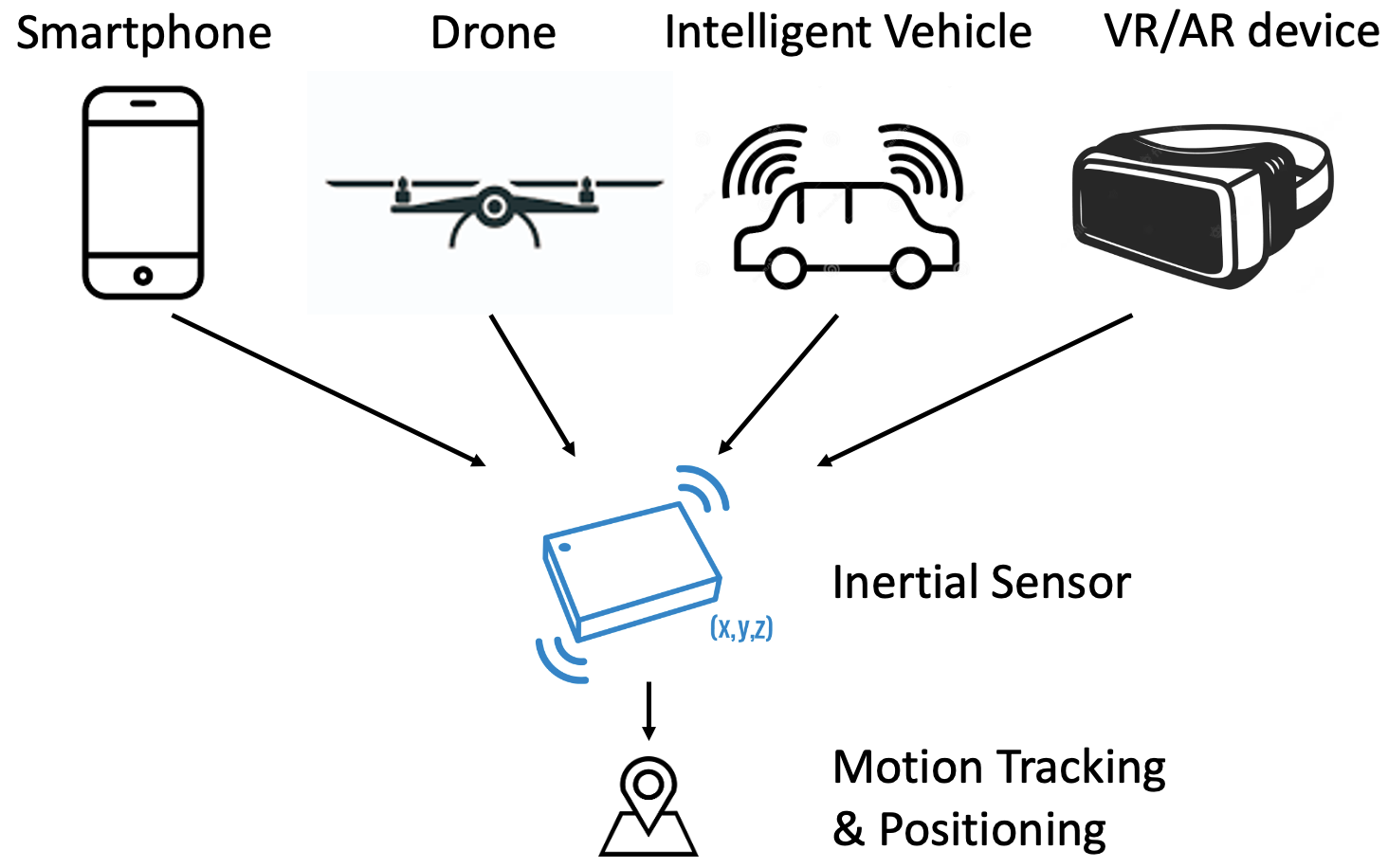
Inertial sensors are widely utilized in smartphones, drones, robots, and IoT devices, playing a crucial role in enabling ubiquitous and reliable localization. Inertial sensor-based positioning is essential in various applications, including personal navigation, location-based security, and human-device interaction. However, low-cost MEMS inertial sensors' measurements are inevitably corrupted by various error sources, leading to unbounded drifts when integrated doubly in traditional inertial navigation algorithms, subjecting inertial positioning to the problem of error drifts. In recent years, with the rapid increase in sensor data and computational power, deep learning techniques have been developed, sparking significant research into addressing the problem of inertial positioning. Relevant literature in this field spans across mobile computing, robotics, and machine learning. In this article, we provide a comprehensive review of deep learning-based inertial positioning and its applications in tracking pedestrians, drones, vehicles, and robots. We connect efforts from different fields and discuss how deep learning can be applied to address issues such as sensor calibration, positioning error drift reduction, and multi-sensor fusion. This article aims to attract readers from various backgrounds, including researchers and practitioners interested in the potential of deep learning-based techniques to solve inertial positioning problems. Our review demonstrates the exciting possibilities that deep learning brings to the table and provides a roadmap for future research in this field.
Motivation & Objective
- To address the fundamental challenge of unbounded error drift in low-cost MEMS inertial navigation systems.
- To review deep learning-based methods that improve inertial positioning accuracy by learning from large-scale sensor data.
- To identify gaps in current research, including lack of standardized benchmarks, model efficiency, and robustness in real-world deployment.
- To explore the integration of physical constraints with deep learning for safer, more reliable inertial positioning systems.
- To provide a unified roadmap for future research in data-driven inertial navigation, including emerging deep learning architectures and training paradigms.
Proposed method
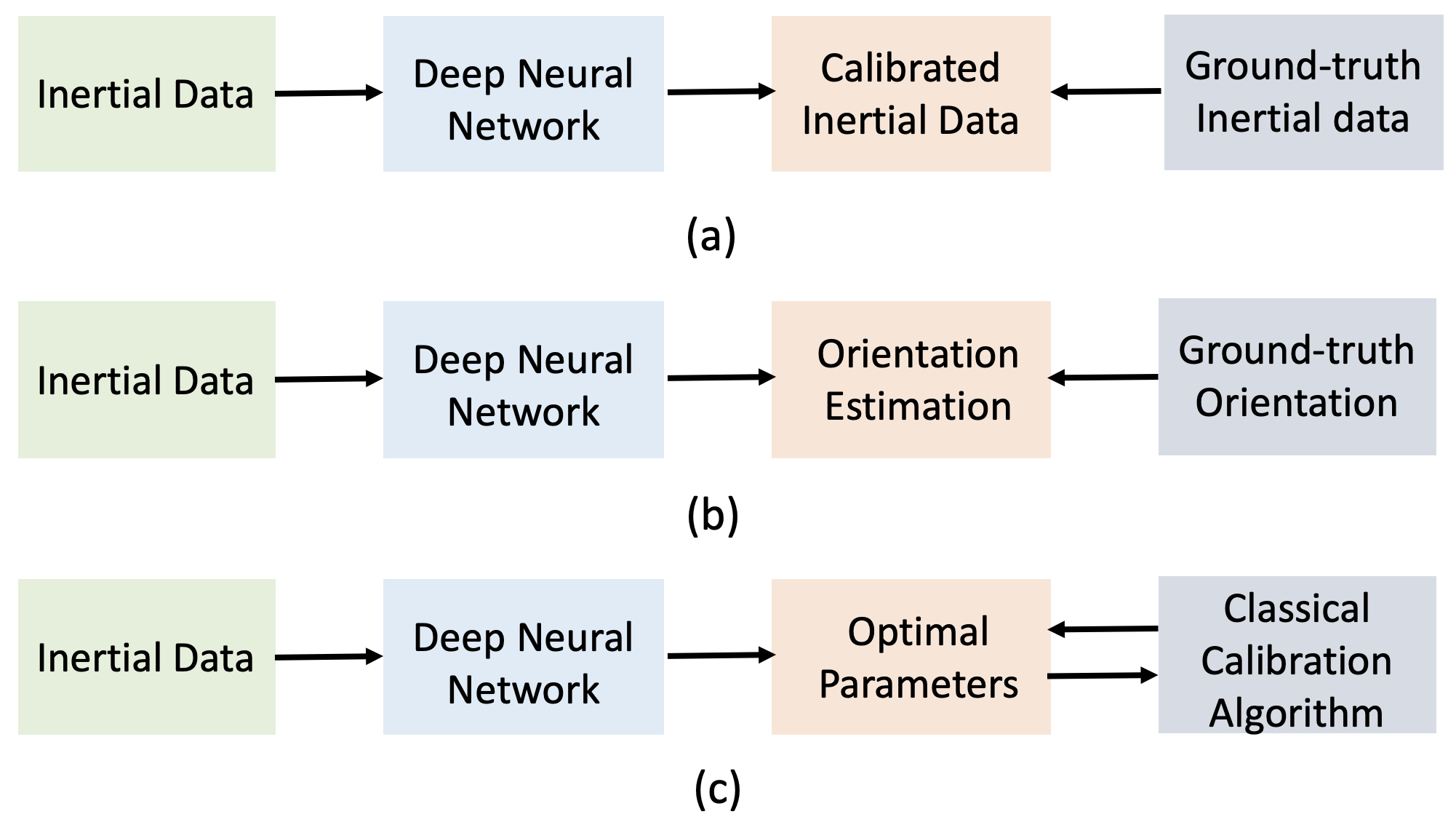
- Systematically categorizes deep learning applications in inertial positioning into three main areas: sensor calibration, error drift mitigation, and multi-sensor fusion.
- Reviews neural network architectures such as CNNs, RNNs, and Transformers used for learning motion patterns and sensor noise characteristics.
- Analyzes hybrid models that combine differentiable physics-based navigation with end-to-end deep learning for improved robustness.
- Discusses model compression techniques like knowledge distillation to enable deployment on low-end devices such as IoT and VR/AR systems.
- Examines data-driven approaches that learn from diverse datasets across users, platforms, and motion dynamics to improve generalization.
- Proposes integrating physical constraints into deep neural networks to enhance reliability and interpretability in safety-critical applications.
Experimental results
Research questions
- RQ1How can deep learning effectively reduce error drift in inertial navigation systems using low-cost MEMS sensors?
- RQ2What are the key deep learning architectures and training strategies that improve inertial positioning accuracy across diverse motion patterns and devices?
- RQ3How can deep learning models be made efficient and deployable on resource-constrained platforms like smartphones and drones?
- RQ4What role can physical constraints play in improving the robustness and interpretability of data-driven inertial positioning models?
- RQ5What are the major challenges in benchmarking deep learning-based inertial positioning, and how can a standardized dataset accelerate future research?
Key findings
- Deep learning-based inertial positioning methods significantly reduce error drift compared to traditional Kalman filtering and pure dead reckoning, especially when combined with periodic human gait models or ZUPT.
- Hybrid models that integrate differentiable physics with deep learning show improved robustness and generalization, particularly in long-term tracking scenarios.
- Model compression techniques such as knowledge distillation enable deployment of large DNNs on edge devices with limited computational and memory resources.
- Despite strong performance, deep learning models are prone to abrupt failures due to lack of physical constraints, highlighting the need for hybrid learning-physical frameworks.
- A lack of standardized benchmarks and diverse, high-precision datasets limits fair comparison and generalization of current methods across different platforms and users.
- Emerging deep learning paradigms like contrastive learning, self-supervised learning, and diffusion models show strong potential for improving inertial positioning with less supervision.
Read this paper
Open the full text in the Nubint reader and ask about any passage as you read.
Read this paper on NubintThis review was generated by AI from the original paper. Please check the paper before citing it.