
[Paper Review] Deep Neural Network Based Relation Extraction: An Overview
This paper provides a comprehensive survey of deep neural network (DNN)-based relation extraction (RE), covering supervised and distant supervision methods. It reviews DNN architectures like CNNs, RNNs, and GNNs for sentence representation and feature extraction, and discusses challenges such as noise in distant supervision, out-of-vocabulary relations, and cross-sentence reasoning, proposing future research directions in transfer learning, relationship reasoning, and unified relation frameworks.
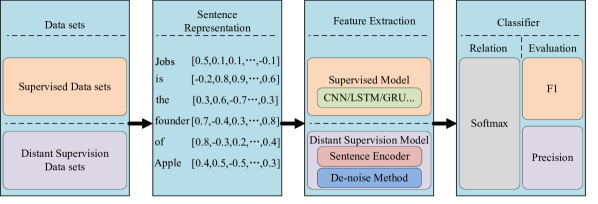
Knowledge is a formal way of understanding the world, providing a human-level cognition and intelligence for the next-generation artificial intelligence (AI). One of the representations of knowledge is semantic relations between entities. An effective way to automatically acquire this important knowledge, called Relation Extraction (RE), a sub-task of information extraction, plays a vital role in Natural Language Processing (NLP). Its purpose is to identify semantic relations between entities from natural language text. To date, there are several studies for RE in previous works, which have documented these techniques based on Deep Neural Networks (DNNs) become a prevailing technique in this research. Especially, the supervised and distant supervision methods based on DNNs are the most popular and reliable solutions for RE. This article 1) introduces some general concepts, and further 2) gives a comprehensive overview of DNNs in RE from two points of view: supervised RE, which attempts to improve the standard RE systems, and distant supervision RE, which adopts DNNs to design sentence encoder and de-noise method. We further 3) cover some novel methods and recent trends as well as discuss possible future research directions for this task.
Motivation & Objective
- To provide a systematic and up-to-date overview of deep neural network-based relation extraction (RE) techniques.
- To compare supervised and distant supervision methods in terms of performance, scalability, and applicability across domains.
- To identify key challenges in current RE systems, including noise in distant supervision, limited domain adaptability, and lack of cross-sentence reasoning.
- To explore future research directions such as transfer learning, relationship reasoning, and unified relation frameworks for improved generalization.
- To address the limitations of existing RE models in handling dynamic knowledge bases and out-of-vocabulary relations.
Proposed method
- Categorizes DNN-based RE into two main paradigms: supervised learning and distant supervision, each with distinct data generation and training strategies.
- Reviews key neural network architectures—CNNs, RNNs, LSTMs, GRUs, and GNNs—used for sentence representation and feature extraction in RE.
- Analyzes the role of word embeddings and position embeddings in capturing syntactic and structural information around entity pairs.
- Examines sentence encoder designs and de-noising techniques in distant supervision to reduce label noise from automatic KB alignment.
- Evaluates the integration of external knowledge (e.g., knowledge graphs, entity descriptions) to enhance reasoning and generalization in RE.
- Proposes a framework for cross-sentence relation extraction, addressing the limitation of intra-sentence modeling in current systems.
Experimental results
Research questions
- RQ1How do supervised and distant supervision methods differ in performance, scalability, and noise handling in DNN-based RE?
- RQ2What are the key architectural components and embedding strategies that improve sentence representation in RE tasks?
- RQ3How can noise in distant supervision be effectively mitigated using DNN-based de-noising techniques?
- RQ4What role can transfer learning and external knowledge play in improving domain adaptability and generalization of RE models?
- RQ5How can cross-sentence relation extraction be modeled effectively to capture long-range dependencies beyond single sentences?
Key findings
- Supervised methods achieve higher accuracy on small, clean datasets but are limited by annotation cost and domain specificity.
- Distant supervision enables large-scale training with minimal human labeling but suffers from high noise due to automatic KB alignment.
- GNNs and attention-based models show strong performance in capturing syntactic and dependency structures for relation classification.
- The use of position embeddings significantly improves performance by encoding relative entity positions in sentences.
- Current models struggle with out-of-vocabulary relations due to inconsistent relation inventories across datasets.
- Cross-sentence RE remains underexplored, but recent approaches show promise in leveraging document-level context for improved relation detection.
Read this paper
Open the full text in the Nubint reader and ask about any passage as you read.
Read this paper on NubintThis review was generated by AI from the original paper. Please check the paper before citing it.