
[Paper Review] Delta-LoRA: Fine-Tuning High-Rank Parameters with the Delta of Low-Rank Matrices
Delta-LoRA jointly updates the full pre-trained weight W and two low-rank matrices A and B by using the delta of their product to steer W, yielding better task performance with memory comparable to LoRA.
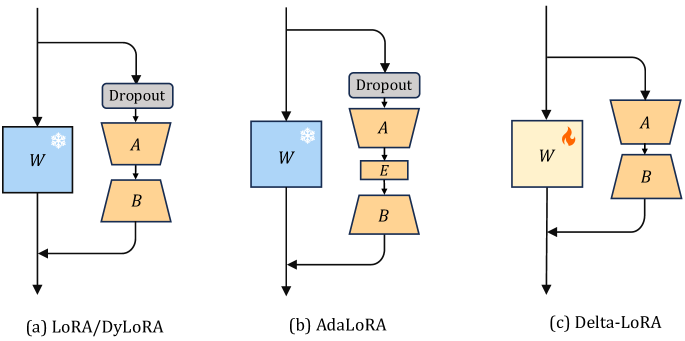
In this paper, we present Delta-LoRA, which is a novel parameter-efficient approach to fine-tune large language models (LLMs). In contrast to LoRA and other low-rank adaptation methods such as AdaLoRA, Delta-LoRA not only updates the low-rank matrices $\bA$ and $\bB$, but also propagate the learning to the pre-trained weights $\bW$ via updates utilizing the delta of the product of two low-rank matrices ($\bA^{(t+1)}\bB^{(t+1)} - \bA^{(t)}\bB^{(t)}$). Such a strategy effectively addresses the limitation that the incremental update of low-rank matrices is inadequate for learning representations capable for downstream tasks. Moreover, as the update of $\bW$ does not need to compute the gradients of $\bW$ and store their momentums, Delta-LoRA shares comparable memory requirements and computational costs with LoRA. Extensive experiments show that Delta-LoRA significantly outperforms existing low-rank adaptation methods. We further support these results with comprehensive analyses that underscore the effectiveness of Delta-LoRA.
Motivation & Objective
- Motivate improved fine-tuning of large language models (LLMs) beyond updating only low-rank adapters.
- Propose Delta-LoRA to broadcast learning signals to the pre-trained weights through the delta of AB.
- Maintain memory efficiency comparable to LoRA while enhancing representation learning.
- Provide theoretical and empirical analyses demonstrating improved gradient alignment and performance.
Proposed method
- Update both the full weight matrix W and two low-rank matrices A and B during fine-tuning.
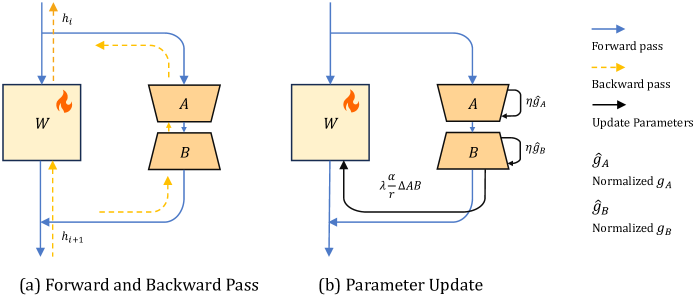
- Compute the delta AB = A(t+1)B(t+1) − A(t)B(t) and use it to update W with a controlled ratio λ and scale α/r.
- Remove the Dropout layer in the low-rank branch to align gradients so that ∂L/∂W ≈ ∂L/∂(AB).
- Approximate the gradient direction for W using −Δ(AB) instead of storing gradients/moments for W.
- Train A and B with AdamW as usual, but apply the AB delta to update W instead of storing optimizer states for W.
- Provide algorithmic steps (including start step K, learning rate η, weight decay β, rank r, and update ratio λ) for Delta-LoRA.
Experimental results
Research questions
- RQ1Does updating W via the delta of the product AB provide a significant performance gain over updating only A and B?
- RQ2Can Delta-LoRA achieve better task performance while maintaining memory and computation costs comparable to LoRA?
- RQ3How does removing Dropout from the low-rank branch affect gradient alignment between ∂L/∂W and ∂L/∂(AB)?
- RQ4What is the impact of hyper-parameter choices (λ, K, η) on Delta-LoRA’s effectiveness across NLP tasks?
Key findings
- Delta-LoRA consistently outperforms LoRA, AdaLoRA, and DyLoRA across multiple NLP tasks and datasets.
- In ablations, updating W via Δ(AB) yields better representations than scaling or increasing the AB update alone, even when making larger AB updates.
- Removing Dropout from the low-rank module improves gradient alignment and final performance.
- Delta-LoRA achieves state-of-the-art results on GLUE, E2E NLG Challenge, WebNLG Challenge 2017, and XSum benchmarks under PEFT settings.
- Experiments show Delta-LoRA maintains memory footprint similar to LoRA while delivering notable performance gains.
Read this paper
Open the full text in the Nubint reader and ask about any passage as you read.
Read this paper on NubintThis review was generated by AI from the original paper. Please check the paper before citing it.