
[Paper Review] Demonstration of a Quantum Noise Limited Traveling-Wave Parametric Amplifier
This paper demonstrates a broadband, quantum-noise-limited traveling-wave parametric amplifier (TWPA) based on NbTiN microstrip and amorphous silicon dielectric, using dispersion engineering to achieve 20 dB gain and quantum-limited noise performance at 20 mK. It further achieves 8 dB of vacuum noise squeezing at the phase-sensitive operating point, validating its potential for high-sensitivity microwave quantum measurements.
Recent progress in quantum computing and the development of novel detector technologies for astrophysics is driving the need for high-gain, broadband, and quantum-limited amplifiers. We present a purely traveling-wave parametric amplifier (TWPA) using an inverted NbTiN microstrip and amorphous Silicon dielectric. Through dispersion engineering, we are able to obtain $50~Ω$ impedance matching and suppress undesired parametric processes while phase matching the three-wave-mixing amplification across a large range of frequencies. The result is a broadband amplifier operating with 20 dB gain and quantum-limited noise performance at 20 mK. At the single frequency where the amplifier is phase sensitive, we further demonstrate 8 dB of vacuum noise squeezing.
Motivation & Objective
- To develop a high-gain, broadband, and quantum-limited microwave amplifier suitable for quantum computing and astrophysical detection.
- To overcome the limitations of conventional HEMT and Josephson parametric amplifiers (JPAs), including high noise temperatures and limited dynamic range.
- To realize a purely traveling-wave parametric amplifier using kinetic inductance nonlinearity without discrete Josephson junctions.
- To achieve simultaneous broadband gain (20 dB) and quantum-limited noise performance through dispersion engineering.
- To demonstrate vacuum noise squeezing, confirming the amplifier’s ability to generate non-classical states for quantum-enhanced sensing.
Proposed method
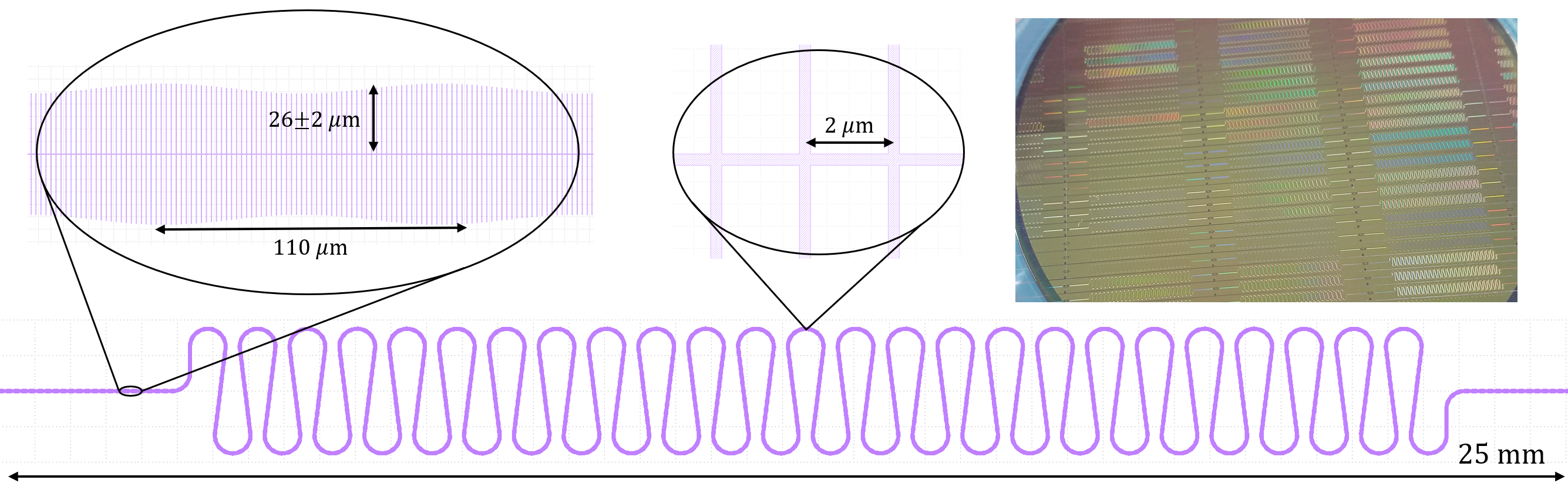
- The TWPA employs an inverted NbTiN microstrip on a silicon substrate with a 190 nm amorphous silicon dielectric layer, enabling high kinetic inductance and low loss.
- Periodic capacitive stubs (26 µm long, 2 µm spacing) are used to achieve 50 Ω impedance matching and increase capacitance per unit length.
- A sinusoidal modulation of stub lengths (110 µm period, 2 µm amplitude) creates a photonic bandgap near 9 GHz, enabling phase matching for three-wave mixing across a broad bandwidth.
- The design achieves a low phase velocity (0.0078c) and suppresses pump harmonics via dispersion engineering, preventing unwanted parametric processes.
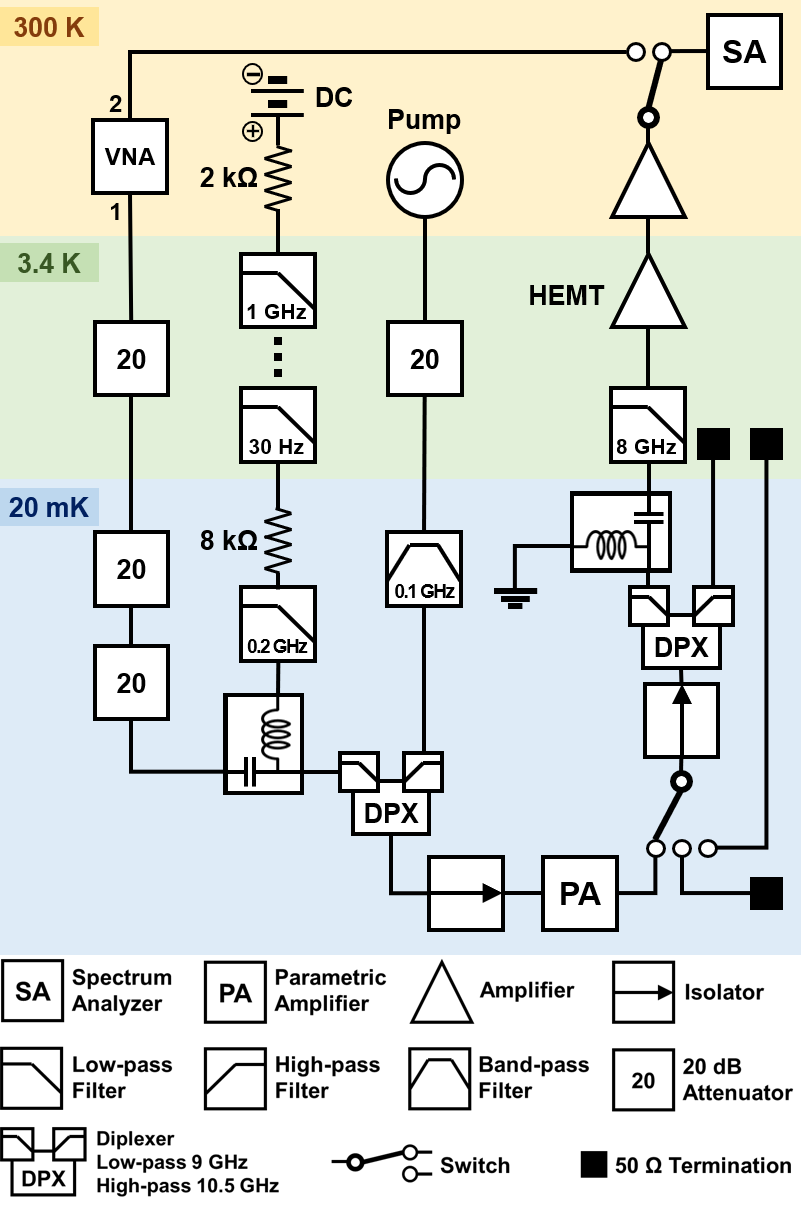
- A modified y-factor method with cryogenic switches and attenuated input lines enables accurate measurement of system noise temperature and amplifier gain.
- Phase-sensitive operation is achieved by locking the pump and signal to a common synthesizer with variable phase, allowing measurement of both amplified and squeezed quadratures via IQ mixing.
Experimental results
Research questions
- RQ1Can a purely traveling-wave parametric amplifier based on kinetic inductance achieve broadband (several GHz) gain with quantum-limited noise performance?
- RQ2Can dispersion engineering in a NbTiN microstrip structure suppress unwanted parametric processes while enabling phase matching across a wide frequency range?
- RQ3To what extent can the amplifier achieve vacuum noise squeezing, and how does its performance compare to the standard quantum limit?
- RQ4Does the absence of Josephson junctions in the TWPA design enable higher dynamic range and improved robustness compared to conventional JPAs?
- RQ5Can the system noise temperature be reduced below the standard quantum limit in the amplified quadrature, and what is the achievable squeezing level?
Key findings
- The TWPA achieves a broadband gain of approximately 20 dB across several gigahertz centered at 5.65 GHz, with a 50 Ω impedance matched design.
- Noise performance is experimentally confirmed to be quantum-limited, with added noise of 0.27 quanta in the amplified quadrature when gain is high.
- The amplifier operates at 20 mK, achieving a system noise temperature below the standard quantum limit in the amplified quadrature.
- At the phase-sensitive operating point (11.313 GHz pump), the TWPA generates vacuum noise squeezing of up to 8 dB, demonstrating non-classical state generation.
- The measured squeezing level deviates slightly from ideal linearity due to residual noise, corresponding to a maximum added noise of 0.16 quanta in the squeezed quadrature.
- The TWPA’s dynamic range is significantly improved over JPAs due to the absence of junctions, enabling amplification of stronger signals before 1 dB compression.
Read this paper
Open the full text in the Nubint reader and ask about any passage as you read.
Read this paper on NubintThis review was generated by AI from the original paper. Please check the paper before citing it.