
[Paper Review] Depth Quality-Inspired Feature Manipulation for Efficient RGB-D Salient Object Detection
This paper proposes DFM-Net, a lightweight RGB-D salient object detection model that uses Depth Quality-Inspired Feature Manipulation (DQFM) to enhance cross-modal fusion by dynamically weighting depth features based on boundary alignment and applying holistic attention to improve robustness. DFM-Net achieves state-of-the-art accuracy with only 8.5MB model size and 140ms inference time on CPU—2.2× faster than prior efficient models—by integrating a tailored depth backbone and two-stage decoder for efficiency.
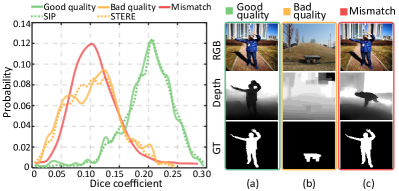
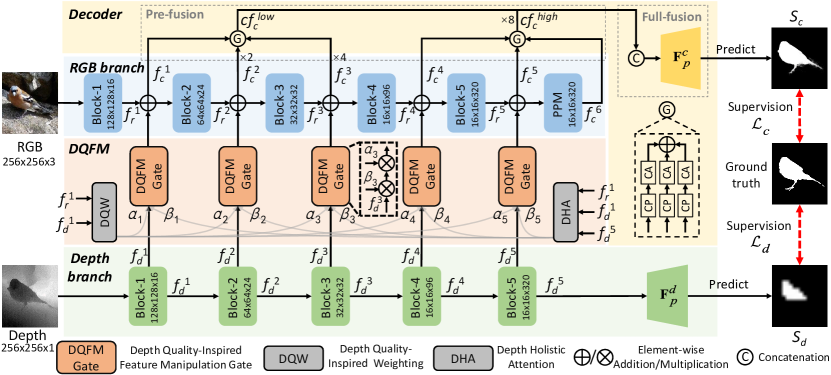
RGB-D salient object detection (SOD) recently has attracted increasing research interest by benefiting conventional RGB SOD with extra depth information. However, existing RGB-D SOD models often fail to perform well in terms of both efficiency and accuracy, which hinders their potential applications on mobile devices and real-world problems. An underlying challenge is that the model accuracy usually degrades when the model is simplified to have few parameters. To tackle this dilemma and also inspired by the fact that depth quality is a key factor influencing the accuracy, we propose a novel depth quality-inspired feature manipulation (DQFM) process, which is efficient itself and can serve as a gating mechanism for filtering depth features to greatly boost the accuracy. DQFM resorts to the alignment of low-level RGB and depth features, as well as holistic attention of the depth stream to explicitly control and enhance cross-modal fusion. We embed DQFM to obtain an efficient light-weight model called DFM-Net, where we also design a tailored depth backbone and a two-stage decoder for further efficiency consideration. Extensive experimental results demonstrate that our DFM-Net achieves state-of-the-art accuracy when comparing to existing non-efficient models, and meanwhile runs at 140ms on CPU (2.2$ imes$ faster than the prior fastest efficient model) with only $\sim$8.5Mb model size (14.9% of the prior lightest). Our code will be available at https://github.com/zwbx/DFM-Net.
Motivation & Objective
- Address the trade-off between efficiency and accuracy in RGB-D salient object detection, especially for mobile deployment.
- Identify depth quality as a key factor affecting model accuracy, particularly in low-quality or noisy depth maps.
- Propose a mechanism that explicitly controls depth feature fusion based on depth quality to improve robustness.
- Design a lightweight, efficient architecture with minimal parameters and fast inference speed.
- Integrate a tailored depth backbone and two-stage decoder to further reduce computational cost without sacrificing performance.
Proposed method
- Propose Depth Quality-Inspired Feature Manipulation (DQFM), a gating mechanism that uses boundary alignment (BA) to assess depth quality and assign adaptive weights to depth features.
- Introduce Depth Quality Weighting (DQW) to dynamically assign higher attention to high-quality depth features based on boundary alignment with RGB features.
- Implement Depth-wise Holistic Attention (DHA) to recalibrate high-level depth features using a learnable attention mechanism that enhances salient regions.
- Design a tailored depth backbone (TDB) optimized for depth data processing, reducing model size from 6.9MB (MobileNet-V2) to 0.9MB.
- Employ a two-stage decoder to progressively refine predictions, improving feature representation while maintaining efficiency.
- Use a multi-variable strategy for DQW and DHA parameters, allowing hierarchical adaptation of quality weights and attention maps across feature levels.
Experimental results
Research questions
- RQ1Can depth quality be effectively leveraged as a signal to improve cross-modal fusion in RGB-D salient object detection?
- RQ2How can a lightweight model maintain high accuracy while drastically reducing parameters and inference time?
- RQ3To what extent does boundary alignment between RGB and depth features correlate with depth quality and detection performance?
- RQ4Can a dedicated, light-weight depth backbone outperform standard backbones like MobileNet-V2 in depth feature extraction for SOD?
- RQ5Does a two-stage decoder with progressive refinement improve detection accuracy without increasing computational cost?
Key findings
- DFM-Net achieves state-of-the-art accuracy among lightweight models on standard RGB-D SOD benchmarks, outperforming prior efficient models.
- The model runs at 140ms on CPU, which is 2.2× faster than the prior fastest efficient model.
- DFM-Net has a model size of only 8.5MB, representing 14.9% of the size of the prior lightest model.
- The tailored depth backbone (TDB) reduces model size to 0.9MB, a 87% reduction compared to MobileNet-V2, while improving accuracy.
- Ablation studies confirm that both DQW and DHA are essential: DQW improves robustness to low-quality depth, and DHA enhances feature recalibration with optimal use of 2x F_rec operations.
- The multi-variable strategy for DQW and DHA parameters increases network flexibility and leads to better performance than single-variable alternatives.
Read this paper
Open the full text in the Nubint reader and ask about any passage as you read.
Read this paper on NubintThis review was generated by AI from the original paper. Please check the paper before citing it.