
[Paper Review] Design of Whisker-Inspired Sensors for Multi-Directional Hydrodynamic Sensing
This paper presents a waterproof, magnetically transduced, whisker-inspired sensor for multi-directional hydrodynamic flow sensing in aquatic robots. Using a mechano-magnetic transduction mechanism that separates the whisker drag element from electronics, the sensor enables robust, corrosion-resistant flow velocity estimation with tunable sensitivity via geometric and immersion depth adjustments, achieving root mean square error (RMSE) of 0.06–0.08 m/s in velocity estimation on a remotely controlled boat.
This research develops a novel sensor for aquatic robots inspired by the whiskers of harbor seals. This sensor can detect the movement of water, offering valuable data on speed, currents, barriers, and water disturbance. It employs a mechano-magnetic system, separating the whisker-like drag part from the electronic section, enhancing water resistance and durability. The flexible design allows customizing the drag component's shape for different uses. The study uses an analytical model to examine the sensor's capabilities, including aspects such as shape, cross-sectional area, ratio, and immersion depth of the whisker part. It also explores the effects of design on Vortex-Induced Vibrations (VIVs), a key focus in the study of biological and robotic aquatic whiskers. The sensor's practical use was tested on a remote-controlled boat, showing its proficiency in estimating water flow speed. This development has enormous potential to enhance navigation and perception for aquatic robots in various applications.
Motivation & Objective
- To address the lack of reliable, waterproof, and durable flow sensing in small aquatic robots.
- To overcome challenges in existing whisker-inspired sensors, including waterproofing failures and difficulty distinguishing flow velocity from vortex-induced vibrations (VIVs).
- To develop a modular, tunable sensor design that enables multi-directional flow velocity estimation and VIV signal capture.
- To demonstrate the sensor’s efficacy in real-world aquatic environments using a commercially available remotely controlled boat.
- To enable robust, wireless, on-board flow sensing for navigation and state estimation in outdoor and remote aquatic applications.
Proposed method
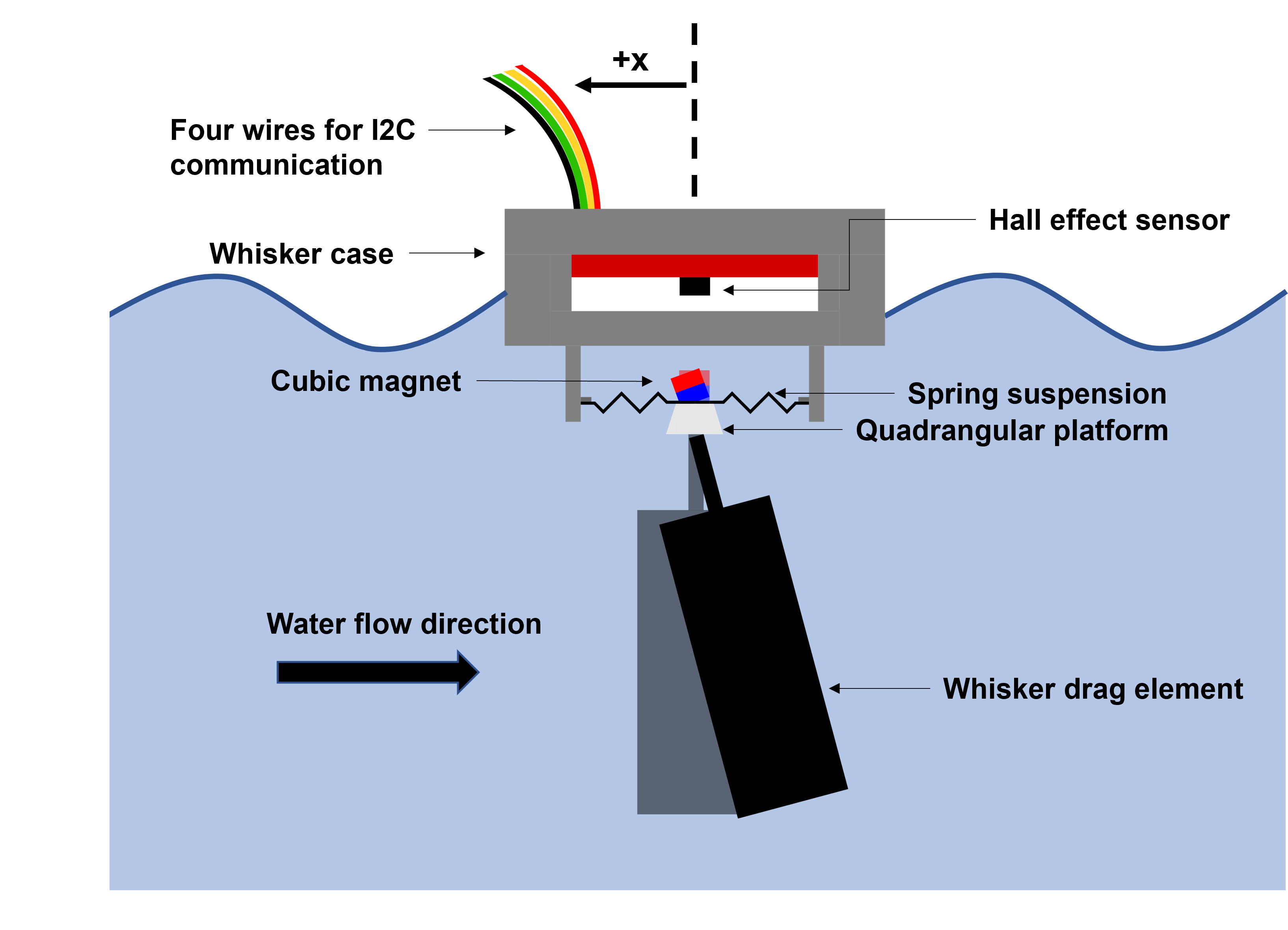
- The sensor uses a mechano-magnetic transduction mechanism where a permanent magnet attached to the whisker's base moves relative to a Hall effect sensor as the whisker deflects under flow.
- The whisker drag element is mechanically isolated from the electronic components, enhancing waterproofing and corrosion resistance.
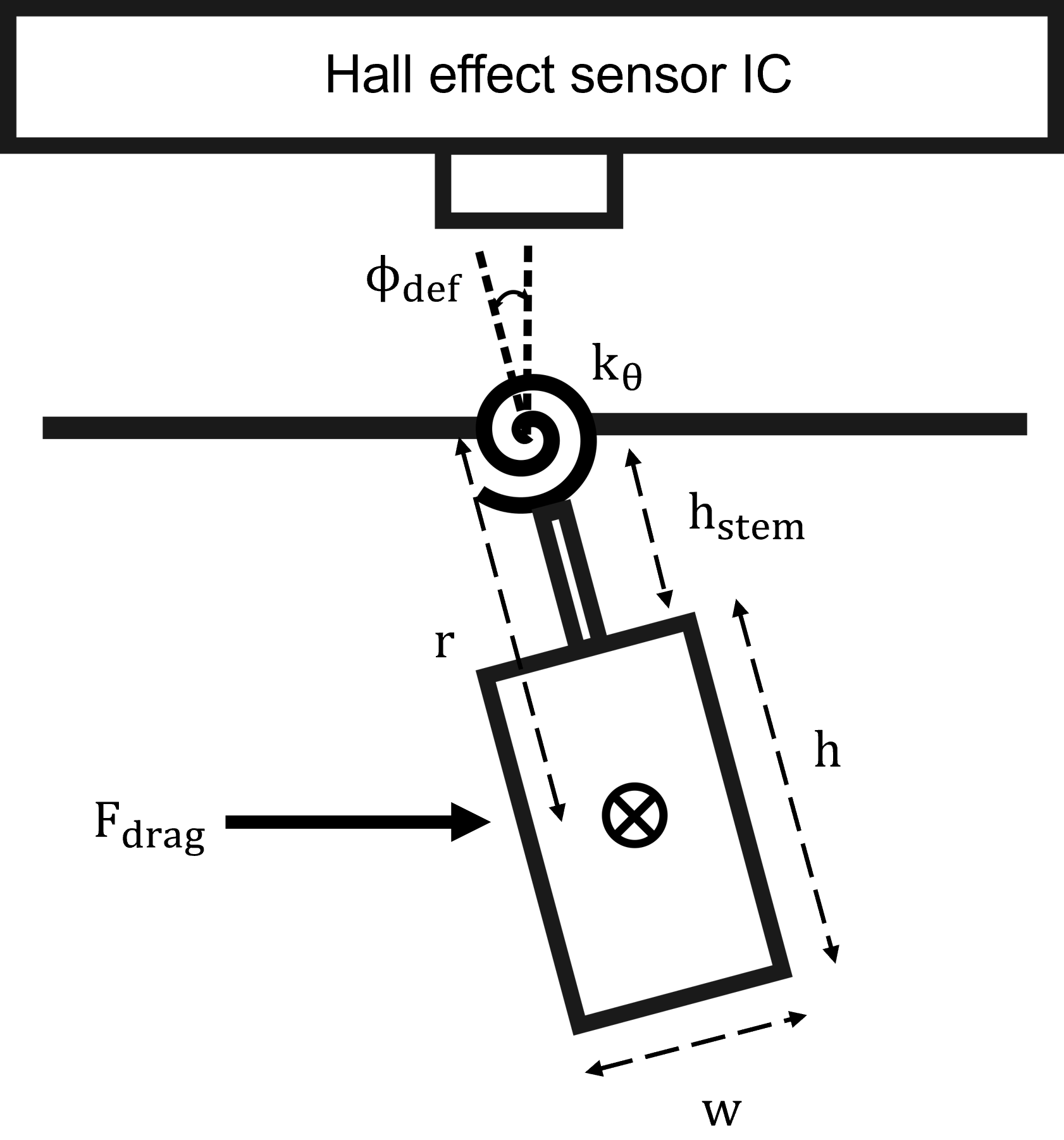
- The sensor’s sensitivity is tuned by adjusting the whisker’s geometric parameters, including cross-sectional area, aspect ratio, and immersion depth.
- An analytical model based on beam deflection and magnetic field response quantifies the sensor’s behavior, with calibration applied post-manufacture to improve accuracy.
- Vortex-Induced Vibration (VIV) signals are extracted from orthogonal magnetic field components (e.g., By for flow in Bx direction), enabling simultaneous detection of flow and VIV dynamics.
- Wireless Bluetooth transmission enables real-time data collection from the sensor on a mobile RC boat during field testing.
Experimental results
Research questions
- RQ1How can a whisker-inspired sensor be designed to enable multi-directional hydrodynamic flow sensing while ensuring long-term waterproofing and corrosion resistance?
- RQ2To what extent can the sensor’s sensitivity and dynamic range be tuned through geometric design and immersion depth adjustment?
- RQ3Can the sensor simultaneously capture both steady flow velocity and periodic Vortex-Induced Vibration (VIV) signals in real-world aquatic conditions?
- RQ4How accurately can the sensor estimate flow velocity in comparison to ground truth data from a high-precision survey system?
- RQ5Can the sensor be effectively integrated into a mobile aquatic robot for on-board, real-time state estimation?
Key findings
- The sensor achieved root mean square error (RMSE) of 0.08 m/s in velocity estimation for a peak velocity profile, and 0.06 m/s for a complex, multi-acceleration profile.
- The sensor successfully captured all dynamic velocity variations, including periodic accelerations and saturation at 0.7 m/s, which was intentionally limited by mechanical stops to prevent plastic deformation.
- The analytical model, calibrated post-manufacture, enabled accurate velocity prediction from magnetic field measurements, demonstrating the feasibility of model-based calibration.
- Vortex-Induced Vibration (VIV) signals were successfully extracted from orthogonal magnetic field channels (e.g., By), indicating the sensor’s capability to detect both steady flow and periodic fluid forces.
- The wireless, on-board configuration with Bluetooth data transmission enabled real-time operation in a field environment, supporting deployment in outdoor and remote aquatic settings.
- The modular design allowed tuning of sensitivity through geometric parameters and immersion depth, enabling customization for diverse application-specific flow ranges.
Read this paper
Open the full text in the Nubint reader and ask about any passage as you read.
Read this paper on NubintThis review was generated by AI from the original paper. Please check the paper before citing it.