
[Paper Review] Detecting and stabilizing measurement-induced symmetry-protected topological phases in generalized cluster models
This paper introduces a framework to detect and stabilize symmetry-protected topological (SPT) phases in out-of-equilibrium quantum random circuits using nonlocal string order parameters. By generalizing Clifford-based circuits to include Haar-random unitaries, it demonstrates that SPT order in the XZX and XZZX cluster models remains stable under broader gate ensembles, with string order parameters successfully distinguishing phases and revealing coexistence of SPT order and spontaneous symmetry breaking.
We study measurement-induced symmetry-protected topological (SPT) order in a wide class of quantum random circuit models by combining calculations within the stabilizer formalism with tensor network simulations. We construct a family of quantum random circuits, generating the out-of-equilibrium version of all generalized cluster models, and derive a set of non-local string order parameters to distinguish different SPT phases. We apply this framework to investigate a random circuit realization of the XZX cluster model, and use the string order parameter to demonstrate that the phase diagram is stable against extending the class of unitary gates in the circuit, from Clifford gates to Haar unitaries. We then turn to the XZZX generalized cluster model, and demonstrate the coexistence of SPT order and spontaneous symmetry breaking, by relying on string order parameters and a connected correlation function.
Motivation & Objective
- To extend the study of measurement-induced SPT phases beyond Clifford circuits to include Haar-random unitaries.
- To develop accessible, nonlocal string order parameters as alternatives to topological entanglement entropy for detecting SPT order.
- To investigate the stability of SPT phases under perturbations from the Clifford group to the full unitary group.
- To explore the coexistence of SPT order and spontaneous symmetry breaking in the XZZX cluster model.
- To establish a unified framework for classifying SPT phases in out-of-equilibrium random circuit models using stabilizer formalism and tensor networks.
Proposed method
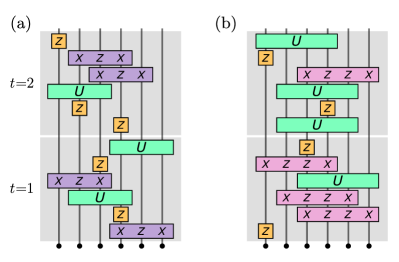
- Construct a family of quantum random circuits that realize out-of-equilibrium versions of generalized cluster models, including XZX and XZZX variants.
- Derive nonlocal string order parameters to detect SPT order in area-law stationary states, serving as robust alternatives to topological entanglement entropy.
- Apply the stabilizer formalism to simulate Clifford circuits exactly, enabling precise computation of string order parameters and phase diagrams.
- Use matrix product state (MPS) tensor network simulations to access the Haar-random unitary regime, where exact stabilizer methods fail.
- Perform finite-size scaling analysis on string order parameters and half-chain entanglement entropy to extract critical exponents and confirm criticality.
- Combine analytical mapping to percolation theory (for measurement-only limit) with numerical fitting to validate critical behavior and phase transitions.
Experimental results
Research questions
- RQ1Can string order parameters reliably detect and distinguish SPT phases in measurement-driven random circuits beyond the Clifford regime?
- RQ2How stable are measurement-induced SPT phases when unitary gates are extended from the Clifford group to Haar-random unitaries?
- RQ3Does the XZZX cluster model host a phase with coexisting SPT order and spontaneous symmetry breaking, and can it be detected with string order parameters and connected correlators?
- RQ4What are the critical exponents of the phase transitions in the XZX and XZZX models, and do they match the percolation universality class?
- RQ5To what extent can tensor network simulations with finite bond dimensions accurately capture the critical behavior in the Haar-random unitary regime?
Key findings
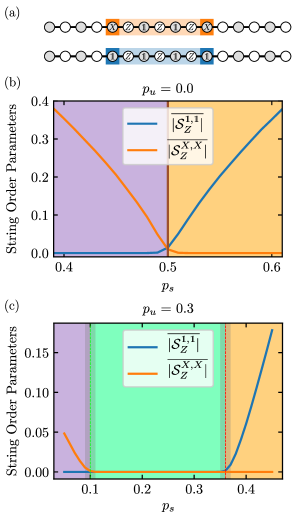
- String order parameters successfully distinguish SPT, trivial, and volume-law phases in the XZX cluster model, confirming the phase diagram's robustness under unitary evolution.
- The critical exponent νs ≈ 4/3 for string order parameters in the measurement-only limit matches the percolation universality class, with excellent finite-size scaling collapse.
- For the XZX model with Clifford unitaries (pu = 0.2), the best finite-size scaling yields νs ∈ [1.1, 1.5], consistent with ν = 4/3 within numerical uncertainty.
- In the Haar-random unitary regime, the scaling collapse of string order parameters remains good, indicating criticality and supporting the existence of a phase transition despite numerical uncertainty.
- The half-chain entanglement entropy shows ν ≈ 1.3, consistent with the percolation value ν = 4/3, confirming criticality in the volume-law to trivial-area-law transition.
- The XZZX model exhibits a phase with coexisting SPT order and spontaneous symmetry breaking, detectable via string order parameters and a connected correlation function.
Read this paper
Open the full text in the Nubint reader and ask about any passage as you read.
Read this paper on NubintThis review was generated by AI from the original paper. Please check the paper before citing it.